
Ernest Hemingway Biography Quotes 76 Report mistakes
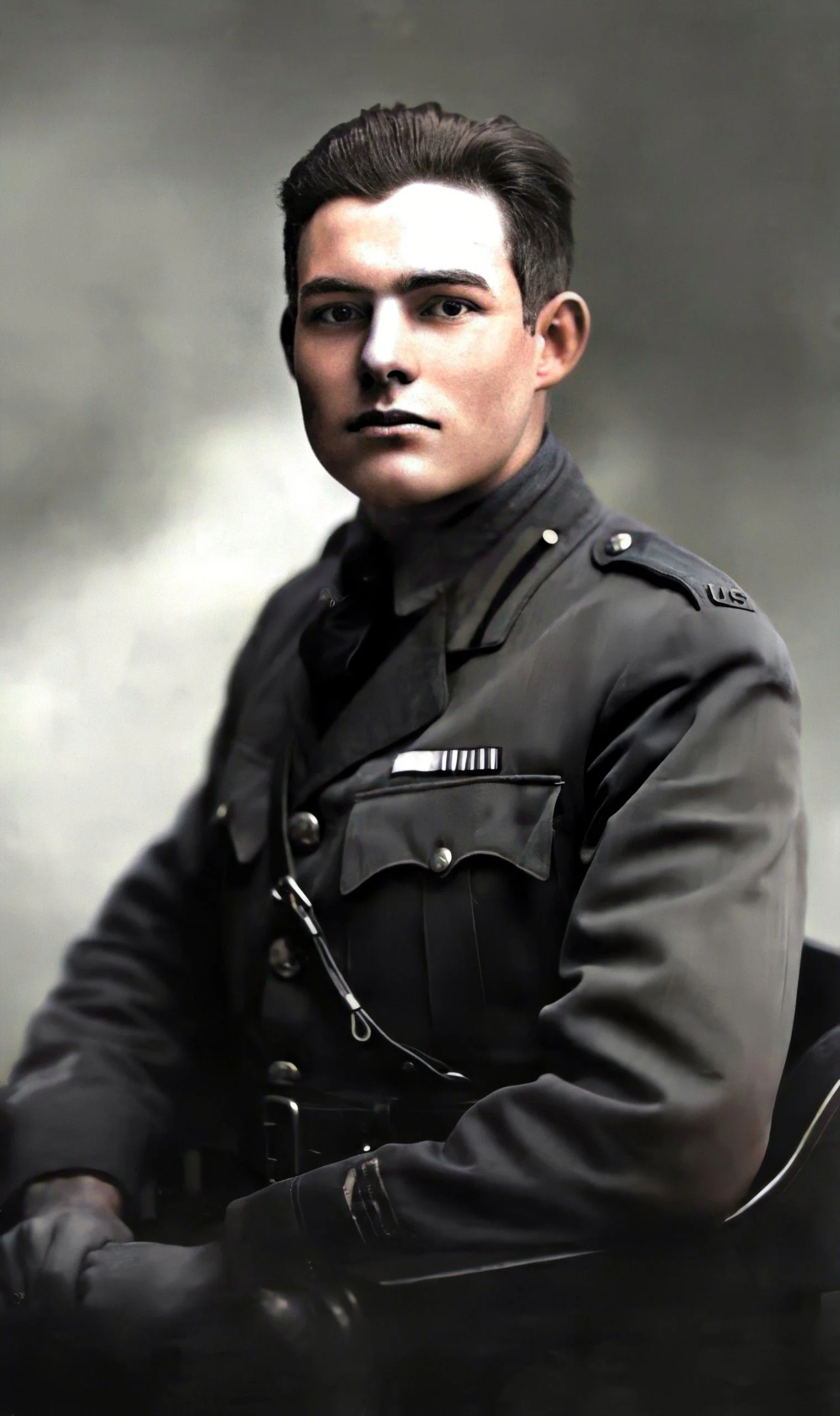
| 76 Quotes | |
| Born as | Ernest Miller Hemingway |
| Occup. | Novelist |
| From | USA |
| Spouses | Hadley Richardson (1921–1927) Pauline Pfeiffer (1927–1940) Martha Gellhorn (1940–1945) Mary Welsh (1946–1961) |
| Born | July 21, 1899 Oak Park, Illinois, USA |
| Died | July 2, 1961 Ketchum, Idaho, USA |
| Cause | Suicide by gunshot |
| Aged | 61 years |
| Cite | |
Citation Formats
APA Style (7th ed.)
Ernest hemingway biography, facts and quotes. (2026, February 1). FixQuotes. https://fixquotes.com/authors/ernest-hemingway/
Chicago Style
"Ernest Hemingway biography, facts and quotes." FixQuotes. February 1, 2026. https://fixquotes.com/authors/ernest-hemingway/.
MLA Style (9th ed.)
"Ernest Hemingway biography, facts and quotes." FixQuotes, 1 Feb. 2026, https://fixquotes.com/authors/ernest-hemingway/. Accessed 20 Mar. 2026.
Early Life and Background
Ernest Miller Hemingway was born on 1899-07-21 in Oak Park, Illinois, a Protestant suburb that prized rectitude and self-control. His father, Clarence Edmonds Hemingway, was a physician and outdoorsman who taught him hunting and fishing; his mother, Grace Hall Hemingway, a musician with strong ambitions for her children, pressed culture and performance. The household offered him two languages of authority - the disciplined domestic order of Oak Park and the rough, wordless competence of the woods - and he spent formative summers at the family cabin on Walloon Lake in northern Michigan.That split helped form a lifelong pattern: he fled interiors for frontiers, yet carried the pressure of propriety inside him as a kind of resisting force. Early brushes with injury, risk, and the male rituals of endurance were not just youthful adventures but rehearsals for an identity he would later turn into art. Underneath the public bravado was a boy learning that affection could feel conditional, and that pain, if mastered, could be made into a private proof.
Education and Formative Influences
Hemingway attended Oak Park and River Forest High School, writing and editing for the school paper and practicing the compressed, high-velocity sentence that journalism rewards. He skipped college, working as a reporter for The Kansas City Star, where the style guide's rules - short sentences, vigorous English, concrete detail - became an internal metronome. In 1918 he volunteered as an ambulance driver with the Red Cross in Italy, was gravely wounded on the Piave front, and fell in love with nurse Agnes von Kurowsky; the combination of romantic idealism and mechanized violence hardened into the emotional alloy that would animate his fiction.Career, Major Works, and Turning Points
After returning to the United States, he moved to Paris in 1921 with his first wife, Hadley Richardson, filing dispatches and absorbing the experimental energy of the expatriate circle around Gertrude Stein and Ezra Pound. Breakthrough came with In Our Time (1925) and The Sun Also Rises (1926), followed by A Farewell to Arms (1929), which converted personal wounding into a public myth of love under fire. He chased wars as both witness and material - the Spanish Civil War informing For Whom the Bell Tolls (1940), and World War II marking his later years - while his private life grew crowded with marriages, drink, and escalating risk. The Old Man and the Sea (1952) restored his reputation and helped secure the Nobel Prize in Literature (1954). By the late 1950s, chronic pain, depression, memory trouble, and fear of surveillance tightened around him; after treatments at the Mayo Clinic, he died by suicide in Ketchum, Idaho, on 1961-07-02.Philosophy, Style, and Themes
Hemingway's style - the famous "iceberg" of withheld explanation - was less a trick than a moral stance: if life is chaotic, the sentence must be clean; if emotion is dangerous, it must be implied, not pleaded. His characters seek codes that can hold when institutions fail: competence, courage, loyalty, and a refusal to counterfeit feeling. That ethic is captured in the defiant paradox, “But man is not made for defeat. A man can be destroyed but not defeated”. The line reads like self-hypnosis, a way to keep going when the body breaks or the heart sours - and it mirrors his own need to turn suffering into a test he could pass.War, for Hemingway, was both addiction and indictment. He recorded its intoxicating clarity and its moral cost, recognizing how violence can reorganize desire: “There is no hunting like the hunting of man, and those who have hunted armed men long enough and liked it, never care for anything else thereafter”. Yet he refused to romanticize the accounting. In his more sober register he insisted, “Never think that war, no matter how necessary, nor how justified, is not a crime”. The tension between these sentences - the lure of danger and the knowledge of sin - is the psychological engine of much of his work, and it helps explain the restlessness that drove him from fishing streams to battlefields, always seeking a purity he did not fully trust.
Legacy and Influence
Hemingway remade 20th-century prose by proving how much can be carried by restraint: dialogue that hides its wounds, description that makes morality tactile, and endings that refuse consolation. His influence runs through American realism, war reporting, and minimalist fiction, shaping writers as different as Raymond Carver, Joan Didion, and countless journalists trained to value accuracy over decoration. The Hemingway myth - the boxer, hunter, drinker, witness - has sometimes obscured the more durable achievement: a body of work that anatomizes courage as a fragile daily practice, and exposes how performance can become a prison. In an era still defined by conflict and spectacle, his best books remain manuals of attention, asking what it costs to live truthfully when the world keeps offering easier lies.Our collection contains 76 quotes written by Ernest, under the main topics: Witty One-Liners - Motivational - Ethics & Morality - Truth - Wisdom.
Other people related to Ernest: Ambrose Bierce (Journalist), Charles Bukowski (Poet), Yousuf Karsh (Photographer), Sherwood Anderson (Writer), John Dos Passos (Novelist), Martha Gellhorn (Journalist), Joan Miro (Artist), George Plimpton (Journalist), Malcolm Cowley (Critic), Alfred Kazin (Critic)
Ernest Hemingway Famous Works
- 1961 The Snows of Kilimanjaro and Other Stories (Short Story Collection)
- 1952 The Old Man and the Sea (Novel)
- 1940 For Whom the Bell Tolls (Novel)
- 1937 To Have and Have Not (Novel)
- 1929 A Farewell to Arms (Novel)
- 1926 The Sun Also Rises (Novel)
- 1925 In Our Time (Short Story Collection)