
Billy Dee Williams Biography Quotes 2 Report mistakes
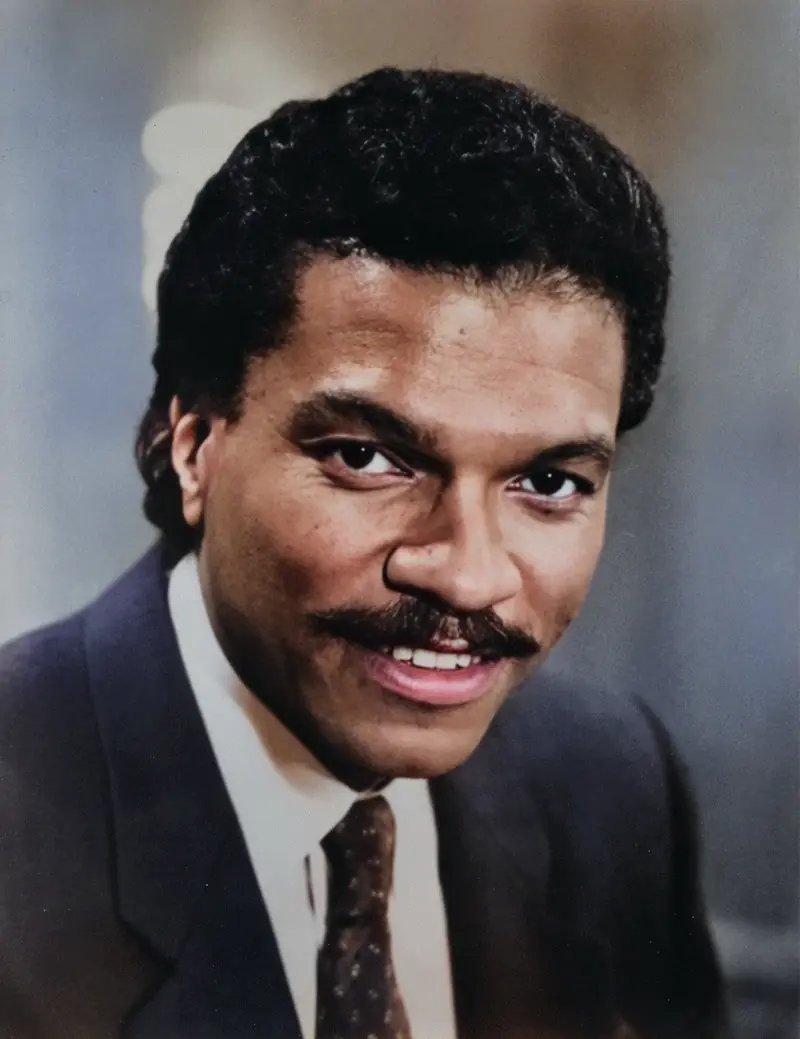
| 2 Quotes | |
| Born as | William December Williams Jr. |
| Occup. | Actor |
| From | USA |
| Spouses | Audrey Sellers (1959-1963) Marlene Clark (1968-1971) Teruko Nakagami (1972) |
| Born | April 6, 1937 New York City, New York, USA |
| Age | 88 years |
William December Williams Jr., known worldwide as Billy Dee Williams, was born on April 6, 1937, in New York City. Raised in Manhattan, he grew up amid a vibrant arts culture that encouraged his talent and curiosity from an early age. He has a twin sister, and the close-knit home he came from helped channel his focus into creative pursuits. New York's stages and galleries were part of his everyday environment, and the city's energy, diversity, and ambition left lasting marks on his sensibility as both an actor and a visual artist.
Training and Early Career
Williams attended the High School of Music & Art in New York, developing as both a performer and a painter. He continued to cultivate his visual art in rigorous studio settings, including time spent at the National Academy of Fine Arts and Design. As a young adult, he pursued stage roles and television work, sharpening his technique in a tradition that prized vocal clarity, physical poise, and emotional nuance. This blended training in acting and painting shaped his later style: expressive yet controlled, aware of composition and rhythm, and attuned to the musicality of dialogue.
Breakthrough on Screen
His breakthrough moment came with the acclaimed television film Brian's Song (1971), in which he portrayed Chicago Bears running back Gale Sayers opposite James Caan as Brian Piccolo. The performance earned him widespread recognition and an Emmy nomination, announcing a leading man of understated power and warmth. He quickly followed with major studio films, most notably Lady Sings the Blues (1972) with Diana Ross, where his presence as a sophisticated, conflicted romantic lead made a striking impression. He and Ross reunited in Mahogany (1975), further establishing him as a bankable star whose charisma carried both glamour and dramatic weight.
Lando Calrissian and Star Wars
In 1980, Williams joined the Star Wars saga as Lando Calrissian in The Empire Strikes Back, bringing a suave, resourceful figure into a universe that had become a global phenomenon. Acting alongside Harrison Ford, Carrie Fisher, and Mark Hamill, and working within the world created by George Lucas, he gave Lando a complexity that balanced charm with loyalty under pressure. He returned in Return of the Jedi (1983), where Lando helps lead the climactic assault on the second Death Star, pivoting from ambiguous ally to committed hero. Decades later, he reprised the role in The Rise of Skywalker (2019), directed by J.J. Abrams, bridging generations of fans as he interacted with newer leads played by Daisy Ridley, John Boyega, and Oscar Isaac. His voice performances as Lando in animated series and games further cemented the character's place in popular culture and sustained the connection with audiences. When Donald Glover portrayed a younger Lando in Solo: A Star Wars Story, their conversations underscored the character's enduring legacy and the responsibility of passing it forward.
Work Beyond Star Wars
Williams consistently balanced franchise fame with diverse roles. He co-starred with Sylvester Stallone in the urban thriller Nighthawks (1981), showcasing his range in grittier terrain. In Batman (1989), directed by Tim Burton and starring Michael Keaton and Jack Nicholson, he played district attorney Harvey Dent, demonstrating his ability to ground comic-book material with authority and elegance. He also became a fixture in advertising and popular media, notably in national campaigns that leveraged his smooth, debonair persona. Television guest spots, voice acting, and appearances at fan conventions kept him a lively public figure, generously engaging with multigenerational admirers of his work.
Artistry, Writing, and Public Persona
Alongside acting, Williams remained a devoted painter, producing canvases that explored color, line, and mood with a modernist sensibility. He exhibited in galleries, returned to the studio between projects, and spoke often about how painting and acting nourished each other: the canvas trained his eye for composition; the stage and screen refined his sense of timing and emotional architecture. Late in life he also reflected on his journey in print, publishing a memoir, What Have We Here?, that offered candid insights into craft, resilience, and the shifting opportunities available to Black performers across decades of American entertainment.
Personal Life
Williams has been married more than once and is a father of two. His son, Corey Dee Williams, worked alongside him during the making of Return of the Jedi, contributing on set and deepening the family's connection to the Star Wars galaxy. He also has a daughter, Hanako. Family, by his own accounts, remains a central anchor, even as professional demands have taken him around the world. The interweaving of craft, kinship, and community is a recurring theme in his public remarks and in the recollections of colleagues who praise his generosity and good humor.
Later Career and Legacy
Williams's later career combined selective screen appearances with ongoing artistic work and public engagements. His return as Lando in 2019 felt less like a reprise than a celebration of how a single role, thoughtfully inhabited, can shift perceptions. He helped rewrite the template for Black leading men in mainstream American cinema: urbane, complicated, and unflappable. Collaborators such as James Caan, Diana Ross, Harrison Ford, Carrie Fisher, Mark Hamill, Sylvester Stallone, Tim Burton, Michael Keaton, Jack Nicholson, J.J. Abrams, and Donald Glover form a constellation that reflects his range and influence across eras. Whether anchoring a landmark television drama, sparring with icons in tentpole franchises, or studying the play of light and shadow on a blank canvas, Billy Dee Williams has carried the confidence of a consummate professional. His career stands as a testament to grace under pressure, artistic curiosity, and a ground-breaking presence that continues to inspire performers and audiences alike.
Our collection contains 2 quotes who is written by Billy, under the main topics: Failure - Tea.
Other people realated to Billy: Richard Pryor (Actor), James Earl Jones (Actor)
Source / external links