
Bruce Lee Biography Quotes 30 Report mistakes
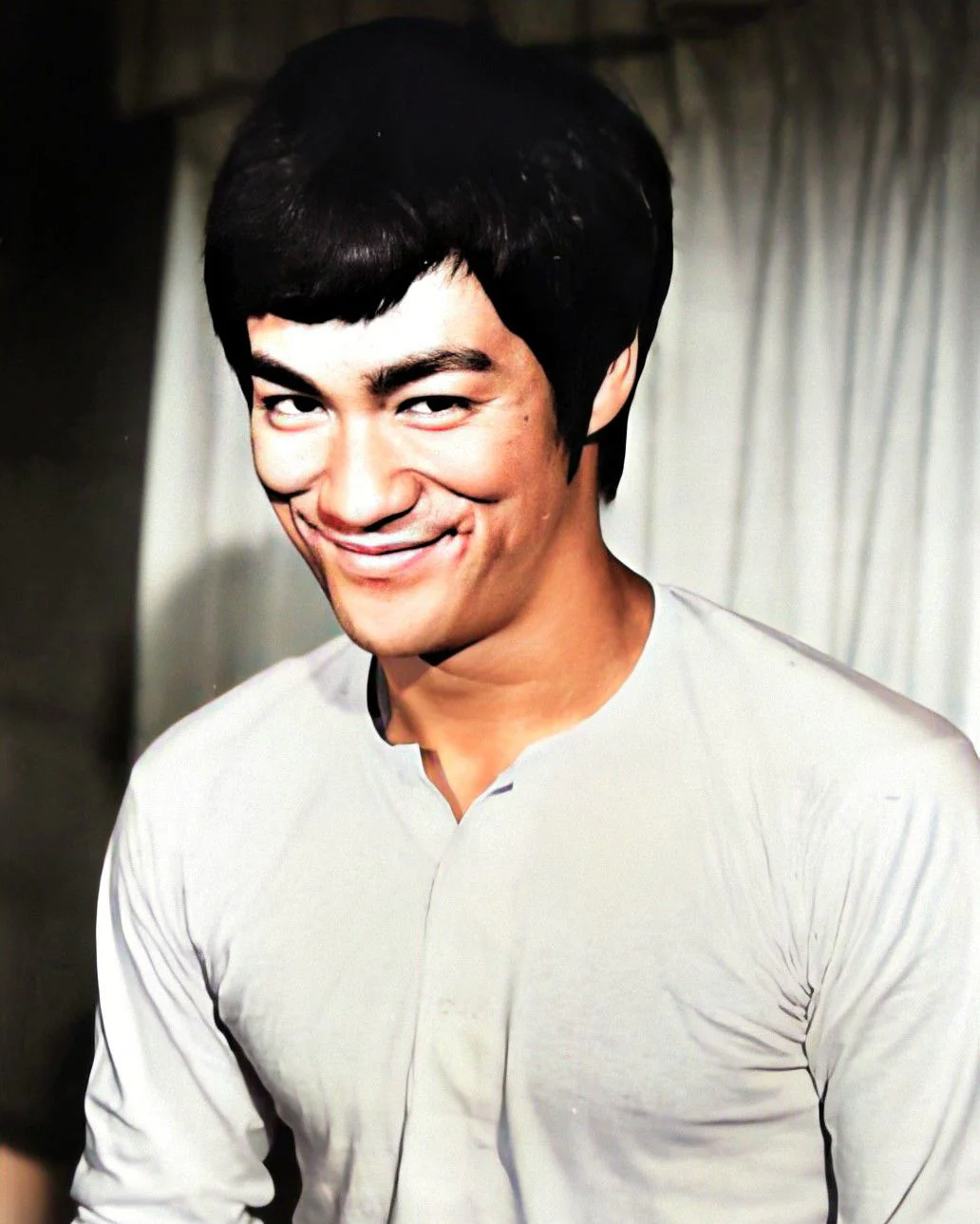
| 30 Quotes | |
| Born as | Lee Jun-fan |
| Occup. | Actor |
| From | USA |
| Born | November 27, 1940 San Francisco, California, U.S. |
| Died | July 20, 1973 Kowloon, British Hong Kong |
| Aged | 32 years |
| Cite | |
Citation Formats
APA Style (7th ed.)
Bruce lee biography, facts and quotes. (2026, February 1). FixQuotes. https://fixquotes.com/actors/bruce-lee/
Chicago Style
"Bruce Lee biography, facts and quotes." FixQuotes. February 1, 2026. https://fixquotes.com/actors/bruce-lee/.
MLA Style (9th ed.)
"Bruce Lee biography, facts and quotes." FixQuotes, 1 Feb. 2026, https://fixquotes.com/actors/bruce-lee/. Accessed 31 Mar. 2026.
Early Life and Background
Bruce Lee was born Lee Jun-fan on November 27, 1940, in San Francisco, California, during his parents' touring stay in the United States. He was raised mainly in British Hong Kong, a crowded entrepot shaped by war-shadow, refugee influx, and colonial hierarchy. His father, Lee Hoi-chuen, was a Cantonese opera performer; the family moved through backstage worlds where discipline, rhythm, and public persona were daily facts, and the child learned early how identity could be performed and remade.Lee entered life already threaded into cinema, appearing as a child actor in Hong Kong films. Yet the glamour sat beside street volatility. As a teenager he drifted into rooftop fights and neighborhood rivalries, a pattern that both threatened him and trained him - the body as instrument, the will as a fuse. Those frictions, plus anxieties about safety and future prospects, helped push his family toward a decisive solution: send him back to the United States, not as a prodigy returning home, but as a young man needing room to change.
Education and Formative Influences
In Hong Kong he trained in Wing Chun under Ip Man and senior students such as Wong Shun-leung, absorbing close-range economy and the ethic of hard sparring. After relocating to Seattle in 1959, he finished high school and studied philosophy at the University of Washington, reading across pragmatism and Asian thought while supporting himself with teaching. Seattle also brought him into interracial relationships and a wider American social mix, expanding his sense that culture could be blended rather than inherited - and that martial arts, like language, could be translated.Career, Major Works, and Turning Points
Lee taught in Seattle, Oakland, and Los Angeles, then broke through on US television as Kato in The Green Hornet (1966-67), gaining visibility but not leading roles in a Hollywood still wary of Asian male stardom. A celebrated turning point followed: frustrated by typecasting, he returned to Hong Kong and, with The Big Boss (1971) and Fist of Fury (1972), became a regional phenomenon. He then wrote, directed, and starred in Way of the Dragon (1972), culminating in the Rome Colosseum fight with Chuck Norris - both spectacle and thesis statement about style versus self. Enter the Dragon (1973), his Hollywood-backed film, released after his death on July 20, 1973, crystallized his image globally; he died in Hong Kong at 32, abruptly freezing a life that had been accelerating toward broader authorship, including the unfinished Game of Death.Philosophy, Style, and Themes
Lee's inner life was defined by impatience with limits and a near-scientific self-scrutiny. He treated training journals, weightlifting, roadwork, and film rehearsal as a single laboratory for personal evolution. His first instinct was to cut clutter, to strip away what looked impressive but failed under pressure. That impulse became an ethic: “It's not the daily increase but daily decrease. Hack away at the unessential”. Psychologically, the line reveals a man fighting his own excesses - anger, pride, scattered ambition - by turning self-mastery into method.Out of that method came Jeet Kune Do, less a fixed system than an argument against systems. He warned that “All fixed set patterns are incapable of adaptability or pliability. The truth is outside of all fixed patterns”. , a credo shaped by his experience of orthodoxy in kung fu schools and orthodoxy in studios. The same theme runs through his film characters: lone figures confronting rigid institutions, whether foreign occupiers, criminal bosses, or corrupt dojos. Even his famed concentration reads like a moral stance against distraction and performative virtuosity: “I fear not the man who has practiced 10, 000 kicks once, but I fear the man who has practiced one kick 10, 000 times”. In Lee, intensity was not bravado; it was a safeguard against chaos, a way to make the body tell the truth when the world demanded a mask.
Legacy and Influence
Lee's influence is both cultural and technical: he helped reframe the Asian man on global screens, seeded the modern kung fu boom, and set a template for action choreography that values clarity, speed, and real athleticism. In martial arts, his cross-training and pressure-testing anticipated contemporary mixed martial arts, while his insistence on personal responsibility continues to attract athletes, actors, and entrepreneurs who hear in his work a mandate to keep learning. His short life also became part of the legend - a reminder of how fiercely he lived and how much unfinished material he left behind - but his enduring power lies in the same thing his best scenes conveyed: liberation through precision, and identity achieved through practice rather than inheritance.Our collection contains 30 quotes written by Bruce, under the main topics: Motivational - Truth - Wisdom - Resilience - Kindness.
Other people related to Bruce: Jackie Chan (Actor), Sharon Tate (Actress), Brandon Lee (Actor)
Source / external links