
Charlie Sheen Biography Quotes 52 Report mistakes
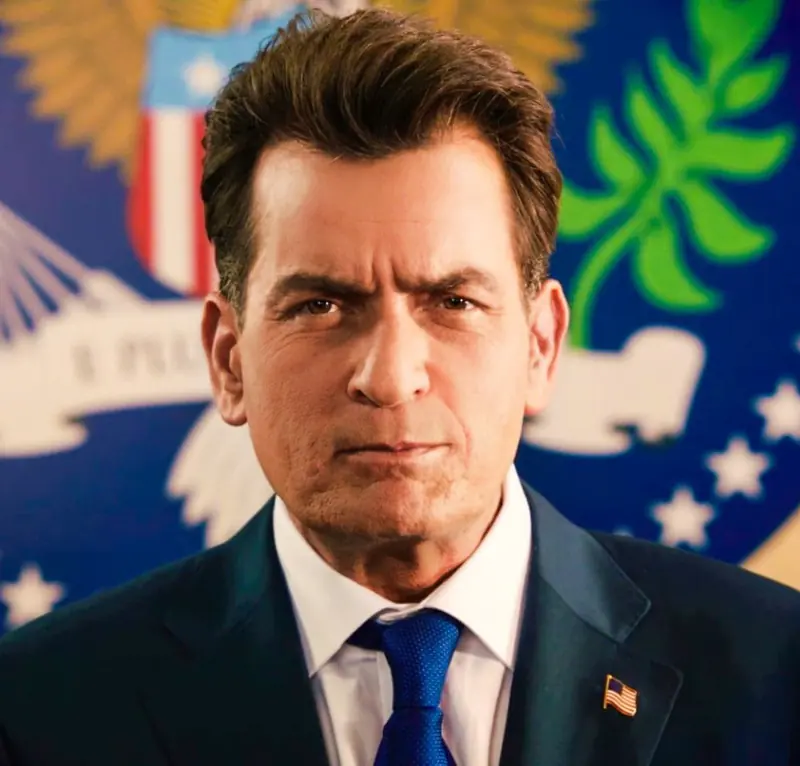
| 52 Quotes | |
| Born as | Carlos Irwin Estévez |
| Occup. | Actor |
| From | USA |
| Spouses | Denise Richards (2002–2006) Brooke Mueller (2008–2011) |
| Born | September 3, 1965 New York City, New York, USA |
| Age | 60 years |
Charlie Sheen was born Carlos Irwin Estevez on September 3, 1965, in New York City, the youngest son of actor Martin Sheen (born Ramon Estevez) and artist-producer Janet Templeton Sheen. He grew up in a family steeped in the performing arts. His siblings Emilio Estevez, Ramon Estevez, and Renee Estevez also pursued careers in entertainment, and the household often revolved around sets, scripts, and the rhythms of film and television work. Raised primarily in California, he attended Santa Monica High School, where he developed an early interest in acting and filmmaking, shooting short movies on Super 8 with friends and his brother Emilio. Adopting his father's professional surname, he began working as Charlie Sheen, while remaining Carlos Estevez off screen, a dual identity he would revisit later in his career.
Early Career and Breakthrough
Sheen's first major screen appearances came in the mid-1980s. He made an impression in Red Dawn (1984), an ensemble action drama, followed by roles in The Boys Next Door (1985) and Lucas (1986), showcasing a mix of intensity and earnestness that would become his hallmark. A memorable comic cameo in Ferris Bueller's Day Off (1986), opposite Jennifer Grey, hinted at his range. His breakthrough arrived with Oliver Stone's Vietnam War drama Platoon (1986), in which Sheen played Chris Taylor, a young soldier caught between the dueling influences of sergeants portrayed by Willem Dafoe and Tom Berenger. The film's critical and commercial success introduced Sheen to a wider audience and aligned him with serious, award-caliber filmmaking.
He cemented that momentum in Stone's Wall Street (1987), starring as Bud Fox opposite Michael Douglas's Gordon Gekko. The film combined Sheen's capacity for boyish ambition with moral conflict, and it was notable for featuring his father, Martin Sheen, as Bud Fox's blue-collar father, giving the movie an added layer of familial tension. Subsequent work in Young Guns (1988), with Emilio Estevez, Lou Diamond Phillips, and Kiefer Sutherland, and Major League (1989), alongside Tom Berenger and Wesley Snipes, broadened his profile. Major League delivered an instantly iconic character in pitcher Ricky "Wild Thing" Vaughn and added a sports-comedy hit to his filmography.
Establishing a Versatile Film Persona
As the 1990s began, Sheen navigated action, comedy, and satire with apparent ease. He co-starred with Clint Eastwood in The Rookie (1990), then pivoted to parody with Hot Shots! (1991) and its sequel Hot Shots! Part Deux (1993), directed by Jim Abrahams and featuring a standout turn by Lloyd Bridges. The Three Musketeers (1993) cast Sheen as Aramis alongside Kiefer Sutherland, Chris O'Donnell, and Oliver Platt, blending swashbuckling adventure with light comedy. He reprised his baseball antihero in Major League II (1994) and led The Chase (1994) opposite Kristy Swanson, cementing his image as both a dramatic lead and a bankable comedic presence.
Later in the decade, Sheen explored science fiction in The Arrival (1996) and buddy-action comedy with Chris Tucker in Money Talks (1997). He demonstrated a self-aware streak with a cameo as "himself" in Being John Malkovich (1999), wryly playing on his celebrity. In the 2000s he would continue to pop up in spoofs like Scary Movie 3 (2003) and Scary Movie 4 (2006). He also returned briefly to the world of Bud Fox in a cameo appearance in Wall Street: Money Never Sleeps (2010), a nod to one of the defining roles of his early career.
Television Stardom
Sheen made a successful transition to television at the turn of the millennium. In 2000 he joined Spin City, taking over the lead role from Michael J. Fox. His performance revitalized the series and earned him a Golden Globe Award, affirming his ability to carry a network sitcom. That momentum set the stage for his most commercially successful television venture: Two and a Half Men, created by Chuck Lorre and Lee Aronsohn. Premiering in 2003, the series showcased Sheen as Charlie Harper, a charming, hedonistic jingle writer whose Malibu lifestyle is disrupted by the arrival of his uptight brother, played by Jon Cryer, and young nephew, played by Angus T. Jones.
The show became one of network television's highest-rated comedies, and Sheen received multiple Emmy and Golden Globe nominations for his work. By the late 2000s he was among the highest-paid actors on television. Behind the scenes, however, tensions mounted. In 2011, amid public disputes with Chuck Lorre and well-documented personal struggles, Sheen departed the series. Ashton Kutcher subsequently joined the cast, and the show continued, but Sheen's swaggering portrayal of Charlie Harper remained central to its cultural impact.
In 2012 he returned to series television with Anger Management on FX, loosely inspired by the film of the same name. With a unique production model that expanded rapidly after an initial trial, the series ran for 100 episodes. It allowed Sheen to reassert his comedic timing and professional discipline, even as he continued navigating the scrutiny that followed him.
Public Image and Personal Life
Sheen's personal life has been as publicized as his screen work. He was engaged for a time to actor Kelly Preston around 1990; the relationship ended after a widely reported incident in which Preston was injured when a firearm discharged at Sheen's home. He married model Donna Peele in 1995; the marriage was short-lived. In 2002 he married actor Denise Richards. Their marriage, which brought the couple into frequent tabloid focus, ended in divorce in 2006. In 2008 he married Brooke Mueller; they divorced in 2011. His relationships and family life often unfolded in the public eye, and a number of legal and custody disputes drew sustained media attention.
Substance use and legal troubles periodically derailed his career momentum. He entered rehabilitation programs at various points, including the late 1990s and again in the 2010s. In early 2011 Sheen became the center of an extraordinary media storm, giving a series of interviews and online broadcasts that popularized catchphrases like "winning" and "tiger blood". He launched a live stage tour, the Violent Torpedo of Truth/Defeat Is Not An Option, which drew large crowds and mixed reviews. The period made him an emblem of the era's viral celebrity culture, amplifying both his fan base and controversy.
Health and Advocacy
In November 2015, Sheen publicly disclosed that he was HIV positive, explaining that he had received the diagnosis several years earlier and had been undergoing antiretroviral therapy. Speaking candidly about his health on television, he described the challenges of managing the condition and the stigma that frequently surrounds it. The disclosure prompted discussions about privacy, medical confidentiality, and the importance of effective treatment. Sheen's acknowledgment that his viral load had been reduced to undetectable levels under medical care underscored advances in HIV treatment and contributed to broader public awareness. His openness on the topic marked a shift from tabloid spectacle to a more measured public presence.
Later Work, Identity, and Legacy
In the 2010s Sheen continued to take on varied projects. He appeared in Machete Kills (2013), directed by Robert Rodriguez, crediting himself as "Carlos Estevez" in a nod to his birth name and heritage, and in the drama 9/11 (2017) with Whoopi Goldberg. He has made cameo appearances that play on his persona, demonstrating a willingness to reflect on his own mythology. Professionally, he remains connected to collaborators across decades, from Oliver Stone and Michael Douglas to costars like Jon Cryer and Kiefer Sutherland, while his family relationships with Martin Sheen and Emilio Estevez continue to situate him within a multigenerational Hollywood story.
Charlie Sheen's legacy is complex and undeniably visible. On screen, he built a résumé that stretches from Platoon and Wall Street to Hot Shots! and Major League, and then to long-running television success on Spin City and Two and a Half Men. Off screen, his life has been a case study in the rewards and risks of notoriety, amplified by modern media cycles. He has influenced pop culture through quotable roles and moments, from the "Wild Thing" swagger on a baseball mound to the exaggerated bravado of his 2011 media tour. Through career highs and personal reckonings, he remains one of the most recognizable American actors of his generation, a performer whose gifts for drama and comedy are matched by a public narrative that continues to evolve.
Our collection contains 52 quotes who is written by Charlie, under the main topics: Witty One-Liners - Motivational - Justice - Funny - Live in the Moment.
Other people realated to Charlie: Ryan Stiles (Actor), Terence Stamp (Actor), Bob Uecker (Athlete), Keith David (Actor), Brian Austin Green (Actor), Corbin Bernsen (Actor), Courtney Thorne Smith (Actress), Chris Tucker (Actor), Corey Haim (Actor), Kelly Preston (Actress)
Source / external links