
John Wayne Biography Quotes 11 Report mistakes
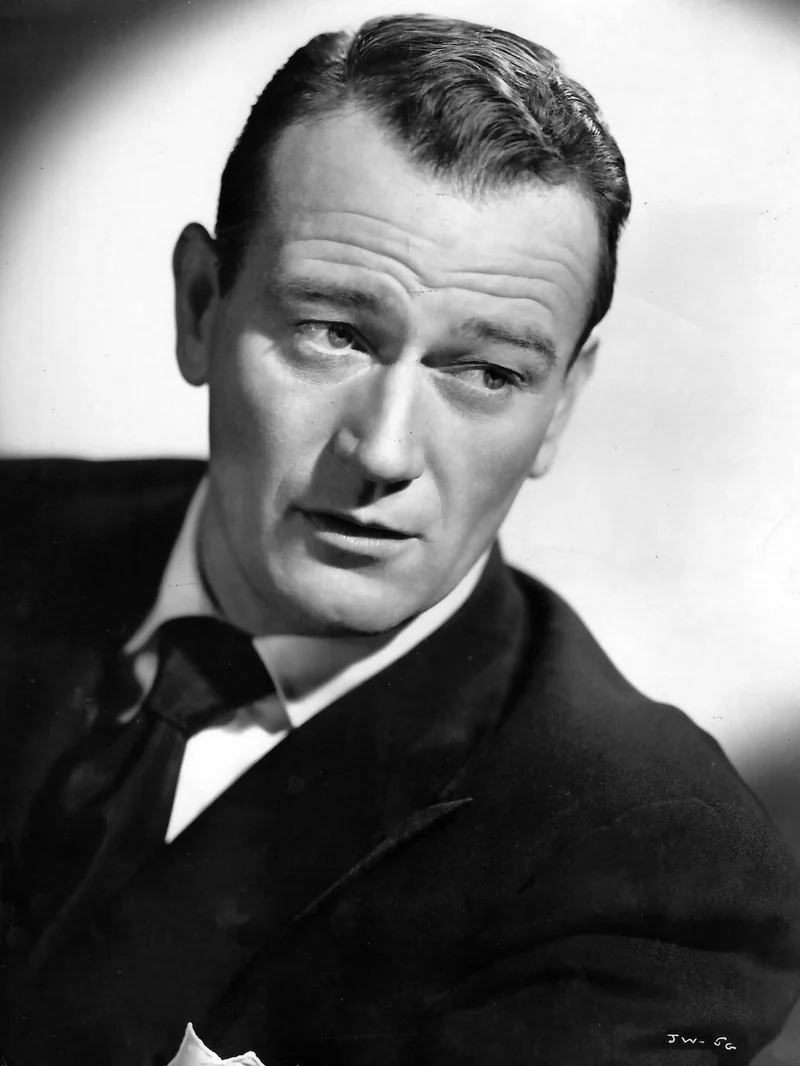
Attr: Public domain
| 11 Quotes | |
| Born as | Marion Robert Morrison |
| Occup. | Actor |
| From | USA |
| Born | May 26, 1907 Winterset, Iowa, USA |
| Died | June 11, 1979 Los Angeles, California, USA |
| Aged | 72 years |
| Cite | |
Citation Formats
APA Style (7th ed.)
John wayne biography, facts and quotes. (2026, February 2). FixQuotes. https://fixquotes.com/actors/john-wayne/
Chicago Style
"John Wayne biography, facts and quotes." FixQuotes. February 2, 2026. https://fixquotes.com/actors/john-wayne/.
MLA Style (9th ed.)
"John Wayne biography, facts and quotes." FixQuotes, 2 Feb. 2026, https://fixquotes.com/actors/john-wayne/. Accessed 26 Mar. 2026.
Early Life and Background
Marion Robert Morrison, later known worldwide as John Wayne, was born on May 26, 1907, in Winterset, Iowa, to Clyde Leonard Morrison, a pharmacist, and Mary Alberta Brown Morrison. America was shifting from rural certainties to industrial speed, and the Morrisons moved west into that current, settling in Southern California during Wayne's youth. He grew up tall, taciturn, and physically capable, absorbing a frontier-inflected code of self-reliance even as the real frontier had long closed and the new national mythmaking was happening on movie screens.The Great Depression-era West he entered as a young man was both a place and an idea - a landscape where work was precarious and identity could be remade. Wayne's early setbacks - money troubles, interrupted schooling, and the need to take any job available - helped form the "ordinary man made durable" persona that later audiences read as authentic. Long before he played captains and cattlemen, he learned how quickly comfort can vanish, and how much dignity depends on endurance.
Education and Formative Influences
Wayne attended Glendale High School and won a football scholarship to the University of Southern California, but a body-surfing accident damaged his shoulder and effectively ended his athletic future, cutting off the path that had promised stability. Needing work, he drifted into the studio system in Los Angeles as a prop man and extra, absorbing filmmaking as a craft from the bottom up and watching directors and stars build authority through economy - of gesture, speech, and emotion. Those years taught him that screen presence could be engineered, and that a man in motion - walking, riding, standing his ground - could communicate as powerfully as dialogue.Career, Major Works, and Turning Points
Wayne's first leading break came with Raoul Walsh's western "The Big Trail" (1930), a commercial disappointment that nonetheless revealed his scale; he then spent the 1930s in low-budget westerns, refining a plainspoken performance style built on posture and rhythm. The defining turn was John Ford's "Stagecoach" (1939), which made him a major star and fixed the Wayne image as both mythic and approachable. Over the next decades he became a central architect of the American western and war film: Ford used him to explore community and cost in "Fort Apache" (1948), "She Wore a Yellow Ribbon" (1949), and "The Searchers" (1956); Howard Hawks paired him with professionalism and mutual respect in "Red River" (1948) and "Rio Bravo" (1959). He won the Academy Award for "True Grit" (1969), a late-career confirmation that his weathered authority had become its own kind of artistry, and he directed and starred in "The Alamo" (1960), a personal statement about sacrifice and nation-building. In his final years, as illness advanced, he returned to mortality and friendship in "The Shootist" (1976), playing a dying gunman in a film that read like farewell. He died on June 11, 1979, in Los Angeles, California.Philosophy, Style, and Themes
Wayne's on-screen power came from restraint: a deliberate walk, a low-set gaze, a voice that suggested decisions made long before the scene began. His characters rarely argued ideas; they enacted them, often under pressure, and the camera treated their physicality as moral evidence. Even when scripts flirted with romance or comedy, he kept the center of gravity in competence - the belief that duty is proven in action, not declared in speeches. This is why his heroes often seem older than their years: they carry an inner ledger of losses, debts, and promises that the films only hint at.Psychologically, Wayne projected a hard-earned pragmatism that mixed tenderness with impatience for self-deception. The blunt warning “Life is hard; it's harder if you're stupid”. reads less like cruelty than a survival ethic from the Depression and the studio trenches - a demand that adults face consequences. His minimalism had its own discipline: “Talk low, talk slow and don't say too much”. That line captures the Wayne method - dominance through composure - and explains why his best performances, especially in "The Searchers" and "Rio Bravo", feel like controlled storms. Yet he also clung to a forward-facing faith that kept sentiment from turning maudlin: "Tomorrow is the most important thing in life. Comes into us at midnight very clean. It's perfect when it arrives and it puts itself in our hands. It hopes we've learned something
Our collection contains 11 quotes written by John, under the main topics: Witty One-Liners - Motivational - Wisdom - Leadership - New Beginnings.
Other people related to John: Louis L'Amour (Author), Howard Hawks (Director), Maureen O'Hara (Actress), Angie Dickinson (Actress), Rich Little (Comedian), Jennifer O'Neill (Actress), Jeffrey Hunter (Actor), Glen Campbell (Musician), Dennis Farina (Actor), Sam Wood (Director)
Source / external links