
Kitty O'Neil Biography Quotes 3 Report mistakes
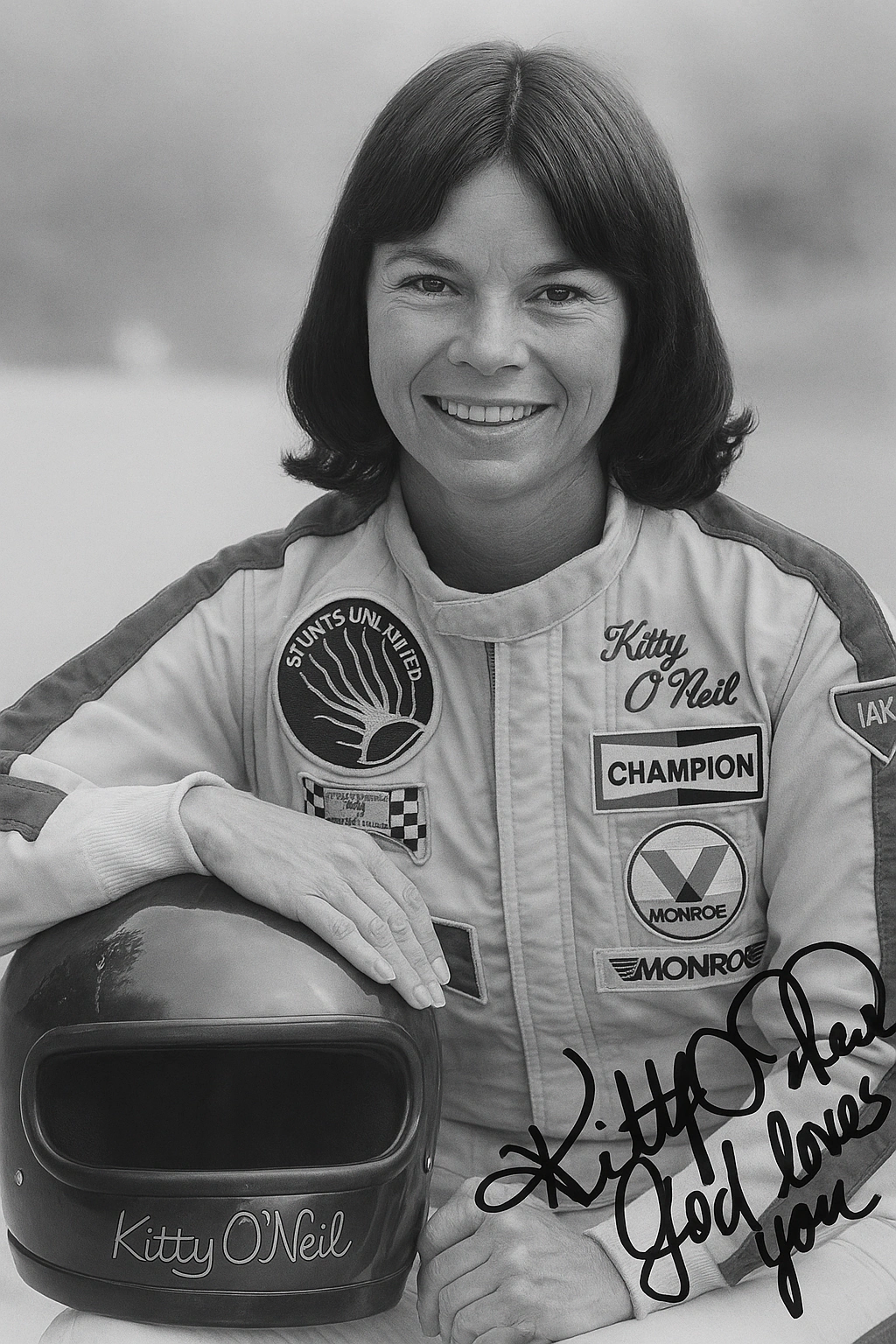
| 3 Quotes | |
| Born as | Susan Lynn O'Neil |
| Occup. | Actress |
| From | USA |
| Born | March 24, 1946 Corpus Christi, Texas, United States |
| Died | November 2, 2018 Eureka, South Dakota, USA |
| Cause | Pneumonia |
| Aged | 72 years |
| Cite | |
Citation Formats
APA Style (7th ed.)
Kitty o'neil biography, facts and quotes. (2026, February 11). FixQuotes. https://fixquotes.com/actors/kitty-oneil/
Chicago Style
"Kitty O'Neil biography, facts and quotes." FixQuotes. February 11, 2026. https://fixquotes.com/actors/kitty-oneil/.
MLA Style (9th ed.)
"Kitty O'Neil biography, facts and quotes." FixQuotes, 11 Feb. 2026, https://fixquotes.com/actors/kitty-oneil/. Accessed 27 Mar. 2026.
Early Life and Background
Susan Lynn "Kitty" O'Neil was born on March 24, 1946, in Corpus Christi, Texas, into a postwar America that prized conformity and underestimated disability. She lost her hearing in early childhood after illness and a damaging reaction to antibiotics, and she grew up reading faces, studying motion, and converting the noise of the world into pattern and intent. Those adaptations were not incidental - they became the basis of her later gifts: explosive focus, a calibrated sense of risk, and an ability to stay calm while others panicked.Her childhood moved across a wide American map, including years in Montana, and was marked by a mix of discipline and restlessness. In a period when deaf children were often steered toward narrow vocational tracks, O'Neil learned to insist on independence. She also learned the social cost of difference: being watched, doubted, and talked around. That pressure sharpened her competitive edge and made performance feel like proof - not simply of talent, but of belonging.
Education and Formative Influences
O'Neil attended schools that emphasized lip-reading and self-reliance and trained in movement with the seriousness of an athlete rather than the delicacy expected of girls at the time. She gravitated toward swimming and diving, sports where the body speaks more loudly than the crowd, and she developed an unusually precise sense of timing and spatial awareness. The 1960s and early 1970s also brought a changing culture of women in sport and entertainment; O'Neil absorbed that opening as permission to be visible, daring, and uncompromising.Career, Major Works, and Turning Points
By the 1970s O'Neil was a nationally recognized sprinter and daring performer, and she parlayed athletic speed into stunt work just as Hollywood action became bigger, faster, and more dangerous. She became widely known for doubling Lynda Carter on the television series Wonder Woman (1975-1979), helping define the show's athletic grace and credibility in fight and chase sequences. Her reputation expanded beyond film sets through headline-making speed runs and a public persona built on defiance of low expectations; she lived in the overlap of sport, spectacle, and pioneering labor, where women and deaf performers were still treated as exceptions.Philosophy, Style, and Themes
O'Neil's inner life was ruled by a paradox: she refused to romanticize deafness, yet she treated it as a source of strategic advantage. The world could not distract her with noise, and that quiet sharpened concentration into something almost monastic. Her performances - whether sprinting, diving, or executing high-risk stunts - were defined by clean lines and exact decisions. She did not sell recklessness; she sold control, the kind born of rehearsed repetition and an almost mathematical understanding of momentum, distance, and consequence.Her public statements were blunt because her project was psychological as much as physical - to replace pity with respect. “I know I'm deaf. But I'm still normal... Being handicapped is not a defect. People say I can't do anything. I say to people I can do anything I want”. That insistence is less motivational slogan than a portrait of how she survived: by refusing the identity others offered her. “Because I was deaf, I had a very positive mental attitude. You have to show people you can do anything”. In O'Neil's worldview, excellence was argument, and fame was not vanity but leverage - a way to force a skeptical culture to revise what it thought was possible.
Legacy and Influence
Kitty O'Neil died on November 2, 2018, but she left a template for modern action performance and disability visibility in American popular culture. She helped normalize the idea that a woman could be the engine of physical spectacle rather than its ornament, and that a deaf athlete and actress could set the standard for precision, courage, and professionalism. Her life reads as a biography of refusal - refusal to be sidelined, refused jobs, refused sympathy - and that stance continues to resonate wherever performers and athletes are asked to shrink to fit other people's limits.Our collection contains 3 quotes written by Kitty, under the main topics: Overcoming Obstacles.
Source / external links