
Leonard Nimoy Biography Quotes 30 Report mistakes
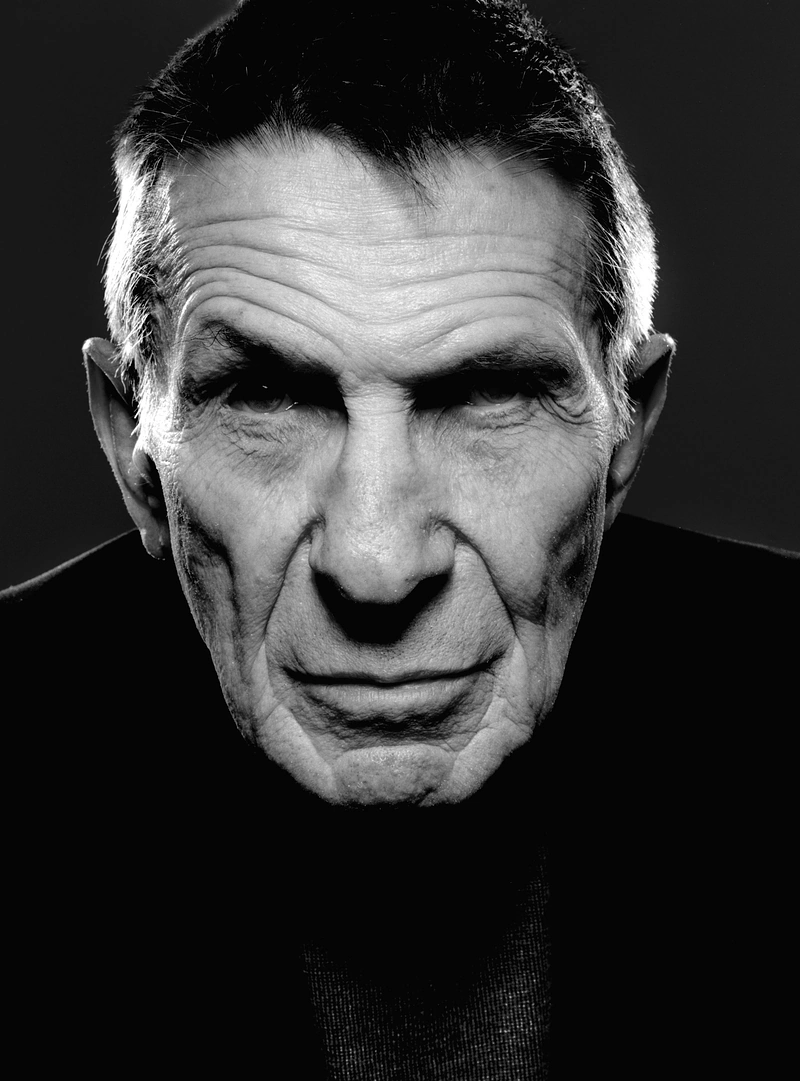
Attr: pinterest.com
| 30 Quotes | |
| Occup. | Actor |
| From | USA |
| Born | March 26, 1931 |
| Age | 95 years |
| Cite | |
Citation Formats
APA Style (7th ed.)
Leonard nimoy biography, facts and quotes. (2026, February 11). FixQuotes. https://fixquotes.com/actors/leonard-nimoy/
Chicago Style
"Leonard Nimoy biography, facts and quotes." FixQuotes. February 11, 2026. https://fixquotes.com/actors/leonard-nimoy/.
MLA Style (9th ed.)
"Leonard Nimoy biography, facts and quotes." FixQuotes, 11 Feb. 2026, https://fixquotes.com/actors/leonard-nimoy/. Accessed 27 Mar. 2026.
Early Life and Background
Leonard Simon Nimoy was born on 1931-03-26 in Boston, Massachusetts, the son of Yiddish-speaking Jewish immigrants from what is now Ukraine. His parents, Max and Dora, carried with them the ethic of thrift and self-discipline common to working-class immigrant households; his father ran a barbershop, and the family lived amid the tight neighborhoods of West End Boston. Nimoy grew up bilingual in sensibility even when he spoke English outside the home - at once steeped in Old World ritual and keenly aware of American assimilation, a tension that later fed his fascination with outsiders who survive by mastering codes.As a boy he gravitated to performance as both escape and self-making. Theater offered a controlled arena in which a shy, observant child could be seen on his own terms, and it trained him early in the paradox that would define him: the more convincing the mask, the more truthful the person beneath it could become. Those early years also gave him his lifelong feeling for community, and for the loneliness that can live inside community - themes that would surface in his most famous role and in his later photography and writing.
Education and Formative Influences
Nimoy began acting in childhood and entered the local theater world before moving west as a teenager to pursue film and stage work in Los Angeles. His formal schooling was intermittent compared to his apprenticeship in auditions, bit parts, and voice work, but he later studied at the Pasadena Playhouse and refined a disciplined craft through repetition rather than pedigree. Military service in the U.S. Army in the early 1950s, including work on troop entertainment, further honed his professional steadiness: he learned to deliver under pressure, to collaborate with ensembles, and to treat performance as labor - a posture that helped him endure years of uncertainty before recognition arrived.Career, Major Works, and Turning Points
After small film roles and steady television work through the 1950s and early 1960s, Nimoy became a cultural figure in 1966 as Mr. Spock on Star Trek. Spock was at once alien and profoundly humane, and Nimoy fought to protect that complexity against simplification, shaping the character's stillness, precision, and underlying warmth; he also helped popularize the Vulcan salute, adapting a Jewish priestly blessing gesture from his upbringing. When the original series ended, he navigated the afterlife of typecasting by diversifying: he voiced animation, appeared in Mission: Impossible, and wrote poetry and memoir. A major turning point came when he expanded into directing, culminating in Star Trek III: The Search for Spock (1984) and the commercially pivotal Star Trek IV: The Voyage Home (1986), which demonstrated his instinct for character-centered spectacle and broadened his authority in the industry. In later decades he returned repeatedly to Spock while sustaining parallel identities as a photographer, narrator, and public advocate for the arts.Philosophy, Style, and Themes
Nimoy's inner life was defined by a productive friction: immigrant-rooted tradition versus American reinvention, rational control versus emotional yearning, privacy versus fame. He understood why audiences clung to Spock - the character offered a fantasy of composure in a chaotic era marked by Cold War dread, civil rights upheaval, and rapidly changing social norms. Yet Nimoy never treated logic as armor for indifference; his best performances imply feeling held in check, not erased. “Logic is the beginning of wisdom, not the end”. That line, associated with Spock but resonant with Nimoy himself, captures his belief that intellect must lead toward empathy, not replace it.Across media, Nimoy favored clear structures that could carry ambiguous emotion. His photography, often in black and white, pursued archetypes and contrasts - body and myth, public and private, the sacred and the everyday - with a craftsman's satisfaction in making an image by hand and then interrogating what it meant. “I became hooked on the idea of being able to shoot an image and process it myself, and end up with a product”. That attraction to process mirrors his acting method: repeatable technique in service of mystery. He also saw art as a kind of metaphysical feedback loop, where private experiments unexpectedly meet collective need. “Other times, you're doing some piece of work and suddenly you get feedback that tells you that you have touched something that is very alive in the cosmos”. For Nimoy, the artist's task was to stand at the boundary - between cultures, between disciplines, between the known and the unspoken - and translate.
Legacy and Influence
Nimoy died in 2015, but his influence remains unusually layered: he is both a symbol of science-fiction's mainstream ascent and a case study in how an actor can co-author an iconic role without being consumed by it. Spock became a template for the modern anti-macho hero - cerebral, ethical, emotionally complex - shaping generations of performers and writers, while Nimoy's directing helped prove that fan-driven franchises could also be humane and socially conscious. Beyond Star Trek, his photography and writing extended his public persona into a sustained inquiry about identity, otherness, and belonging, making him enduringly relevant in a culture still negotiating the costs and gifts of difference.Our collection contains 30 quotes written by Leonard, under the main topics: Witty One-Liners - Wisdom - Art - Mortality - Learning.
Other people related to Leonard: Nancy Travis (Actress), Judith Anderson (Actress), Stephen Collins (Actor), Nichelle Nichols (Musician), William Shatner (Actor), Philip Kaufman (Director)