
Monica Bellucci Biography Quotes 27 Report mistakes
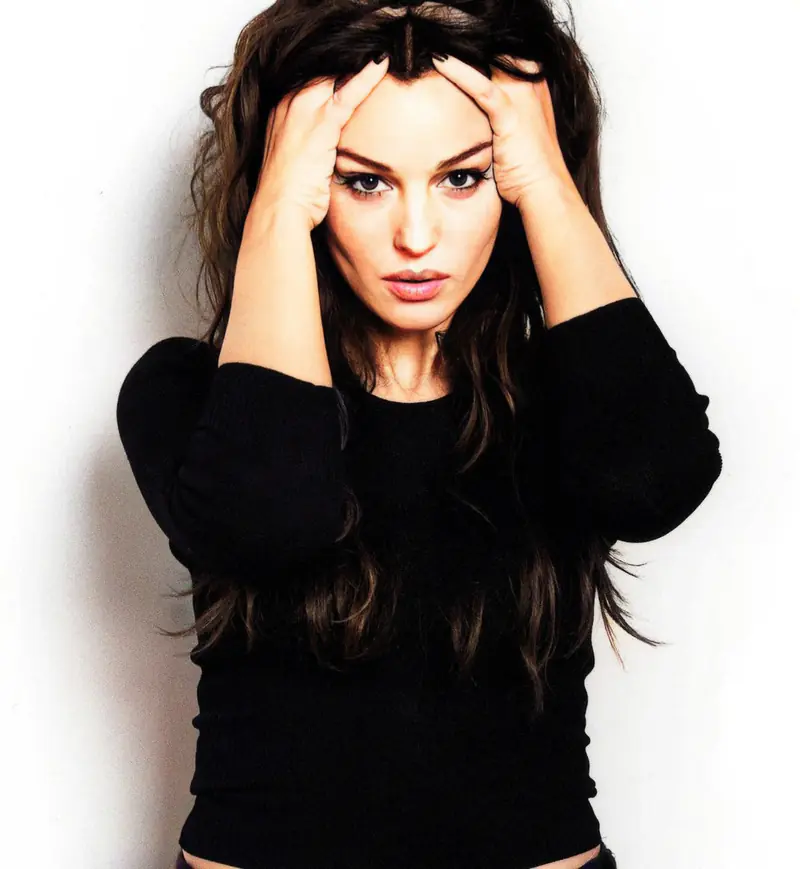
| 27 Quotes | |
| Born as | Monica Anna Maria Bellucci |
| Occup. | Actress |
| From | Italy |
| Born | September 30, 1964 Città di Castello, Umbria, Italy |
| Age | 61 years |
Monica Anna Maria Bellucci was born on September 30, 1964, in Citta di Castello, Umbria, Italy, an interior region better known for its craftsmen and quiet provincial rhythms than for cinema. Her father, Pasquale Bellucci, worked as a truck driver, and her mother, Brunella Briganti, was a painter; the family background was not aristocratic or show-business connected, but rooted in work, taste, and the discipline of making do. That mix of pragmatism and aesthetics would later surface in her screen presence: sensuality without frivolity, glamour tempered by a visible gravity.
Growing up in 1970s and early 1980s Italy meant living amid fast-changing images of femininity - television variety shows, the long afterglow of Italian auteur cinema, and the rise of fashion as a national export. Bellucci has often seemed shaped by that moment: she learned to command the gaze without appearing consumed by it. Even before film, she carried the imprint of a culture where beauty could be both passport and trap, a public language that demanded private negotiation.
Education and Formative Influences
She moved to Perugia to study law at the University of Perugia, supporting herself through modeling, a pragmatic decision that became a calling when agencies and photographers recognized her camera intelligence. Modeling introduced her to Rome, Milan, and Paris - cities where image-making is industrialized - and offered an early lesson in performance as labor: posing, repetition, and the controlled revelation of personality. Those years also placed her near the crossroads of European cinema and fashion, and she absorbed how directors, stylists, and editors build a narrative from surfaces.
Career, Major Works, and Turning Points
Bellucci transitioned from modeling to acting in the early 1990s, beginning with Italian projects before widening into French and international films; her breakthrough visibility arrived with roles in Francis Ford Coppola's "Bram Stoker's Dracula" (1992) and Claude Chabrol's "L'Enfer" (1994), followed by a major Italian hit in Gabriele Muccino's "L'ultimo bacio" (2001). She became a defining face of early-2000s transnational cinema: "Malena" (2000) turned her into an emblem of wartime desire and cruelty; the Wachowskis cast her in "The Matrix Reloaded" and "Revolutions" (2003); and her artistic risk-taking peaked in Gaspar Noe's "Irrversible" (2002), whose notoriety often obscured the precision of her performance. She married French actor Vincent Cassel in 1999; they worked together repeatedly, most notably in "Irrversible" and later in "Black Swan" (2010), and they had two daughters, Deva (born 2004) and Leonie (born 2010), before separating in 2013. In 2015 she entered a new phase of global iconography as a Bond woman in "Spectre", notably cast at fifty - a quiet disruption of franchise expectations.
Philosophy, Style, and Themes
Bellucci's screen identity has always been a negotiation between myth and personhood. She resists the vocabulary of stardom, insisting, "I'm not a movie star. I'm just an actress". That refusal is less modesty than strategy: it protects a private self from the public narrative that beauty invites, and it helps explain why she repeatedly chooses directors and films that complicate the gaze. Her work often centers on women watched, judged, or pursued - and on the moral weather around them - yet she plays those roles with a composure that suggests interior sovereignty rather than victimhood.
Her performances are built on intimacy and withheld explanation: "In acting process, it's very difficult to explain. It's something very intimate, very private". That privacy reads on camera as density - a sense that the character is thinking beyond the frame - and it suits films where desire is inseparable from violence, shame, or time. In "Malena", the body becomes a public battleground; in "Irrversible", the body becomes history, a site where narrative cannot be repaired. Bellucci has framed risk as growth rather than provocation, and she returns repeatedly to the idea that cinema survives on longing and artifice: "We all need illusions. That's why we love movies". The line is revealing: she understands illusion as necessity, not deception, and she treats performance as a humane lie that makes unbearable truths speakable.
Legacy and Influence
Bellucci's enduring influence lies in how she expanded the idea of what a European leading woman could be in the global market: multilingual, continentally mobile, erotic without comedic diminishment, and willing to attach her image to films that challenge viewers rather than flatter them. She helped normalize a model of fame rooted in craft and selection - moving between Italian, French, and English-language sets without surrendering to a single industry's branding - and her later casting in major franchises signaled a slow recalibration of age and desire on screen. For audiences and younger performers, she remains a case study in sustaining mystery without manufactured scandal: a career built not on constant reinvention, but on controlled exposure, taste for risk, and the insistence that the person behind the image stays partly unowned.
Our collection contains 27 quotes who is written by Monica, under the main topics: Wisdom - Truth - Friendship - Art - Equality.
Source / external links