
Orson Welles Biography Quotes 42 Report mistakes
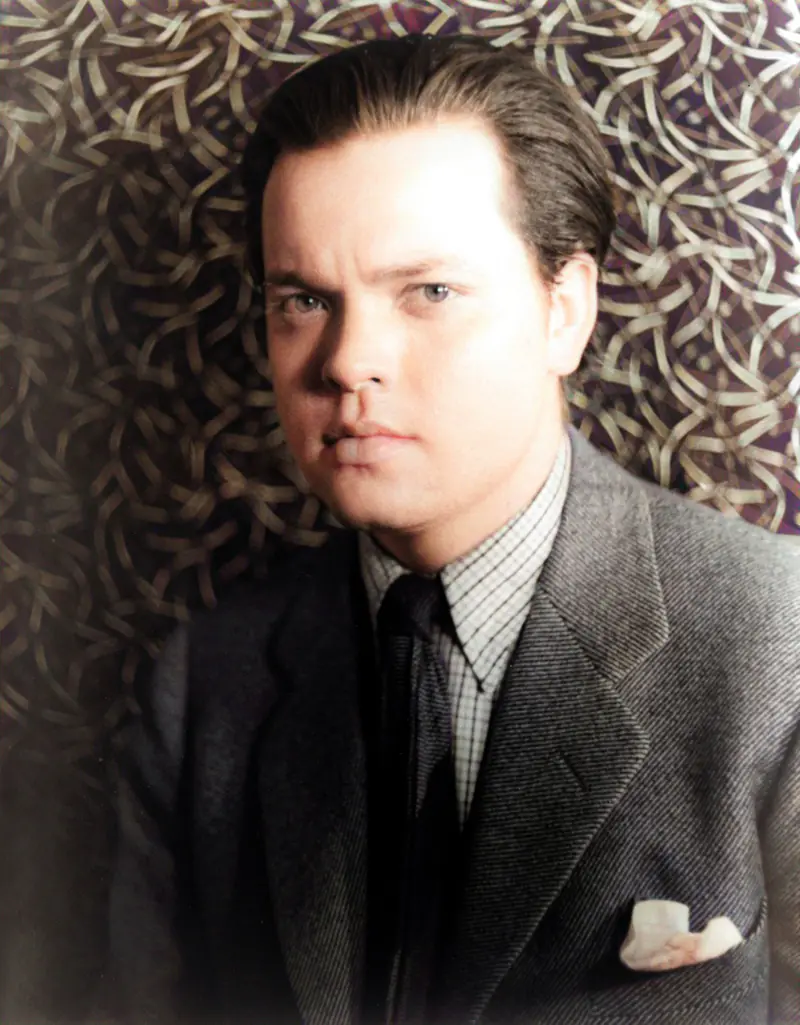
| 42 Quotes | |
| Occup. | Actor |
| From | USA |
| Born | May 6, 1915 |
| Died | October 10, 1985 |
| Aged | 70 years |
George Orson Welles was born May 6, 1915, in Kenosha, Wisconsin, into a household that mixed invention, music, and instability. His father, Richard Head Welles, had prospered from a bicycle lamp business; his mother, Beatrice Ives Welles, was a pianist with social ambitions and exacting tastes. The child learned early how performance could fill a room and how charisma could patch over family fractures. When the family drifted between Wisconsin and Chicago, the era itself - Prohibition, fast money, fast ruin - mirrored the boy's sense that adult authority was both theatrical and fragile.
Loss arrived early and set the emotional register. Beatrice died in 1924 when Orson was nine, and Richard's decline through alcoholism made the son's independence less a choice than a necessity. By his mid-teens Welles was, in effect, self-directed: voracious, resistant to supervision, and already practicing the trick that would define him - turning private insecurity into public command. The combination of privilege, neglect, and precocious talent gave him a lifelong double consciousness: the showman who could dominate a crowd, and the orphan who expected the ground to give way.
Education and Formative Influences
Welles attended the Todd School for Boys in Woodstock, Illinois, under headmaster Roger Hill, who became a mentor and collaborator. Todd gave him a stage, a press, and a laboratory for illusions: he acted, designed, and directed, absorbing Shakespeare, magic, and the mechanics of attention. After graduating, he traveled to Ireland and talked his way into the Gate Theatre in Dublin in 1931, an early demonstration that audacity could substitute for credentials. Back in the United States, he found the Depression-era arts world hungry for boldness, and he learned to treat every medium - stage, radio, film - as a single instrument for shaping belief.
Career, Major Works, and Turning Points
In New York he rose quickly through the Federal Theatre Project, drawing national notice with an incendiary "Macbeth" (1936) staged with an all-Black cast in Harlem, and with the "Voodoo Macbeth" atmosphere that fused classic text with contemporary dread. With producer John Houseman he founded the Mercury Theatre, then conquered radio: the 1938 broadcast of "The War of the Worlds" used news-bulletin realism to test how easily an audience could be led. Hollywood answered with an unprecedented contract at RKO, yielding "Citizen Kane" (1941), co-written with Herman J. Mankiewicz - a revolution in deep focus, sound, and narrative structure, and a direct collision with William Randolph Hearst that shadowed its release. The pattern that followed was both brilliant and bruising: "The Magnificent Ambersons" (1942) was re-cut without him; later projects became feats of improvisation under financial pressure - "The Lady from Shanghai" (1947), "Touch of Evil" (1958), "Chimes at Midnight" (1965) - while Welles, often in Europe, financed passion films with acting jobs, narration, and commercials. By the time of "F for Fake" (1973), his late masterwork of playful skepticism, the struggle itself had become part of the art.
Philosophy, Style, and Themes
Welles thought in terms of limits and loopholes. He treated obstacles - studio interference, thin budgets, rushed schedules - not merely as misfortune but as raw material, insisting, "The enemy of art is the absence of limitations". That conviction shaped his style: baroque compositions that still feel muscular, low-angle frames that turn ceilings into psychological pressure, soundscapes that layer rooms with lies, and editing that makes time behave like memory rather than chronology. His camera does not simply observe; it interrogates, as he put it, "A film is never really good unless the camera is an eye in the head of a poet". The poetry, in his hands, is never decorative - it is a weapon used to expose how power performs.
Under the bravura lay an intimate metaphysics of loneliness and masks. Welles returned obsessively to fallen kings, betrayed fathers, corrupt magnates, and genial con men - figures who turn life into theater because sincerity feels unsafe. His own self-mythmaking was unusually candid about its costs: "I have an unfortunate personality". The line reads less like a joke than a diagnosis of the engine that drove him: the need to control the frame because the world would not stay still, the need to enchant because enchantment postpones abandonment. Even his narrative structures - looping testimonies in "Kane", the patchwork elegy of "Chimes at Midnight", the hoax-and-truth braid of "F for Fake" - suggest a man convinced that identity is a story told to survive the night.
Legacy and Influence
Welles died October 10, 1985, in Los Angeles, leaving a body of completed classics and a trail of unfinished films that became legend - proof of both his ambition and the industry's inability to accommodate it. "Citizen Kane" remains a reference point for visual grammar and narrative daring; "Touch of Evil" and "Chimes at Midnight" stand as monuments to expressive camera movement and tragic scale; his radio work still defines audio realism. Beyond individual titles, his enduring influence is the model he offered: the filmmaker as total author, actor-director-magician, forever negotiating with money and power while refusing to cede imagination. Modern cinema's antiheroes, nonlinear biographies, and self-reflexive documentaries carry his fingerprints, as does the romantic idea of the genius who fights the system - and, sometimes, himself.
Our collection contains 42 quotes who is written by Orson, under the main topics: Witty One-Liners - Motivational - Wisdom - Justice - Faith.
Other people realated to Orson: Patrick McGoohan (Actor), Graham Greene (Playwright), Zsa Zsa Gabor (Actress), Richard Wright (Novelist), Brooks Atkinson (Critic), Jean Renoir (Director), Loretta Young (Actress), David Niven (Actor), Charlton Heston (Actor), Booth Tarkington (Novelist)
Source / external links