
Sophie Marceau Biography Quotes 20 Report mistakes
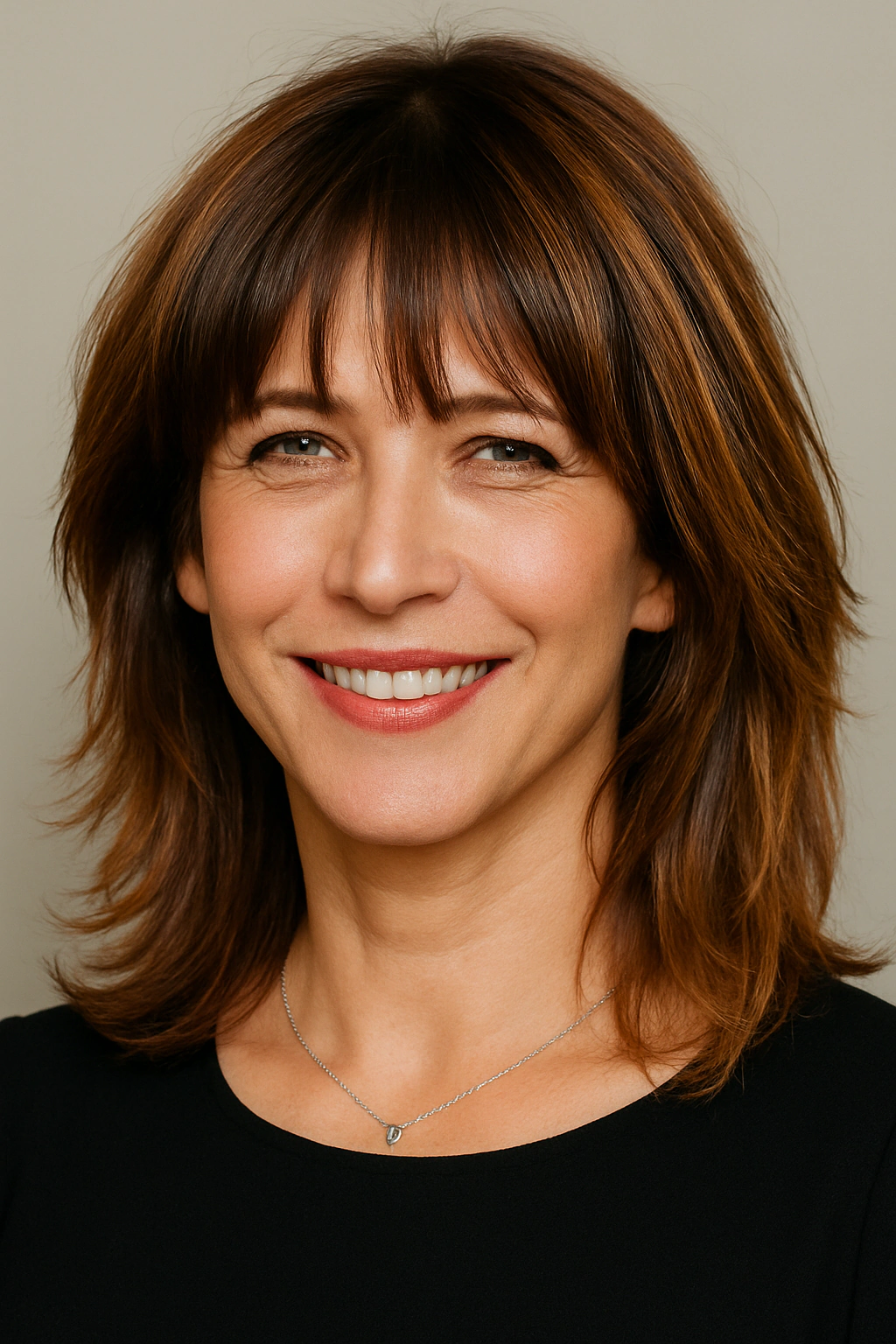
| 20 Quotes | |
| Born as | Sophie Danièle Sylvie Maupu |
| Occup. | Actress |
| From | France |
| Born | November 17, 1966 Paris, Île-de-France, France |
| Age | 59 years |
| Cite | |
Citation Formats
APA Style (7th ed.)
Sophie marceau biography, facts and quotes. (2026, March 13). FixQuotes. https://fixquotes.com/actors/sophie-marceau/
Chicago Style
"Sophie Marceau biography, facts and quotes." FixQuotes. March 13, 2026. https://fixquotes.com/actors/sophie-marceau/.
MLA Style (9th ed.)
"Sophie Marceau biography, facts and quotes." FixQuotes, 13 Mar. 2026, https://fixquotes.com/actors/sophie-marceau/. Accessed 1 Apr. 2026.
Early Life and Background
Sophie Marceau was born Sophie Daniele Sylvie Maupu on November 17, 1966, in Paris, and grew up in a modest, non-bohemian household in the suburbs. Her father worked as a truck driver and her mother as a shop assistant, placing her far from the elite cultural circuits that traditionally fed French cinema. That social distance mattered. Marceau did not emerge from a dynasty of actors or intellectuals; she came from the ordinary France of the late Gaullist and post-1968 years, a country modernizing fast but still marked by class boundaries and by a powerful belief that Parisian culture belonged to other people. Her early life gave her a double perspective that would remain central to her screen presence: she could project glamour, but she never entirely lost the alertness of someone who had entered that world from outside.
Her life changed abruptly at fourteen when, accompanying a friend to a casting, she auditioned for Claude Pinoteau's La Boum. Released in 1980, the film made her an overnight national sensation as Vic Beretton, the adolescent heroine through whom a generation recognized itself. France in the early 1980s was ready for a new emblem of youth - modern but not cynical, sensual but not hardened - and Marceau embodied that balance with startling ease. Fame arrived before emotional adulthood, and with it came the pressure of being fixed in the public imagination as "the French teenager". The experience formed her in contradictory ways: it gave her freedom, money, and cultural power, yet it also created the long struggle, visible across her career, to prove that charm was not the whole of her talent.
Education and Formative Influences
Marceau's real education was accelerated and practical, learned on sets rather than in conservatory classrooms. After La Boum and La Boum 2, for which she won the Cesar for Most Promising Actress in 1983, she moved quickly from teen celebrity into collaborations that broadened her range and seriousness. Her long relationship with the Polish director Andrzej Zulawski was especially formative, both artistically and psychologically. With him she entered a cinema of extremity, emotional exposure, and intellectual risk, appearing in films such as L'Amour braque and later Mes nuits sont plus belles que vos jours. Zulawski's influence pushed her away from safe stardom toward more demanding, unstable work, while French auteurs and international productions taught her how to modulate between naturalism and stylization. She also absorbed the peculiar burden of French celebrity in the 1980s and 1990s: the actress as national symbol, expected to be sensual, articulate, and self-aware all at once.
Career, Major Works, and Turning Points
The arc of Marceau's career is the story of repeated reinvention. After her adolescent breakthrough, she secured adult credibility with Fort Saganne, Police, and especially Laudiante, then gave one of her most acclaimed performances in Maurice Pialat's Police-adjacent era of hard realism and in Zulawski's turbulent romantic dramas. International audiences embraced her in Mel Gibson's Braveheart in 1995, where as Princess Isabelle she brought intelligence and inwardness to what might have been a decorative role, and mass global visibility expanded again with her appearance as Elektra King in The World Is Not Enough in 1999. Yet she never surrendered fully to Anglo-American stardom. Instead, she moved restlessly between commercial and personal projects, including directing Parlez-moi d'amour in 2002, a sign of her wish to control narrative rather than merely embody it. Later work in films such as LOL (Laughing Out Loud), Ne te retourne pas, and Everything Went Fine confirmed a durable screen identity: mature, emotionally legible, often carrying histories of desire, doubt, and disillusionment beneath an elegant surface.
Philosophy, Style, and Themes
Marceau's acting style has often been mistaken for ease because she makes emotional access look unforced. In fact, her gift lies in calibrating volatility - giving the impression that feeling is arriving in real time, not being demonstrated for effect. This is why she has been effective in romance, comedy, thriller, and historical drama without ever seeming entirely reducible to genre. She has said, “I think it's almost easier to make people cry than to make people laugh”. That remark reveals a technician's mind beneath the icon's image: she understands that comedy requires precision, timing, and social intelligence, not merely sparkle. Her performances often hinge on that precision - on micro-shifts between irony and sincerity, defiance and vulnerability. Even at her most glamorous, there is usually a trace of self-observation, as though the character knows she is being watched and resists becoming a simple object of desire.
The deeper continuity in Marceau's career is her insistence on immediacy and human truth over category or prestige. “What I am interested in is the present time”. That preference helps explain her refusal to settle into one stable artistic identity, whether ingénue, sex symbol, international star, or prestige actress. It also connects to her work as a writer and director, where speech, confession, and interpersonal tension become central. “Words, yes, formulating things, creating something from your heart, it is something very necessary, yes”. She has often seemed drawn to characters for whom language is both revelation and failure - women speaking through desire, silence, wit, or rupture. Even her beauty, so central to her fame, became in her best work less a fixed attribute than a dramatic problem: how to remain inwardly free while the world insists on reading the face first.
Legacy and Influence
Sophie Marceau endures as one of the rare French stars to belong simultaneously to popular memory, auteur cinema, and international mass culture. For French audiences she remains permanently linked to adolescence because La Boum was more than a hit - it was a generational landmark - yet her larger achievement was escaping the prison of that first image without disowning it. She demonstrated that a performer from a non-elite background could become a national icon while retaining curiosity, risk, and a measure of privacy. Later actresses inherited a path she helped normalize: moving between French and English-language work, between mainstream visibility and personal projects, between acting and authorship. Her legacy is not only the films themselves but the model of artistic adulthood they suggest - one built on reinvention, emotional candor, and the refusal to let celebrity define the full scale of a life.
Our collection contains 20 quotes written by Sophie, under the main topics: Witty One-Liners - Dark Humor - Love - Writing - Life.
Other people related to Sophie: Robert Carlyle (Director), Catherine McCormack (Actress)
Source / external links