
Ursula Andress Biography Quotes 28 Report mistakes
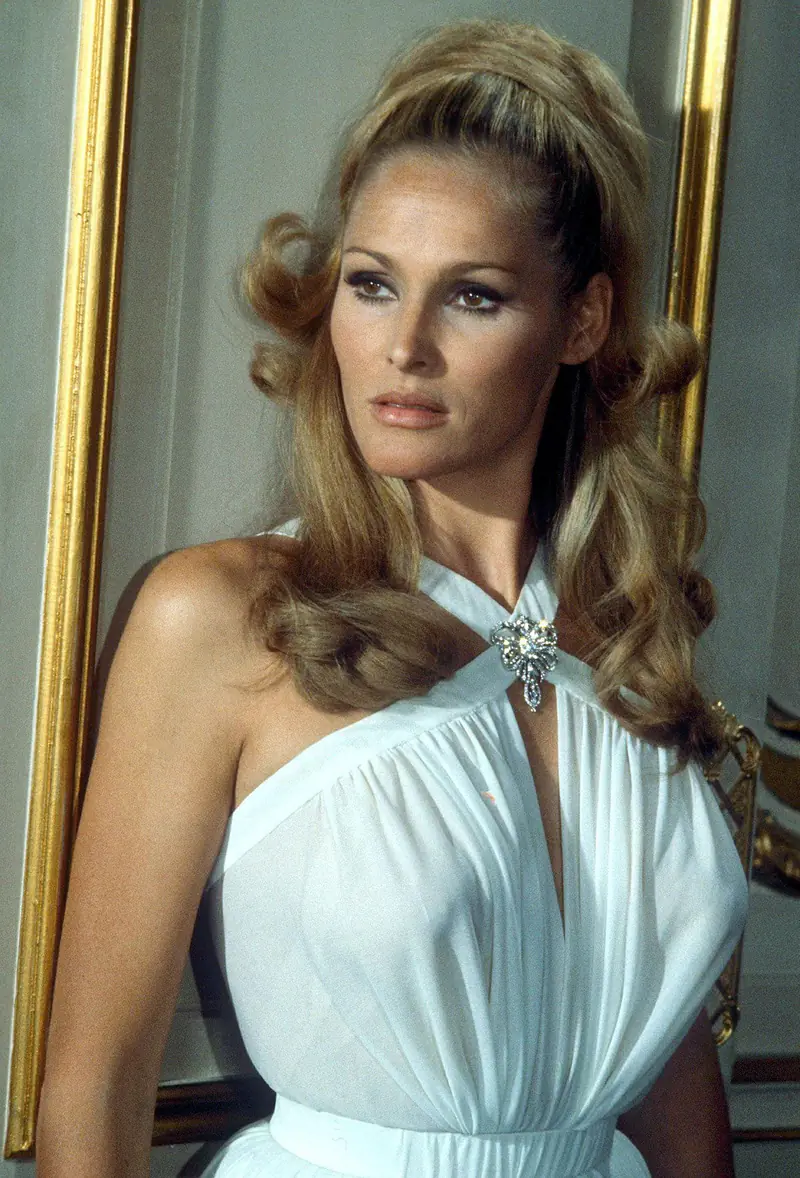
| 28 Quotes | |
| Occup. | Actress |
| From | Switzerland |
| Spouse | John Derek (1957-1966) |
| Born | March 19, 1936 Ostermundigen, Bern, Switzerland |
| Age | 89 years |
Ursula Andress was born on March 19, 1936, in Ostermundigen, near Bern, Switzerland, into a German-speaking Swiss family shaped by the war-shadowed 1940s. Her father, Rolf Andress, was a Swiss diplomat whose service and wartime experiences contributed to a home life marked by reserve, caution, and a pragmatic sense that security could vanish quickly. In that milieu, beauty was not yet a currency but a private attribute, and the young Andress learned early how to watch, wait, and keep parts of herself unspoken.
Switzerland offered stability but also a kind of provincial containment, and Andress - tall, striking, and quietly ambitious - felt the pull of elsewhere. The postwar European film world was rebuilding and expanding, with Rome and Paris becoming magnets for talent, and her adolescence coincided with a new international appetite for screen glamour. That tension between Swiss inwardness and continental spectacle would define her: an actress who became an icon, yet often spoke like someone standing slightly outside her own image.
Education and Formative Influences
She attended school in Bern and worked briefly in clerical jobs while taking early modeling and screen opportunities, but her true education came from movement: leaving Switzerland as a teenager for Italy and then wider Europe, learning languages, manners, and camera craft by immersion rather than conservatory training. In Rome, where Cinecitta helped export a modern, sunlit idea of Europe, she absorbed the era's visual grammar - the composed stillness, the emphasis on silhouette, the way a face could carry a scene even when dialogue could not.
Career, Major Works, and Turning Points
Andress began with small roles in European films in the mid-1950s, then moved to the United States and married actor-director John Derek in 1957, a relationship that placed her in Hollywood's orbit while also intensifying public scrutiny. Her watershed arrived with Dr. No (1962), where her entrance as Honey Ryder in a white bikini - emerging from the Caribbean surf - became one of cinema's most reproduced images and effectively set the template for the "Bond girl" as global brand. Subsequent work leaned into and sometimes battled that myth: adventure and spectacle in Fun in Acapulco (1963) and She (1965), a turn to European star vehicles, and a Golden Globe-winning pivot in Woody Allen's Casino Royale (1967), which used parody to show she could play the icon while winking at it. In the 1970s and 1980s she alternated between international productions and select roles, including a late-Bond echo opposite Sean Connery in Never Say Never Again (1983), while her private life - notably her partnership with actor Jean-Paul Belmondo and the birth of her son, Dimitri Hamlin, in 1980 - revealed a woman choosing intimacy on her own terms even as the industry preferred her as an emblem.
Philosophy, Style, and Themes
Andress' screen presence relied less on demonstrative acting than on controlled stillness - a poised, watchful minimalism that fit an era when images traveled faster than biographies. She understood that the camera could turn a body into a headline, yet she resisted the idea that she was performing seduction as technique: "I don't use my body to seduce, no. I just stand there". That sentence captures both her method and her psychology - a defensive simplicity, as if insisting that the spectacle was something done to her as much as something she did.
Fame, for Andress, often sounded like estrangement from her own reflection. "I'm always shocked when I see myself because I don't recognize myself". The remark reads like more than modesty; it suggests a lifelong split between the private Swiss self and the international pin-up that culture manufactured. In later years she spoke with similar disbelief about time and public numbering: "I suddenly find out that I'm 60, and I get shocked by the number, because I feel like I'm 20". Across decades, the same theme repeats - identity as something provisional, easily miscaptioned, with the inner life insisting on its own tempo even as the world assigns an age, a role, a label.
Legacy and Influence
Andress endures as one of the defining faces of 1960s international cinema, not simply because of a single famous shot but because that shot reframed how stardom could be exported - Swiss-born, European-made, Hollywood-amplified, and instantly legible worldwide. Her Honey Ryder entrance helped fix the visual language of modern franchise glamour, influencing casting, costume, and marketing for generations of action and spy films, while her career also offers a subtler legacy: a case study in how an actor can be simultaneously empowered by an image and made invisible behind it, negotiating autonomy in a system eager to reduce complex people to unforgettable silhouettes.
Our collection contains 28 quotes who is written by Ursula, under the main topics: Witty One-Liners - Life - Mortality - Success - Aging.
Other people realated to Ursula: David Niven (Actor), Harry Hamlin (Actor), George Peppard (Actor)
Source / external links