
Verne Troyer Biography Quotes 21 Report mistakes
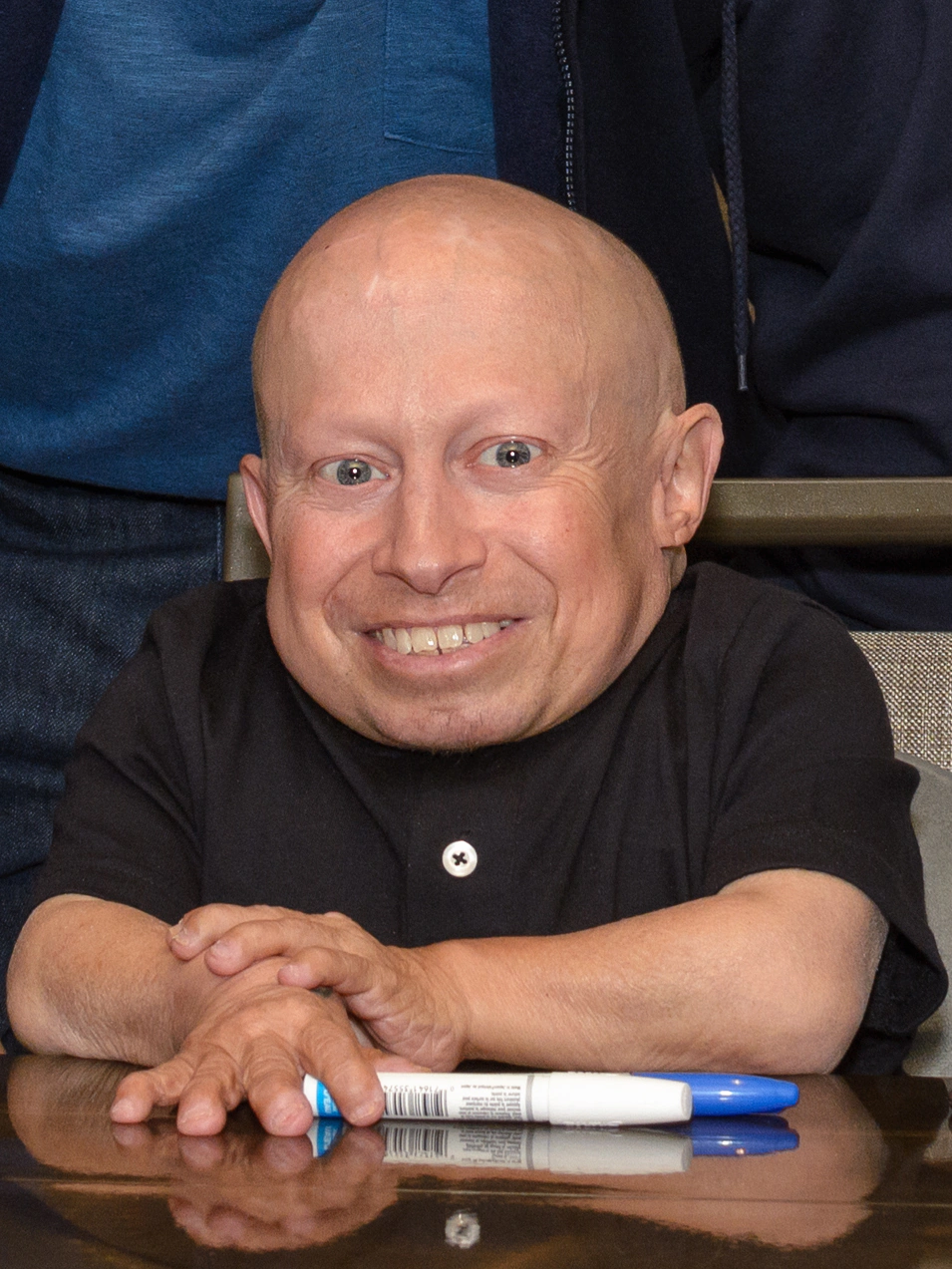
Attr: Rob DiCaterino, CC BY 2.0
| 21 Quotes | |
| Born as | Verne Jay Troyer |
|---|---|
| Occup. | Actor |
| From | USA |
| Born | January 1, 1969 Sturgis, Michigan, USA |
| Died | April 21, 2018 Los Angeles, California, USA |
| Cause | Suicide by Alcohol Intoxication |
| Aged | 49 years |
| Cite | |
Citation Formats
APA Style (7th ed.)
Verne troyer biography, facts and quotes. (2026, August 13). FixQuotes. https://fixquotes.com/actors/verne-troyer/
Chicago Style
"Verne Troyer biography, facts and quotes." FixQuotes. August 13, 2026. https://fixquotes.com/actors/verne-troyer/.
MLA Style (9th ed.)
"Verne Troyer biography, facts and quotes." FixQuotes, 13 Aug. 2026, https://fixquotes.com/actors/verne-troyer/. Accessed 10 Oct. 2026.
Early Life and Background
Verne Jay Troyer was born on January 1, 1969, in Sturgis, Michigan, and raised near Centreville in a conservative Midwestern farming community shaped by Amish and Mennonite values of work, privacy, and practical endurance. He was born with achondroplasia, a form of dwarfism, and grew up in a world not built for his body but quick to define him by it. His parents, Susan and Reuben Troyer, raised him alongside siblings in a household where chores, mechanical problem-solving, and self-reliance mattered more than self-dramatization. Rural life could be physically awkward for him, but it also trained the compact toughness, comic timing, and refusal of self-pity that would later become central to his public image.
That childhood was marked by contradiction. Troyer was visibly different in a small town where everyone knew everyone, yet familiarity could blunt cruelty and make difference ordinary. He later recalled, “I grew up in Michigan, in a very small town, Centreville. In my graduating class, I had like 92 people”. The remark sounds casual, but it reveals the scale of his early world: intimate, bounded, observant. In such a setting he learned to disarm attention before it turned hostile, to make spectators into companions, and to transform scrutiny into performance. Those instincts would become both an asset and a burden once Hollywood amplified them.
Education and Formative Influences
Troyer attended Centreville High School and later studied at Kellogg Community College, experiences that widened his social range without severing him from his working-class roots. He was drawn to athletics, especially wrestling culture, not because he fit conventional physical ideals but because he admired competitive grit and strategic use of leverage. He later said, “In high school and college, all my friends and my brother wrestled”. , a clue to the masculine environment that helped shape his appetite for physical challenge. Long before fame, he had developed unusual body control and a willingness to use his stature professionally. Like a number of performers with distinctive physiques, he entered entertainment through the industry's margins - stand-in work, body doubles, creature suits, and stunt assignments - learning film sets from the inside out before audiences knew his name.
Career, Major Works, and Turning Points
Troyer's early screen career emerged through specialty performance. In the 1990s he found work as a stunt performer and body double, including assignments connected to child-sized or fantastical characters that required precision rather than simple novelty. He appeared in films such as Baby's Day Out and developed a reputation for reliability in physically demanding work. The decisive turning point came in 1999 with Austin Powers: The Spy Who Shagged Me, where his role as Mini-Me - Dr. Evil's nearly silent miniature clone - turned him into an international pop-cultural figure. The character distilled many of Troyer's strengths: expressive physical comedy, alert reaction, menace mixed with innocence, and a willingness to weaponize audience assumptions. He reprised the role in Austin Powers in Goldmember, appeared in The Grinch, Bubble Boy, and reality television, and became a fixture of celebrity culture in the 2000s. Yet fame cut both ways. His image was widely recognized, but the industry's imagination often remained narrow, offering him versions of spectacle more often than fully dimensional roles. Offscreen, he faced public turmoil, struggles with alcohol, hospitalizations, and the strain of living as both person and meme in an era increasingly driven by tabloids and viral visibility. He died on April 21, 2018, at age forty-nine, after years of health and addiction battles that underscored the fragility behind the comic persona.
Philosophy, Style, and Themes
Troyer's screen style was built on compression: he could seize a scene with a glance, a sprint, a glare, or a sudden burst of aggression. Because dialogue was often secondary in his roles, he became a highly legible physical actor, closer in some respects to silent comedy or stunt performance than to conventional character acting. His own comments show how consciously he understood that craft. “I've done approximately 15 films, and most of the things I've done have either been stunt or costume work”. “Doing stunt work is risky, but it's something I enjoy”. These are not throwaway lines; they reveal a performer who saw himself less as a victim of typecasting than as a worker mastering a specialized, demanding form. His body was never merely an object of display. It was an instrument he trained, protected, and repeatedly put on the line.
At the same time, Troyer's psychology seems to have been marked by a tension between gratitude and confinement. “I just take it one day at a time. Austin Powers has given me a lot of opportunities as far as my career”. The sentence is modest, but "one day at a time" also carries the cadence of someone managing instability, trying to convert overwhelming visibility into manageable increments. He embraced the doors fame opened, yet the very role that liberated him could also fix him in public consciousness. His best performances played with that trap: he was cute and threatening, absurd and disciplined, comic and strangely dignified. The theme running through his career is agency under conditions of reduction - how to remain an actor, worker, and person when the market prefers an instantly legible novelty.
Legacy and Influence
Verne Troyer's legacy rests not only on Mini-Me, though that creation remains one of the most indelible comic figures of late-1990s studio comedy. It also lies in how he exposed the mechanics of visibility in modern entertainment: who gets seen, on what terms, and at what psychic cost. He expanded the space for actors with dwarfism while also showing how incomplete that expansion remained. Colleagues remembered his professionalism, generosity, and fearlessness on set; audiences remembered the explosive hilarity of a performer who could dominate a frame without saying much at all. His life, viewed whole, resists sentimental simplification. It was a story of discipline, invention, exploitation, resilience, and pain - a distinctly American passage from rural obscurity to global recognizability, and a reminder that celebrity can magnify talent while consuming the person who supplies it.
Last updated August 2026 · Editorial standards
Our collection contains 21 quotes written by Verne, under the main topics: Witty One-Liners - Funny - Puns & Wordplay - Life - Movie.
Source / external links