
Will Rogers Biography Quotes 100 Report mistakes
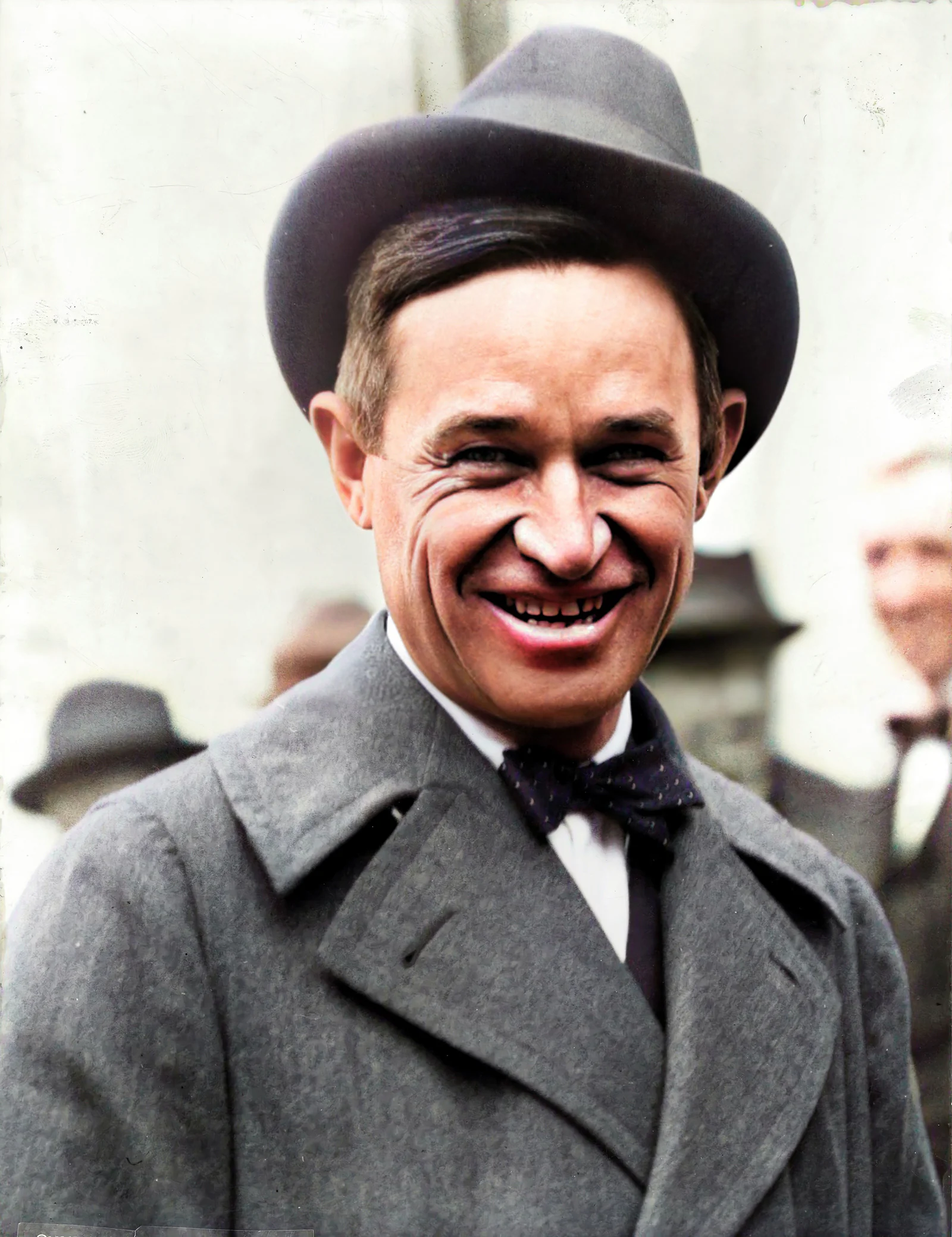
Attr: Underwood & Underwood
| 100 Quotes | |
| Born as | William Penn Adair Rogers |
| Occup. | Actor |
| From | USA |
| Born | November 4, 1879 Oologah, Indian Territory, United States |
| Died | August 15, 1935 Point Barrow, Alaska, United States |
| Cause | Plane Crash |
| Aged | 55 years |
| Cite | |
Citation Formats
APA Style (7th ed.)
Will rogers biography, facts and quotes. (2026, February 2). FixQuotes. https://fixquotes.com/actors/will-rogers/
Chicago Style
"Will Rogers biography, facts and quotes." FixQuotes. February 2, 2026. https://fixquotes.com/actors/will-rogers/.
MLA Style (9th ed.)
"Will Rogers biography, facts and quotes." FixQuotes, 2 Feb. 2026, https://fixquotes.com/actors/will-rogers/. Accessed 5 Mar. 2026.
Early Life and Background
William Penn Adair Rogers was born on November 4, 1879, on the Dog Iron Ranch near Oologah in Indian Territory (later Oklahoma), into a Cherokee family whose standing was both political and precarious. His father, Clement Vann Rogers, was a rancher, trader, and later a territorial politician; his mother, Mary America Schrimsher, died when Will was still young, leaving him with an early sense of loss and an ingrained habit of turning feeling into performance rather than confession. Growing up among ranch hands, horse traders, and Cherokee neighbors, he learned that reputation traveled faster than truth and that humor could cross boundaries that argument could not.The frontier around him was not merely scenery but a moral training ground. The closing of the open range, the pressure of allotment and statehood, and the mingling of cultures in Indian Territory gave him a lifelong sensitivity to ordinary people being talked over by distant power. He absorbed the rhythms of speech, the quiet hierarchies of work, and the way community judgment was delivered as a joke before it hardened into condemnation. That early mix of insecurity and belonging shaped the public persona that later seemed effortless: the plainspoken man who sounded like the crowd and then slipped a needle under the skin.
Education and Formative Influences
Rogers attended local schools in Indian Territory and briefly studied at institutions including Kemper Military School in Boonville, Missouri, but formal education never held him as strongly as skills you could prove with your hands. He became an expert roper and rider, steeped in Wild West show craft, newspaper humor, and the older American tradition of the homespun moralist. By his late teens he was traveling, chasing work and widening his sense of what the nation looked like beyond the ranch gate - a country of boosters, hustlers, and anxious strivers hungry for a voice that felt trustworthy.Career, Major Works, and Turning Points
After working with ranches and riding exhibitions, Rogers entered show business through roping acts and soon found that talk - offhand, reactive, and sharp - was the real attraction. He toured internationally with circus and vaudeville, then broke through in the Ziegfeld Follies on Broadway, where his improvised monologues and lariat tricks turned current events into intimate conversation. By the 1920s he was a major film star, transitioning smoothly from silent pictures to sound, and a national columnist whose syndicated pieces, radio appearances, and public lectures made him one of the most recognized Americans of his era. His turning point was the discovery that fame could be used as a civic instrument: he traveled widely, commented on presidents and policies without sounding like a scold, and became a steadying voice during the boom-and-bust cycle that culminated in the Great Depression. In 1935, while traveling in Alaska with aviator Wiley Post, he died in a plane crash near Point Barrow (Utqiagvik) on August 15, cutting short a career that had become a kind of informal national office.Philosophy, Style, and Themes
Rogers built a philosophy out of modesty performed as strategy. He cultivated the pose of the well-meaning citizen who might be wrong, which disarmed audiences long enough for him to tell them what they were refusing to see. “All I know is just what I read in the papers, and that's an alibi for my ignorance”. The line is not just self-deprecation; it is a diagnosis of mass democracy in the age of syndicated news, when people outsourced certainty to headlines and then mistook that certainty for knowledge. By playing ignorant, he exposed the ways power hid behind jargon and the ways voters hid behind tribal loyalty.His humor leaned on paradox and timing - a gentle drawl carrying a hard verdict. He distrusted panic, especially the kind marketed for profit or politics, and he treated emotional self-control as a civic virtue: “Don't let yesterday use up too much of today”. Even his jokes about money and markets functioned as moral instruction, mocking speculative bravado while sympathizing with the small saver trying not to be fooled: “Don't gamble; take all your savings and buy some good stock and hold it till it goes up, then sell it. If it don't go up, don't buy it”. The gag lands because it is impossible advice - and because it reveals how American optimism can be exploited by anyone selling certainty.
Legacy and Influence
Rogers left behind more than a filmography and a shelf of collected columns; he modeled a democratic style of truth-telling that later comedians and broadcasters would mine for a century: criticism delivered as neighborly talk, skepticism softened by affection, and politics treated as a shared human problem rather than a purity test. In an era of rapid modernization, he preserved the voice of the range while interpreting radio, movies, and mass news for millions, becoming a bridge between frontier memory and modern celebrity. His enduring influence lies in the blend: a performer whose jokes carried an ethic, and an ethic that survived because it arrived as entertainment.Our collection contains 100 quotes written by Will, under the main topics: Witty One-Liners - Motivational - Truth - Mortality - Sarcastic.
Other people related to Will: Florenz Ziegfeld (Producer)
Source / external links