
Brian Eno Biography Quotes 42 Report mistakes
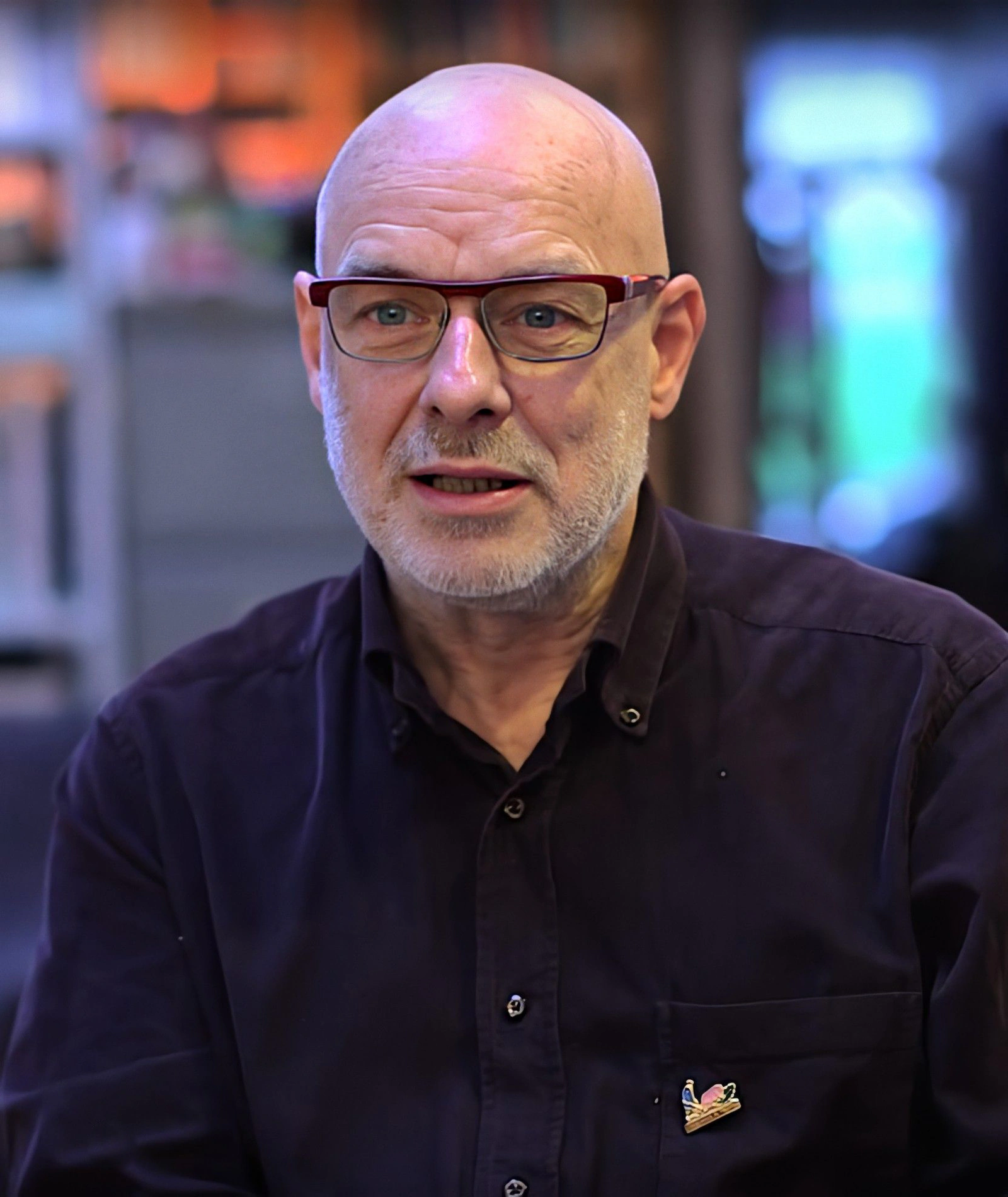
Attr: How We Get To Next, CC BY 3.0
| 42 Quotes | |
| Born as | Brian Peter George St John le Baptiste de la Salle Eno |
| Occup. | Musician |
| From | United Kingdom |
| Born | May 15, 1948 Suffolk, England |
| Age | 77 years |
| Cite | |
Citation Formats
APA Style (7th ed.)
Brian eno biography, facts and quotes. (2026, February 11). FixQuotes. https://fixquotes.com/artists/brian-eno/
Chicago Style
"Brian Eno biography, facts and quotes." FixQuotes. February 11, 2026. https://fixquotes.com/artists/brian-eno/.
MLA Style (9th ed.)
"Brian Eno biography, facts and quotes." FixQuotes, 11 Feb. 2026, https://fixquotes.com/artists/brian-eno/. Accessed 25 Mar. 2026.
Early Life and Background
Brian Peter George St John le Baptiste de la Salle Eno was born on 1948-05-15 in the East Anglian town of Melton, Suffolk, United Kingdom, into a Catholic family shaped by postwar austerity and the quiet, stubborn self-invention of provincial England. The landscapes of flat fields, big skies, and seaside weather were not merely backdrop - they became an early template for his later fascination with atmosphere, drift, and the way sound behaves in space rather than on a stage.In the 1950s and early 1960s, British popular culture was reorganizing itself around radio, singles, art schools, and the widening availability of recording technology, yet for many households the tools of sonic experimentation remained rare. Eno grew up amid church music, school discipline, and the emerging shock of televised modernity; he learned early that identity could be manufactured, swapped, and performed. That tension - between a strict moral frame and a playful appetite for artifice - would later surface in his public persona as both conceptualist and pop musician, always half inside the spotlight and half resisting it.
Education and Formative Influences
Eno studied at Ipswich Art School and later Winchester School of Art, where British art education encouraged cross-pollination: minimalism, Fluxus attitudes, systems-based thinking, and a skepticism toward virtuosity. The art-school ethos treated studios like laboratories and valued process over polish; Eno absorbed the idea that one could design conditions for art to happen rather than author every note. He encountered experimental composers and the emerging logic of generative systems, while also noticing how studios, amplifiers, and tape could turn accidents into aesthetic decisions - an outlook that prepared him to treat recording itself as an instrument.Career, Major Works, and Turning Points
In the early 1970s Eno became known as Roxy Music's flamboyant "non-musician" manipulator of tape effects and synthesizers, helping define a new British glam modernism before leaving in 1973 as internal pressures grew. His solo records - Here Come the Warm Jets (1974), Taking Tiger Mountain (By Strategy) (1974), Another Green World (1975) - pivoted from art-rock songcraft toward textural composition; Discreet Music (1975) and Ambient 1: Music for Airports (1978) effectively named and codified "ambient" as a public genre. Parallel work as producer and collaborator made him a hinge figure: with David Bowie on the Berlin-era albums, with Talking Heads on Remain in Light (1980), with U2 on The Unforgettable Fire and The Joshua Tree, and in countless studio interventions where his methods - Oblique Strategies, chance operations, constraint-based prompts - changed how rock and pop could be built. Later projects extended to installations, generative software pieces, and long-form collaborations (including with Harold Budd and, later, Jon Hopkins), keeping him at the edge where composition, design, and technology blur.Philosophy, Style, and Themes
Eno's inner life reads as a sustained negotiation with attention: what it means to listen, to choose, and to relinquish control. He repeatedly framed creativity as environment-building rather than heroic expression, and his discomfort with celebrity was not coyness but a practical aesthetic stance. “I felt extremely uncomfortable as the focal point, in the spotlight. I really like the behind the scenes role, because all my freedom is there”. The statement doubles as biography and method: from production rooms, he could steer outcomes through nudges, constraints, and sonic architecture without hardening into an idol who must repeat himself.His work treats songs and records as systems that can be sketched, populated, and left to develop - a designer's mindset applied to sound. “I'm not interested in possible complexities. I regard song structure as a graph paper”. That line points to his preference for clear frameworks that invite unpredictable detail, the same logic behind his ambient music: stable grids, shifting textures, and room for the listener's mind to complete the piece. At the same time, he resisted the reduction of music to mere instruction sets or technical labor, critiquing human-computer hierarchies: “The basis of computer work is predicated on the idea that only the brain makes decisions and only the index finger does the work”. In Eno's universe, hands, rooms, machines, and accidents all "decide" together; authorship is distributed, and meaning comes from interaction, not dominance.
Legacy and Influence
Eno's enduring influence lies less in any single sound than in a portable way of thinking: treat the studio as compositional space, use constraints to unlock invention, and value atmosphere as structure. He helped legitimize ambient music as a serious form, reshaped late-20th-century rock production, and quietly rewired the ambitions of electronic music, post-rock, and modern scoring by proving that subtlety can be radical. In an era increasingly defined by algorithms, playlists, and background listening, his best work remains a rigorous argument that "background" can be intentional, emotionally complex, and socially transformative - a music of designed conditions that keeps granting listeners permission to hear differently.Our collection contains 42 quotes written by Brian, under the main topics: Art - Music - Nature - Deep - Change.
Other people related to Brian: Robert Fripp (Musician), Bryan Ferry (Musician), Fred Frith (Composer), Gavin Bryars (Composer), Chris Martin (Musician), Jerry Harrison (Musician), Arto Lindsay (Musician)
Source / external links