
Buddy Holly Biography Quotes 4 Report mistakes
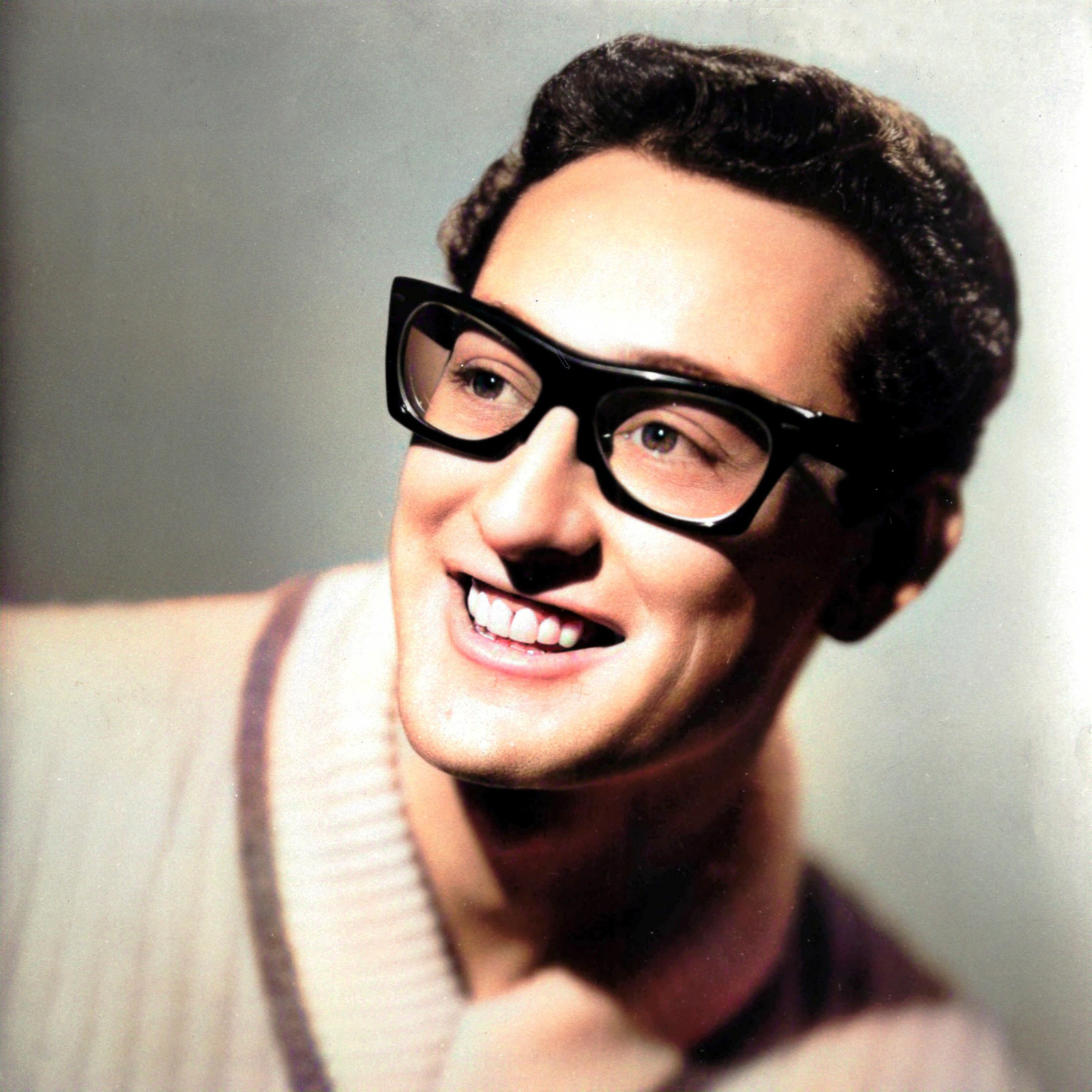
| 4 Quotes | |
| Born as | Charles Hardin Holley |
| Occup. | Musician |
| From | USA |
| Spouse | Maria Elena Santiago |
| Born | September 7, 1936 Lubbock, Texas, USA |
| Died | February 3, 1959 Clear Lake, Iowa, USA |
| Cause | Plane crash |
| Aged | 22 years |
| Cite | |
Citation Formats
APA Style (7th ed.)
Buddy holly biography, facts and quotes. (2026, February 11). FixQuotes. https://fixquotes.com/artists/buddy-holly/
Chicago Style
"Buddy Holly biography, facts and quotes." FixQuotes. February 11, 2026. https://fixquotes.com/artists/buddy-holly/.
MLA Style (9th ed.)
"Buddy Holly biography, facts and quotes." FixQuotes, 11 Feb. 2026, https://fixquotes.com/artists/buddy-holly/. Accessed 12 Feb. 2026.
Early Life and Background
Charles Hardin Holley was born on September 7, 1936, in Lubbock, Texas, the fourth child of Lawrence Odell "L.O". Holley and Ella Pauline Drake Holley. The Texas Panhandle in the Depression and wartime years was a place of church socials, radio barn dances, and hard-working families, and the Holleys fit the mold: modest means, close-knit kin, and music as both pastime and social glue. The boy who would later trim the surname to "Holly" grew up hearing country, western swing, gospel, and the clean harmonies that traveled over AM radio, absorbing a vernacular musical vocabulary that would later surface in his clipped phrasing and bright chord changes.Lubbock was also a frontier town for postwar youth culture. By the early 1950s, rhythm and blues filtered into Texas through records and touring bands, and a new teen marketplace formed around jukeboxes, school dances, and local radio. Holly learned early that performance was a kind of citizenship - you proved yourself, you got invited back - and that a band was a small republic held together by timing, humor, and reliability. That early sense of music as work, not mysticism, shaped his later discipline in the studio and his instinct for arrangements that sounded effortless while being tightly engineered.
Education and Formative Influences
Holly attended Lubbock High School, where he played guitar and developed a stage presence that mixed shyness with practiced charm. He partnered with classmate Bob Montgomery as "Buddy and Bob", drawing on country duet traditions while experimenting with the new electric sound. His ear was widened by the era's crosscurrents: Hank Williams and bluegrass flatpicking alongside R&B grooves, and especially the shock of Elvis Presley appearing as both a regional phenomenon and a national rupture. As the postwar recording industry consolidated, a teenager in West Texas could suddenly imagine a route from local dance halls to radio, and Holly pursued it with a seriousness that belied his youthful look.Career, Major Works, and Turning Points
After early recordings and regional gigs, Holly's career accelerated in 1957 when he recorded in Clovis, New Mexico, at Norman Petty's studio, a pragmatic, innovative room where limitations became signature sound. Under the name Buddy Holly and the Crickets, he scored a run of defining singles: "That'll Be the Day", "Peggy Sue", "Oh, Boy!", "Not Fade Away", and the luminous ballad "Everyday". He helped normalize the self-contained rock group - two guitars, bass, drums - and his writing, guitar work, and arranging showed unusual control for a 20-year-old. In 1958 he married Maria Elena Santiago and moved toward New York, seeking autonomy from management and a broader musical life; the transition brought financial strain and band tensions, but also ambitious late recordings such as "True Love Ways" and "Raining in My Heart". On February 3, 1959, after a show in Clear Lake, Iowa, he chartered a small plane to outrun a brutal tour schedule; it crashed near Mason City, killing Holly, Ritchie Valens, and J.P. "The Big Bopper" Richardson - a sudden end that froze his image at the moment his artistry was expanding.Philosophy, Style, and Themes
Holly's inner life reads as a blend of small-town steadiness and modern restlessness. He believed in professionalism - in showing up, staying presentable, and winning access to adult spaces that still distrusted rock and roll. "If anyone asks you what kind of music you play, tell him 'pop.' Don't tell him 'rock'n'roll' or they won't even let you in the hotel". The line is more than a joke about gatekeepers; it reveals a strategic temperament, a young artist navigating prejudice with a salesman's tact, determined to keep doors open for the band and, by extension, for the music.Stylistically, Holly fused country clarity with R&B propulsion, then polished it with studio imagination: hiccupped vocal attacks, sudden stops, close harmonies, and guitar figures that functioned like hooks. He rarely sounded like he was performing rebellion; instead he sounded like he was building something, brick by brick, in public. His respect for the first wave of rock celebrity was candid and unsentimental: "Without Elvis none of us could have made it". That acknowledgment maps his psychology - competitive yet grateful, ambitious yet aware of lineage - and it aligns with his themes, which circle adolescence not as chaos but as a precise emotional science: longing, elation, jealousy, devotion, all compressed into two and a half minutes and delivered with a voice that could turn vulnerability into rhythm.
Legacy and Influence
Holly's influence is structural as much as stylistic: the idea of a band writing and playing its own material, the guitar-led arrangement with drummer as engine, the studio as instrument, the singer as auteur. The Beatles drew directly from him - from harmonies to the Crickets' very name - while later artists from the Rolling Stones to power-pop and punk acts borrowed his economy, his bright aggression, and his trust in melody. His death at 22 sealed a myth, but the enduring power lies in the work: recordings that sound like the future arriving early, made by a musician who treated pop as craft, and craft as a route to freedom.Our collection contains 4 quotes written by Buddy, under the main topics: Dark Humor - Music - Writing.
Other people related to Buddy: George Harrison (Musician), Waylon Jennings (Musician), Gary Busey (Actor), Bo Diddley (Musician), Gordon Waller (Musician), Don McLean (Musician), Paul Anka (Musician)
Source / external links