
Chuck Berry Biography Quotes 3 Report mistakes
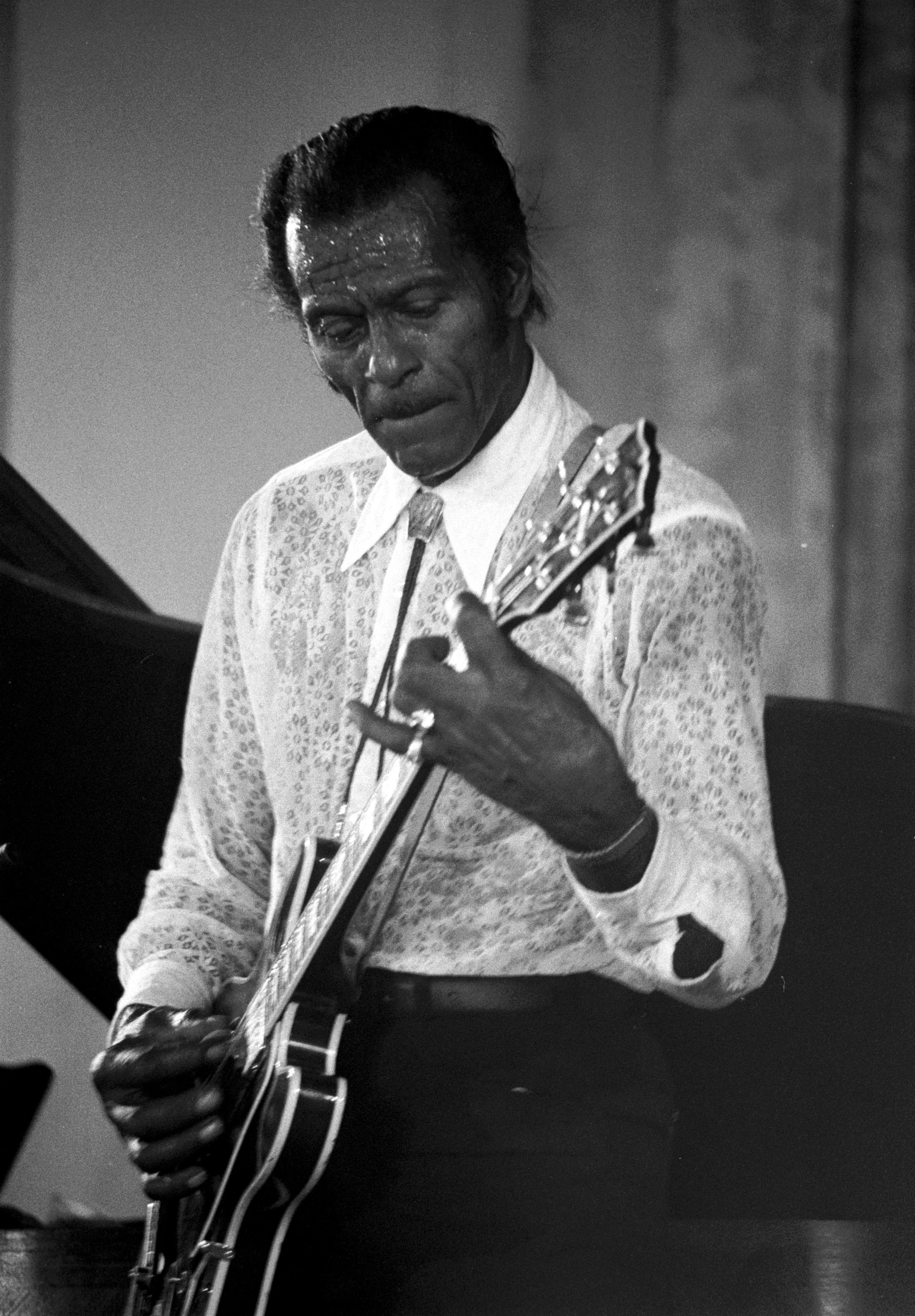
| 3 Quotes | |
| Born as | Charles Edward Anderson Berry |
| Occup. | Musician |
| From | USA |
| Born | October 18, 1926 St. Louis, Missouri, U.S. |
| Age | 99 years |
| Cite | |
Citation Formats
APA Style (7th ed.)
Chuck berry biography, facts and quotes. (2026, February 11). FixQuotes. https://fixquotes.com/artists/chuck-berry/
Chicago Style
"Chuck Berry biography, facts and quotes." FixQuotes. February 11, 2026. https://fixquotes.com/artists/chuck-berry/.
MLA Style (9th ed.)
"Chuck Berry biography, facts and quotes." FixQuotes, 11 Feb. 2026, https://fixquotes.com/artists/chuck-berry/. Accessed 12 Feb. 2026.
Early Life and Family
Charles Edward Anderson Berry was born on October 18, 1926, in St. Louis, Missouri, and grew up in the city's vibrant Black middle-class neighborhood known as The Ville. His father, Henry Berry, was a contractor and church deacon, and his mother, Martha, was a schoolteacher; the family's emphasis on discipline, education, and faith shaped his early outlook. At Sumner High School he showed an aptitude for performance, picking up the guitar and performing popular songs for classmates. A brush with the law as a teenager led to time in a reformatory, an experience he later recalled as sobering and formative. In 1948 he married Themetta "Toddy" Suggs, whose support anchored him as he balanced family life with an emerging musical career.Beginnings in Music
After working a series of jobs to support his young family, Berry began performing around St. Louis in small clubs. He gravitated to a combo led by pianist Johnnie Johnson, whose blues-based playing style meshed with Berry's crisp guitar attack. The two developed a conversational interplay that would become central to Berry's best records; Johnson's piano fills and Berry's chattering double-stops sounded like a dialogue. Berry listened closely to T-Bone Walker for guitar phrasing and to Nat King Cole for vocal poise, and he sharpened a stagecraft that already included the famous "duck walk".Breakthrough and Chess Records
In 1955, during a visit to Chicago, blues star Muddy Waters advised Berry to see Leonard Chess at Chess Records. Berry arrived with a reworked country tune inspired by "Ida Red". Retitled "Maybellene", and recorded with key Chicago players such as bassist Willie Dixon and drummer Fred Below, the track burst with speed, teenage romance, and car-culture imagery. Radio personality Alan Freed championed the single, helping it become a national hit. With the support of Leonard and Phil Chess, Berry set off on a run of defining records: "Roll Over Beethoven", "School Day", "Rock and Roll Music", "Sweet Little Sixteen", "Johnny B. Goode", "Carol", "Memphis, Tennessee", and "Back in the U.S.A". Each fused blues harmony, country twang, and swinging backbeats into compact stories that teenagers across America recognized as their own.Songwriting, Guitar Style, and Stagecraft
Berry's songwriting distilled American adolescence into sharp, cinematic scenes: lockers slamming, radios blaring, highways stretching to the horizon. His guitar lines, built from ringing double-stops and nimble bends, set a template later copied by Keith Richards, George Harrison, and countless garage-band players. He aimed his words at youth and possibility, but the precision of his rhyme and meter showed a craftsman's ear. On stage he turned his shows into theater, cueing the band with kicks and glances, duck-walking across the floor, and teasing the crowd with stop-time breaks before detonating back into full swing. The interplay with Johnnie Johnson remained crucial, even as Berry's records sometimes featured Chess session pianists; the piano-and-guitar weave became a signature of the Chess sound.Legal Troubles and Career Resilience
Success brought scrutiny. In 1960 Berry was arrested under the Mann Act and, after controversial proceedings, served a prison term in the early 1960s. He emerged to find the musical landscape changed, yet his catalog had only grown in stature. In the late 1970s he again served time, this time for tax-related offenses. The legal setbacks interrupted touring but did not erase his reputation or his drawing power. Across the decades he often relied on local pickup bands, an approach that once had a young Bruce Springsteen and his group backing him, bringing his show to towns large and small with minimal rehearsal and maximal energy.Global Influence and Collaborations
Berry's songs became a lingua franca of the rock era. The Beatles, led by John Lennon and Paul McCartney, covered his material on early records and radio sessions. The Rolling Stones, with Mick Jagger and Keith Richards at the helm, built their first sets around Berry tunes; Richards would later serve as musical director for a 1986 celebration of Berry's music that became the film Hail! Hail! Rock 'n' Roll, with guests including Eric Clapton and Etta James. Brian Wilson drew heavily from "Sweet Little Sixteen" to craft "Surfin' U.S.A.", a testament to Berry's melodic architecture. The ripple effects stretched from London clubs to American garages, and even into space: "Johnny B. Goode" was placed on the Voyager Golden Record in 1977 as an emblem of human musical achievement.Later Career and Recognition
Berry recorded for Mercury Records in the late 1960s and returned to Chess in the 1970s. Unexpectedly, "My Ding-a-Ling" topped the U.S. charts in 1972, his only Billboard Hot 100 No. 1, demonstrating the breadth of his audience. Honors accumulated: a Grammy Lifetime Achievement Award in 1984 and induction as a charter member of the Rock and Roll Hall of Fame in 1986 affirmed his foundational role. He continued to tour relentlessly, and in his hometown he performed regularly at Blueberry Hill, a St. Louis landmark. Even in later years, audiences came to hear the opening lick of "Johnny B. Goode" and the shuffle that powered "No Particular Place to Go", delivered with the economy and showmanship that defined his approach.Personal Life and Character
Berry's marriage to Themetta "Toddy" Suggs endured through upheavals, and their family life remained largely private. His working relationships could be intense; disputes over credit strained ties, notably with Johnnie Johnson, though their musical kinship was undeniable. With producers like Leonard Chess and bandmates such as Willie Dixon and Fred Below, he forged a studio method that balanced spontaneity with craft. He managed his business affairs with a hard-nosed independence, booking gigs on his terms and often insisting on cash payment, a practice that became part of his legend and, at times, his legal troubles.Legacy
Chuck Berry's synthesis of blues feeling, country clarity, and urbane wit created the grammar of rock and roll. He gave the music its archetypal hero in "Johnny B. Goode", its self-referential anthem in "Rock and Roll Music", and its teenage diary in "School Day". Guitarists learned his licks as a rite of passage; songwriters studied his verses for their internal rhymes and narrative drive. Artists from John Lennon to Keith Richards have called him the poet laureate and the architect of the form. When he died on March 18, 2017, near St. Louis, tributes emphasized not only the catalog of hits but the worldview inside them: optimistic, propulsive, and democratic. His records remain the common ground where blues, country, and the modern backbeat meet, and where the voices of Leonard and Phil Chess, Johnnie Johnson, Willie Dixon, and so many others can still be heard in chorus with his own.Our collection contains 3 quotes written by Chuck, under the main topics: Music - Learning - Learning from Mistakes.
Other people related to Chuck: Tom Petty (Musician), Johnny Rivers (Musician), Taylor Hackford (Director), George Thorogood (Musician), George Benson (Musician)
Source / external links