
David Byrne Biography Quotes 33 Report mistakes
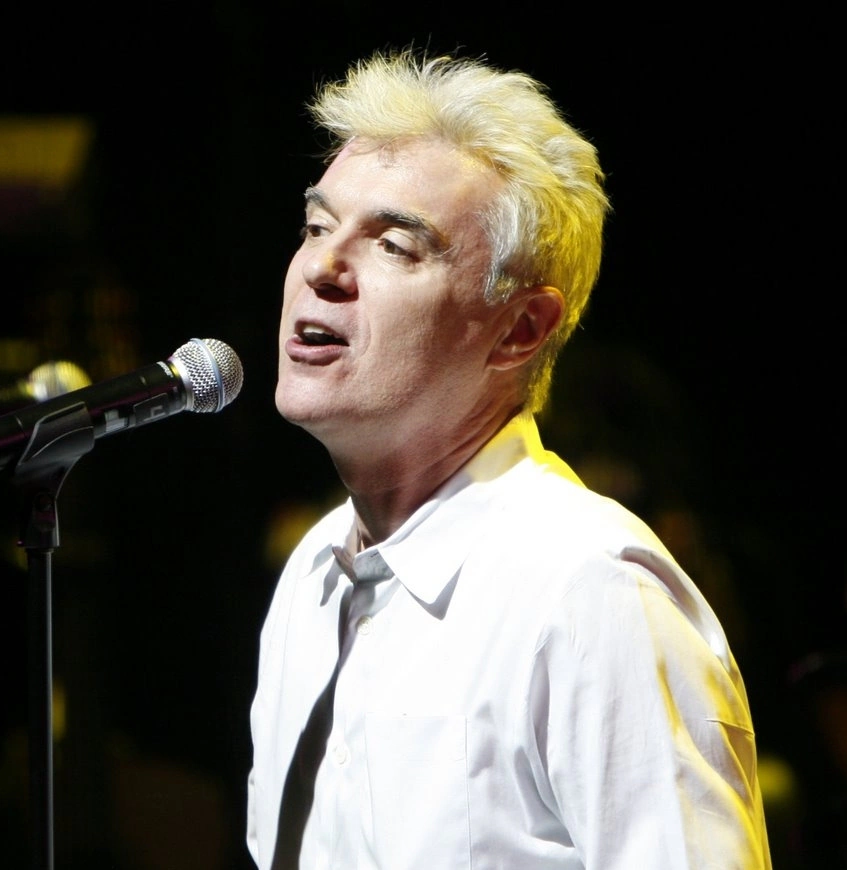
| 33 Quotes | |
| Occup. | Musician |
| From | Scotland |
| Born | March 14, 1952 Dumbarton, Scotland, UK |
| Age | 73 years |
| Cite | |
Citation Formats
APA Style (7th ed.)
David byrne biography, facts and quotes. (2026, February 11). FixQuotes. https://fixquotes.com/artists/david-byrne/
Chicago Style
"David Byrne biography, facts and quotes." FixQuotes. February 11, 2026. https://fixquotes.com/artists/david-byrne/.
MLA Style (9th ed.)
"David Byrne biography, facts and quotes." FixQuotes, 11 Feb. 2026, https://fixquotes.com/artists/david-byrne/. Accessed 5 Mar. 2026.
Early Life and Background
David Byrne was born on March 14, 1952, in Dumbarton, Scotland, into a postwar Britain still marked by ration-memory austerity and a cautious social order. His early world was both tight-knit and unsettled: when he was a small child his family emigrated, part of a larger mid-century current of Atlantic moves that carried ambition and unease in equal measure.He grew up largely in the United States, with formative years in Maryland, learning early the double vision of an outsider who can study a culture as if it were a system of signs. That stance - alert to accents, rituals, and the choreography of ordinary life - would later become a signature: songs that sound like overheard conversations, performances that treat stage behavior as both expression and experiment. Even before fame, Byrne was known for a watchful intensity, less a confessional romantic than an observer of how people perform themselves.
Education and Formative Influences
Byrne attended the Rhode Island School of Design in the late 1960s, an environment that blurred fine art, design, and pop, but he left before graduating, restless with institutional frames. The art-school lens stayed: he absorbed conceptual strategies, collage thinking, and an interest in systems - architecture, signage, consumer language - while listening widely, from rock to funk to the rising downtown New York underground. That mix primed him to treat music not only as sound but as staging, image, and social anthropology.Career, Major Works, and Turning Points
In 1975 Byrne co-founded Talking Heads in New York City with Tina Weymouth and Chris Frantz, soon joined by Jerry Harrison; they emerged from the CBGB circuit alongside punk and new wave but insisted on their own angles of rhythm and intellect. Albums such as Talking Heads: 77, More Songs About Buildings and Food, Fear of Music, and Remain in Light tracked a steep evolution - from nervous minimalism to dense, polyrhythmic groove - fueled by collaborations with producer Brian Eno and an expanding fascination with African and Afro-diasporic patterns. The 1983 concert film Stop Making Sense, directed by Jonathan Demme, turned Byrne into an emblem of art-rock performance, its "big suit" becoming both joke and thesis. Parallel work widened his range: the My Life in the Bush of Ghosts experiment with Eno, film and theater pieces, and a solo career that moved between pop songwriting, world-music curiosity, and gallery-adjacent projects, while later decades brought major-stage reinvention with American Utopia and its acclaimed Broadway and film incarnations.Philosophy, Style, and Themes
Byrne's inner life reads as a continuous negotiation between control and surrender. He can appear cerebral, even clinical, yet his best work is body-first: grooves that make the listener move while the lyrics ask why we move the way we do. He often treats identity as a costume and the self as a role one can step into, a sensibility he has stated plainly: “I try never to wear my own clothes, I pretend I'm someone else”. That line is not mere style-talk; it describes a psychological strategy - distance that enables candor. By displacing "David Byrne" into a character, he can expose anxiety, desire, and social rules without the usual rock-star confession.His art also registers a moral suspicion of mass culture's flattening pressures, paired with a collector's love of difference. He came of age when downtown scenes rewarded specificity, and he has remembered the period as an ecosystem of distinct voices: “Television sounded really different than the Ramones sounded really different than us sounded really different than Blondie sounded really different than the Sex Pistols”. The refusal of sameness becomes an ethic in his production choices, his interest in non-Western rhythmic structures, and his insistence that presentation matters as much as melody. That suspicion persists as anxiety about cultural convergence: “I'm afraid that everything will get homogenized and be the same”. In Byrne, the fear is productive - it drives him toward hybrid forms, toward collaboration, and toward a perpetual beginner's mind in which curiosity is a defense against the deadening certainty of genre.
Legacy and Influence
Byrne helped redefine what a rock musician could be: part bandleader, part conceptual artist, part ethnographer of modern life. Talking Heads proved that intellectual rigor and danceable music could share the same room, and Stop Making Sense remains a master class in how stagecraft can clarify, rather than distract from, musical ideas. His later work - from label curation and visual art to American Utopia's communal, democratic vision of the band-as-society - extended that influence into theater and contemporary performance. Across five decades he has modeled a career built not on a single persona but on reinvention, leaving behind a blueprint for artists who want to think structurally, move physically, and keep difference alive.Our collection contains 33 quotes written by David, under the main topics: Witty One-Liners - Truth - Art - Justice - Friendship.
Other people related to David: Tina Weymouth (Musician), Bernie Worrell (Musician)
Source / external links