
Elvis Presley Biography Quotes 57 Report mistakes
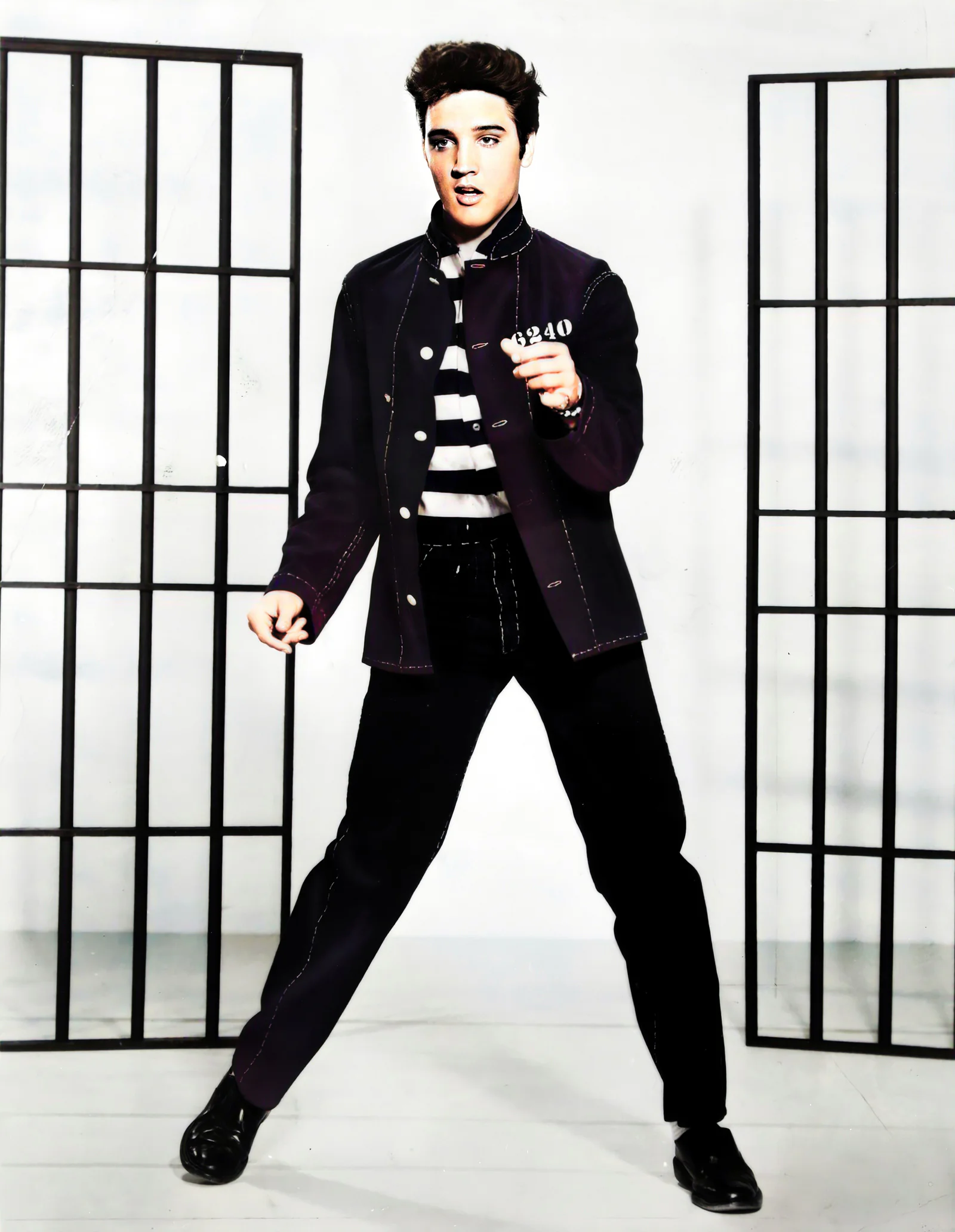
Attr: Metro-Goldwyn-Mayer
| 57 Quotes | |
| Born as | Elvis Aaron Presley |
| Occup. | Musician |
| From | USA |
| Born | January 8, 1935 Tupelo, Mississippi, USA |
| Died | August 16, 1977 Memphis, Tennessee, USA |
| Cause | Cardiac arrhythmia |
| Aged | 42 years |
| Cite | |
Citation Formats
APA Style (7th ed.)
Elvis presley biography, facts and quotes. (2026, February 1). FixQuotes. https://fixquotes.com/artists/elvis-presley/
Chicago Style
"Elvis Presley biography, facts and quotes." FixQuotes. February 1, 2026. https://fixquotes.com/artists/elvis-presley/.
MLA Style (9th ed.)
"Elvis Presley biography, facts and quotes." FixQuotes, 1 Feb. 2026, https://fixquotes.com/artists/elvis-presley/. Accessed 12 Feb. 2026.
Early Life and Background
Elvis Aaron Presley was born on January 8, 1935, in Tupelo, Mississippi, during the hard years of the Great Depression. He arrived a twin, but his brother Jesse Garon was stillborn, a loss that haunted the family story and deepened the protective bond between Elvis and his parents, Vernon and Gladys. They moved through a landscape of debt, odd jobs, and Pentecostal church life, where gospel music offered both structure and release. From early on, he absorbed sound the way other children absorbed rules - as atmosphere, emotion, and promise.In 1948 the Presleys relocated to Memphis, Tennessee, a city where Black and white musical worlds touched at street level even as Jim Crow kept them formally apart. Elvis lived in working-class neighborhoods, listened to gospel quartets, blues, and country, and watched performers on Beale Street with the hungry focus of someone who sensed that showmanship could be a form of escape. He was shy, often solitary, and intensely close to his mother, but he carried an instinct for performance that could override insecurity the moment he had a stage, a microphone, or even a circle of classmates.
Education and Formative Influences
Elvis attended Humes High School in Memphis and graduated in 1953, not as a prodigy or scholar but as a young man quietly assembling an identity from disparate sources - Southern gospel harmonies, the blues of B.B. King and Arthur "Big Boy" Crudup, the country broadcast of the Grand Ole Opry, and the smooth pop of Dean Martin. He worked as a truck driver for Crown Electric after graduation, and his off-hours were spent haunting record shops and radio signals, building a private curriculum in rhythm, phrasing, and style that owed as much to Black musical tradition as to white Southern country.Career, Major Works, and Turning Points
In 1953-54 Elvis walked into Sun Records to cut acetates; producer Sam Phillips paired him with Scotty Moore and Bill Black, and the loose, electric breakthrough of "That's All Right" (1954) made him a local phenomenon. After signing with RCA in 1955 under manager Colonel Tom Parker, he became a national event: "Heartbreak Hotel", "Hound Dog", and "Don't Be Cruel" turned teenage desire into mass culture, while his stage movement scandalized gatekeepers and thrilled audiences. Drafted in 1958, he served in the U.S. Army and returned in 1960 to a more controlled career: hit singles and a long run of Hollywood musicals. The 1968 NBC "Comeback Special" restored his edge, and his 1970s Las Vegas era - anchored by "Suspicious Minds", "In the Ghetto", and "Burning Love" - mixed vocal power with spectacle as his health declined under exhaustion and prescription drug dependence. He died at Graceland in Memphis on August 16, 1977.Philosophy, Style, and Themes
Presley understood music less as theory than as embodied force, a kind of physical truth that took over the nervous system. "Rock and roll music, if you like it, if you feel it, you can't help but move to it. That's what happens to me. I can't help it.'". That sentence captures his core psychology: he presented himself as the conduit rather than the architect, someone compelled by rhythm, desire, and crowd electricity. Yet compulsion also hints at vulnerability - a man who needed performance to metabolize anxiety, loneliness, and the expectations projected onto him.His style was synthesis made believable: blues inflection, gospel intensity, country storytelling, pop polish, and a visual language of hair, clothes, and stance that rewrote masculinity for mid-century America. He was unusually frank about where the engine came from, especially in an era that rewarded forgetting: "The colored folks been singing it and playing it just like I'm doin' now, man, for more years than I know. I got it from them". That acknowledgment complicates the usual myths - he was both beneficiary of a segregated marketplace and a bridge through which Black musical innovations entered white mainstream life. Behind the bravado sat a persistently jittery temperament: "I'm so nervous. I've always been nervous, ever since I was a kid". Nervousness became part of the method - the tension that made the voice tremble, the leg shake, the ballad ache, and the stage persona feel simultaneously larger than life and oddly intimate.
Legacy and Influence
Elvis Presley remains a defining figure in 20th-century popular culture because he fused sound, image, and mass media into a single, repeatable phenomenon - the modern pop star. He expanded the commercial possibilities of rock and roll, influenced singers from The Beatles to Bruce Springsteen, and helped shift American performance toward a more openly physical, emotionally charged style. His story also endures as a cautionary biography of fame: the speed of ascent, the isolation of celebrity, managerial control, and the slow corrosion of health under constant demand. In the end, he stands as both symbol and person - an artist who could electrify a room with a phrase, and a man who never fully escaped the cost of being, for millions, the face of a new kind of freedom.Our collection contains 57 quotes written by Elvis, under the main topics: Witty One-Liners - Motivational - Truth - Puns & Wordplay - Music.
Other people related to Elvis: Frank Sinatra (Musician), Alvin Lee (Musician), Nancy Sinatra (Musician), Charley Pride (Athlete), Lisa Marie Presley (Musician), Buffy Sainte-Marie (Canadian), Elvis Costello (Musician), Mac Davis (Musician), Priscilla Presley (Actress), Bill Haley (Musician)
Source / external links