
Johnny Ramone Biography Quotes 9 Report mistakes
| 9 Quotes | |
| Born as | John William Cummings |
| Occup. | Musician |
| From | USA |
| Born | October 8, 1951 Long Island, New York, USA |
| Died | September 15, 2004 Los Angeles, California, USA |
| Cause | Prostate cancer |
| Aged | 52 years |
| Cite | |
Citation Formats
APA Style (7th ed.)
Johnny ramone biography, facts and quotes. (2026, February 11). FixQuotes. https://fixquotes.com/artists/johnny-ramone/
Chicago Style
"Johnny Ramone biography, facts and quotes." FixQuotes. February 11, 2026. https://fixquotes.com/artists/johnny-ramone/.
MLA Style (9th ed.)
"Johnny Ramone biography, facts and quotes." FixQuotes, 11 Feb. 2026, https://fixquotes.com/artists/johnny-ramone/. Accessed 13 Feb. 2026.
Early Life
John William Cummings, known to the world as Johnny Ramone, was born in Queens, New York City, and grew up in the middle-class neighborhood of Forest Hills. As a teenager he developed a fierce, practical approach to music that matched his no-nonsense personality. Before the band that made him famous, he worked construction jobs and played guitar in local groups, most notably with Thomas Erdelyi (later Tommy Ramone) in a garage outfit called the Tangerine Puppets. The raw minimalism of 1960s rock and roll, and the speed and directness of proto-punk acts, appealed to him. These tastes, combined with his disciplined temperament, would become the foundation for a new sound.Formation of the Ramones
In 1974, in Forest Hills, Cummings joined forces with Douglas Colvin (Dee Dee Ramone) and Tommy Erdelyi to form a new band. Jeffrey Hyman, soon to be Joey Ramone, initially tried drums before moving to lead vocals. All four adopted the shared surname "Ramone", an idea drawn from a pseudonym once used by Paul McCartney, to project unity and a clear identity. With Dee Dee's relentless "1-2-3-4" count-offs, Joey's unmistakable voice, Tommy's streamlined drumming, and Johnny's cutting guitar, the Ramones coalesced into a singular force in the New York scene centered on CBGB, run by Hilly Kristal. Their tight, fast sets and leather-jacketed look stood out amid a still-forming punk culture.Sound, Style, and Role
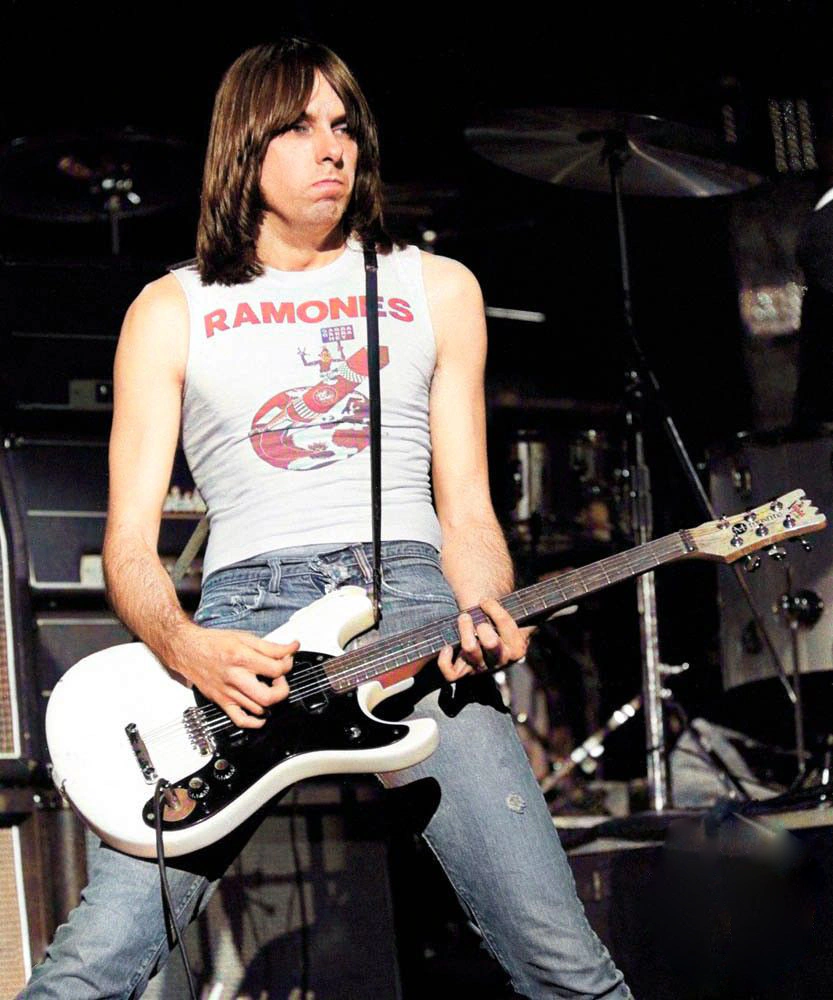
Johnny's guitar defined the Ramones: rapid-fire downstrokes, locked-in eighth-note patterns, and concise power chords with almost no solos. He used a stripped-down rig to project a hard, percussive wall of sound that drove the songs forward with unwavering tempo. Onstage he often stood ramrod straight, legs apart, providing an anchor while chaos unfolded around him. Inside the band he was a disciplinarian, insisting on consistency, speed, and work ethic. Though songwriting credits were frequently shared, his arrangements and authoritative right hand shaped how Ramones songs felt. Producers and collaborators learned that the band's core energy came from Johnny's precision and refusal to dilute the attack.Breakthrough Years
The Ramones released their self-titled debut in 1976 on Sire Records, championed by Seymour Stein and managed early on by Danny Fields, who helped position them beyond the downtown clubs. While American radio gave limited support, the group's early tours, including key shows in the United Kingdom, galvanized a generation of musicians. Albums like Leave Home and Rocket to Russia arrived in quick succession, proving the band's method could generate a catalog of immediately recognizable songs. Their appearance in the film Rock 'n' Roll High School added pop-cultural visibility without compromising their persona.Creative Battles and Collaborators
Working with famed producer Phil Spector on End of the Century (1980) introduced a clash of philosophies. Spector's layered "Wall of Sound" often collided with Johnny's preference for stark, hard-edged arrangements. The sessions were tense, reflecting the broader struggle between studio polish and the band's Spartan aesthetic. Throughout other records, engineers and producers such as Ed Stasium helped capture the balance between clarity and the band's relentless drive. Within the lineup, Tommy eventually gave way to Marky Ramone (Marc Bell), and later Richie Ramone (Richard Reinhardt) and C.J. Ramone (Christopher Ward) would join during evolving phases of the band's long touring life. Despite personnel shifts, Johnny's guitar remained the constant.Relationships Inside the Band
The personal dynamic between Johnny and Joey Ramone was famously strained. Differences in personality and politics, and interpersonal tensions, hardened over the years, yet they maintained a professional focus that kept the group working. With Dee Dee Ramone, Johnny shared a rugged determination, even as Dee Dee's life took turbulent turns. Tommy's early guidance and later production contributions were essential in shaping their sound, and Marky's lengthy tenure stabilized the rhythm section in later eras. The Ramones' tour manager Monte Melnick, a near-constant presence, helped keep the machine moving. Together, this network sustained an unforgiving travel and recording schedule over two decades.Hardships and Endurance
Life in the Ramones demanded stamina. Johnny suffered a violent assault in the early 1980s that required emergency medical treatment, yet he returned to the stage quickly, a testament to his resilience. The band's finances and business decisions often fell under his careful, sometimes strict eye. Though the Ramones seldom achieved blockbuster chart figures in the United States, they built a global following through sheer persistence, concise songwriting, and a brand of showmanship that treated every night like a sprint.Politics and Persona
In a scene often associated with left-leaning attitudes, Johnny was outspokenly conservative, a stance he neither hid nor softened. This view influenced how fans and fellow musicians perceived him and sometimes complicated relationships within the band, particularly with Joey. Still, the contrast also underscored a broader truth about the Ramones: abrasively simple in sound yet complex in the personalities that made the music possible.Later Years and Retirement
After an exhaustive run of albums and tours, the Ramones retired in 1996. In the early 2000s, the band members began to be recognized with major honors, including induction into the Rock and Roll Hall of Fame in 2002. Loss followed, as Joey died in 2001 and Dee Dee in 2002. Johnny, living in Los Angeles with his wife, Linda Ramone (Linda Cummings), faced his own health battles with prostate cancer. He remained active socially, known among friends and artists for his sharp taste in classic films and for championing the Ramones' legacy with Linda's support. He died in 2004, leaving behind a model of guitar minimalism that countless bands adopted.Legacy
Johnny Ramone's influence is felt every time a guitarist attacks a song with strict downstrokes and a commitment to speed and economy. His contribution helped define punk not as chaos but as focus: few chords, maximum intent, no filler. Bands across multiple generations, from first-wave British punk acts to American alternative and pop-punk groups, cite him as a primary influence. The Ramones' uniform look, short songs, and relentless consistency owe as much to his resolve as to any single aesthetic choice. Posthumously, his notes and recollections were assembled into a memoir, and a statue in his honor stands at Hollywood Forever Cemetery in Los Angeles, where Linda has been central in preserving his memory. Frequently listed among the most influential guitarists in rock history, Johnny Ramone shaped an approach that remains a rite of passage for new players and a benchmark of purity for veterans.Assessment
Johnny Ramone distilled rock guitar to its essence. Surrounded by key collaborators and foils, Joey Ramone's voice, Dee Dee Ramone's drive, Tommy Ramone's structure, Marky Ramone's steadiness, Danny Fields' early management, Seymour Stein's label support, and even producers like Phil Spector who challenged him, he forged a sound that outpaced fashion. More than a style, his playing became a standard: relentless rhythm as the lead instrument. In doing so, he left a legacy larger than charts or sales, measured instead by the millions of hands that learned to count off "1-2-3-4" and attack the strings the way he did.Our collection contains 9 quotes written by Johnny, under the main topics: Justice - Music - Work Ethic - Movie - Gratitude.
Other people related to Johnny: Richard Hell (Musician)
Source / external links