
Nat King Cole Biography Quotes 29 Report mistakes
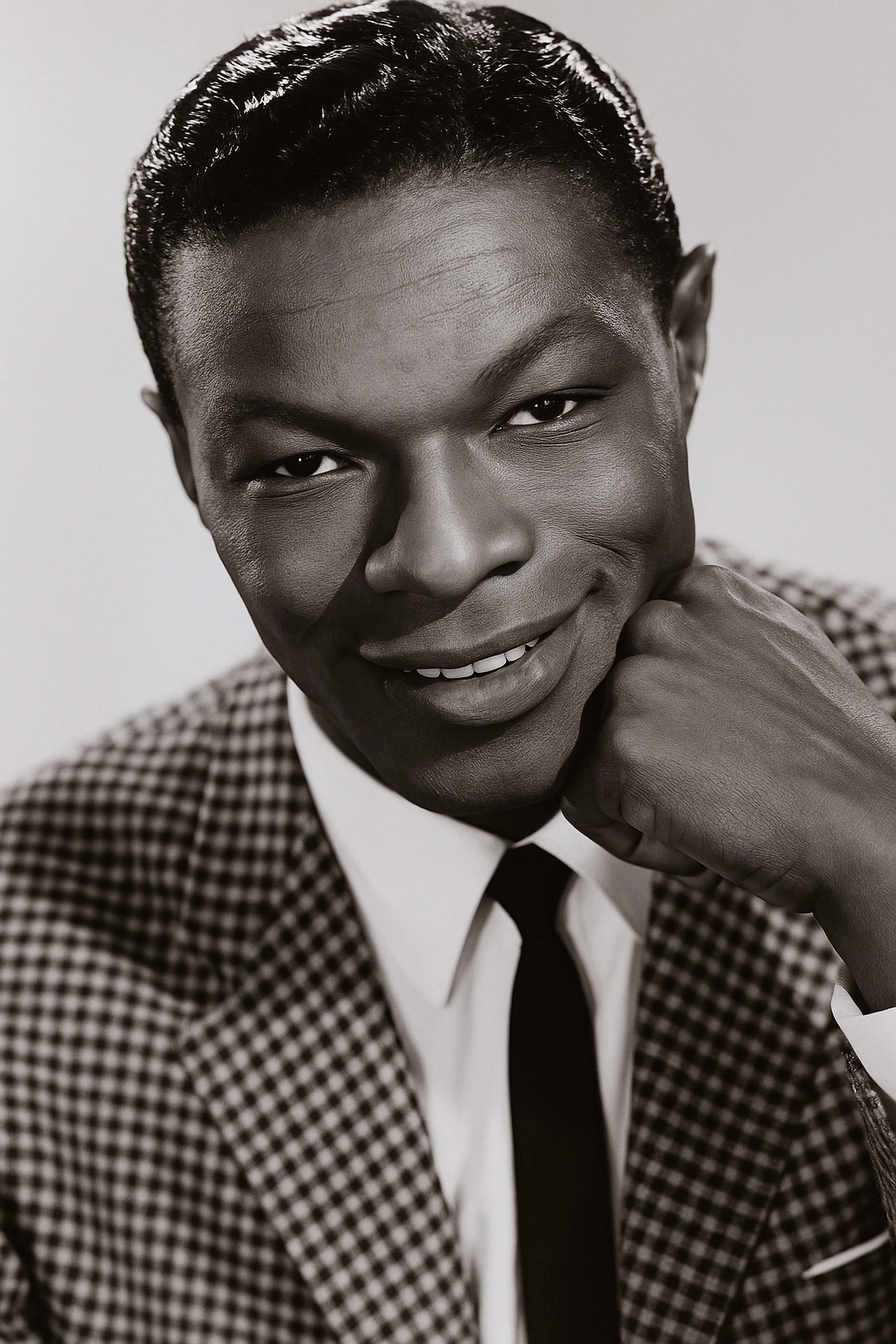
| 29 Quotes | |
| Born as | Nathaniel Adams Coles |
| Occup. | Musician |
| From | USA |
| Born | March 17, 1919 Montgomery, Alabama, United States |
| Died | February 15, 1965 Santa Monica, California, United States |
| Cause | Lung cancer |
| Aged | 45 years |
| Cite | |
Citation Formats
APA Style (7th ed.)
Nat king cole biography, facts and quotes. (2026, February 21). FixQuotes. https://fixquotes.com/artists/nat-king-cole/
Chicago Style
"Nat King Cole biography, facts and quotes." FixQuotes. February 21, 2026. https://fixquotes.com/artists/nat-king-cole/.
MLA Style (9th ed.)
"Nat King Cole biography, facts and quotes." FixQuotes, 21 Feb. 2026, https://fixquotes.com/artists/nat-king-cole/. Accessed 4 Mar. 2026.
Early Life and Background
Nathaniel Adams Coles was born March 17, 1919, in Montgomery, Alabama, the son of Edward Coles, a Baptist minister, and Perlina Coles. In the Jim Crow South, church was both refuge and training ground, and music was not decoration but a working language - gospel harmonies, call-and-response, and the steady discipline of performance. The family soon joined the Great Migration stream, settling in Chicago, where industrial promise existed alongside racial boundaries that shaped every public step.On Chicago's South Side, Coles grew up amid storefront theaters, rent parties, and the new authority of radio. He absorbed the sounds that defined interwar Black urban life - blues pianists, big bands, and the emerging modern swing - while learning how quickly opportunity could harden into routine. The nickname "Nat" followed him into his teens, as did the instinct to lead from the keyboard: he was quiet in demeanor, but assertive in tempo, already thinking like an arranger and bandleader rather than a mere accompanist.
Education and Formative Influences
Cole studied piano as a child, learning formal technique before street education took over, and he listened obsessively to Earl Hines, whose Chicago-based virtuosity became an early model. He attended DuSable High School briefly but left to work, playing clubs and theaters to help support himself. The era's social realities - segregated venues, exploitative contracts, and the need to please mixed crowds without surrendering musical identity - formed his practicality early, while jazz's internal standards pushed him toward precision, timing, and harmonic clarity.Career, Major Works, and Turning Points
By the late 1930s Cole was in Los Angeles, building a reputation as a pianist of uncommon touch and swing; in 1939 he formed the Nat King Cole Trio with guitarist Oscar Moore and bassist Wesley Prince (later replaced by Johnny Miller), a format that helped redefine small-group jazz by giving piano and guitar the rhythmic authority of a full band. The Trio's blend of elegance and drive drew national attention, and a singing feature at the microphone - first a convenience, then a revelation - opened the door to stardom. In the 1940s he moved from jazz insider to mass audience with hits such as "Straighten Up and Fly Right" (1943), then became one of Capitol Records' defining voices with "Nature Boy" (1948) and, in the 1950s, lush orchestral ballads including "Mona Lisa" (1950), "Unforgettable" (1951), and "The Christmas Song" (his signature 1946 recording, revisited in 1953 and 1961). In 1956-57 he hosted The Nat King Cole Show on NBC, a breakthrough in visibility that was also a lesson in limits: major national sponsors largely refused to back a Black star in prime time. Even as his artistry broadened internationally, the stress of racism, relentless touring, and heavy smoking shadowed his later years; he died in Santa Monica, California, on February 15, 1965, from lung cancer.Philosophy, Style, and Themes
Cole's inner life was marked by a musician's self-scrutiny and an entertainer's realism. He never stopped thinking of himself as a pianist first, and his phrasing as a singer often behaved like piano touch - rounded attacks, delayed resolutions, and a calm, intimate swing that made sentimental material feel structured rather than syrupy. His own description of performance as narrative was not modesty but method: “I'm an interpreter of stories. When I perform, it's like sitting down at my piano and telling fairy stories”. That storyteller stance helped him bridge audiences without flattening the music; even in pop arrangements, his timing carried jazz's conversational logic.Yet the same practicality that helped him survive the industry could sound almost severe when stated plainly. “I'm a musician at heart, I know I'm not really a singer. I couldn't compete with real singers. But I sing because the public buys it”. The line reveals a psychology built on craft over mystique - he treated fame as a job to be mastered, not a crown to be admired. At the same time, Cole understood the soft power of tone in a divided country and held, however cautiously, to music as social leverage: “I may be helping to bring harmony between people through my music”. His themes - romance, longing, composure under pressure - were not escapism so much as a disciplined offer of dignity, an insistence that elegance could be a form of self-defense.
Legacy and Influence
Cole left a twofold legacy: as a pioneering Black mainstream star who navigated - and publicly tested - mid-century America's racial boundaries, and as a musician whose technical standards set a template for modern vocal phrasing. His Trio influenced generations of small-group jazz, while his Capitol-era recordings became reference points for pop orchestration and intimate microphone singing. Artists from Ray Charles to Frank Sinatra, from Diana Krall to Gregory Porter, have studied his balance of warmth and restraint. The enduring appeal of "Unforgettable", the perennial return of his Christmas repertoire, and the quiet authority of his piano work ensure that Nat King Cole remains not only a voice of an era but a continuing lesson in how polish can carry depth.Our collection contains 29 quotes written by Nat, under the main topics: Witty One-Liners - Music - Equality - Mental Health - Embrace Change.
Other people related to Nat: Peabo Bryson (Musician), Herbie Hancock (Musician), Oscar Peterson (Musician), Johnny Mercer (Musician), Eartha Kitt (Actress), Diana Krall (Musician), Ray Evans (Musician), Jay Livingston (Composer), Eden Ahbez (Musician), Natalie Cole (Musician)
Frequently Asked Questions
- Nat King Cole children: Natalie; twins Timolin and Casey; adopted Carole (Cookie) and Nat Kelly.
- Nat King Cole - When I Fall in Love: From the 1957 album Love Is the Thing; arranged by Gordon Jenkins.
- Nat King Cole On a Bicycle Built for Two: His 1963 take on Daisy Bell, on Those Lazy-Hazy-Crazy Days of Summer.
- Nat King Cole Smile: His 1954 hit rendition of Chaplin's Smile.
- Nat King Cole songs: Unforgettable, L-O-V-E, Mona Lisa, Nature Boy, The Christmas Song, When I Fall in Love, Smile.
- Nat King Cole L-O-V-E: 1964 hit and album title track; upbeat jazz-pop standard.
- Nat King Cole Unforgettable: 1951 signature song; later a 1991 duet with daughter Natalie.
- How old was Nat King Cole? He became 45 years old
Source / external links