
Pink Floyd Biography Quotes 9 Report mistakes
| 9 Quotes | |
| Occup. | Musician |
| From | United Kingdom |
| Cite | |
Citation Formats
APA Style (7th ed.)
Pink floyd biography, facts and quotes. (2026, February 8). FixQuotes. https://fixquotes.com/artists/pink-floyd/
Chicago Style
"Pink Floyd biography, facts and quotes." FixQuotes. February 8, 2026. https://fixquotes.com/artists/pink-floyd/.
MLA Style (9th ed.)
"Pink Floyd biography, facts and quotes." FixQuotes, 8 Feb. 2026, https://fixquotes.com/artists/pink-floyd/. Accessed 1 Apr. 2026.
Origins and Formation
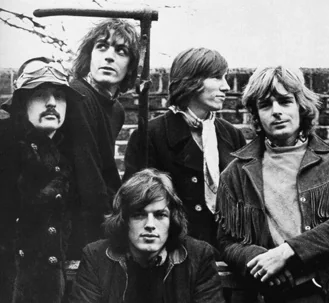
Pink Floyd emerged in mid-1960s London, where a circle of student musicians developed a sound that fused rhythm-and-blues with experimental improvisation. The group coalesced around guitarist and singer Syd Barrett, bassist Roger Waters, keyboardist Richard Wright, and drummer Nick Mason. An early guitarist, Bob Klose, departed as the band moved decisively toward Barrett's adventurous songwriting. Barrett combined playful English psychedelia with an ear for hypnotic drones and guitar textures, and he famously rechristened the ensemble after American bluesmen Pink Anderson and Floyd Council. Guided in the underground scene by managers Peter Jenner and Andrew King, the band became a fixture at spaces such as the UFO Club and the Roundhouse, where light shows and extended jams set them apart.Early Psychedelia and Syd Barrett
In 1967 the band scored British hits with the singles Arnold Layne and See Emily Play, and released its debut album, The Piper at the Gates of Dawn, recorded at Abbey Road with producer Norman Smith. That record, dominated by Barrett's surreal miniatures and free-form interludes, quickly placed Pink Floyd at the forefront of the psychedelic movement. Yet Barrett's fragile mental health, exacerbated by heavy drug use and the pressures of sudden fame, led to erratic behavior. By late 1967, his reliability onstage and in the studio had deteriorated. To stabilize the group, childhood friend David Gilmour joined on guitar and vocals, initially to support Barrett. By early 1968 Barrett departed, and the band's early managers remained with him, while Pink Floyd's long-term managerial stewardship passed to Steve O'Rourke.Transition and Expanding Ambitions
Post-Barrett, Pink Floyd reshaped itself. Waters' conceptual instincts, Wright's harmonic sense and keyboards, Gilmour's lyrical guitar, and Mason's meticulous drumming began to define a collective voice. A Saucerful of Secrets (1968) bridged psychedelic improvisation with emerging thematic cohesion, including Barrett's poignant farewell, Jugband Blues. The band explored film soundtracks and long-form pieces, building an identity through atmosphere, dynamics, and sound design rather than conventional singles. Their live shows, enhanced by quadraphonic sound experiments and circular screen projections, underscored a growing commitment to immersive experience.The Dark Side of the Moon
That commitment culminated in The Dark Side of the Moon (1973), engineered by Alan Parsons and packaged by Storm Thorgerson and Aubrey Powell of Hipgnosis with the now-iconic prism artwork. Structured as a continuous suite, the album traced pressures of modern life, time, money, conflict, mortality, and wove studio experimentation, tape loops, and soulful vocal features into cohesive drama. It became a cultural phenomenon, spending years on the sales charts and transforming Pink Floyd into a global headliner. The record's precise engineering, conceptual unity, and sonic polish set a new standard for the album as an art form.Wish You Were Here and Barrett's Shadow
The follow-up, Wish You Were Here (1975), deepened the self-reflective themes. Framed by the nine-part Shine On You Crazy Diamond, it served as an elegy to Barrett's brilliance and absence. Collaborators helped crystallize the statement: guest singer Roy Harper delivered the biting industry critique Have a Cigar, while Hipgnosis crafted cover imagery about absence and faceless commerce. Melancholy, space, and restraint gave the album a timeless quality and secured the band's stature beyond the psychedelic label.Animals and The Wall
Animals (1977) sharpened Waters' sociopolitical lens, presenting a bleak allegory of society through longer, guitar-driven pieces. The music grew darker and more aggressive, with Gilmour's solos cutting through dense arrangements and Wright's textures anchoring the atmosphere. Then came The Wall (1979), a sprawling rock opera developed by Waters and co-produced with Bob Ezrin and James Guthrie. The narrative, alienation, fame, and emotional isolation, was matched by an ambitious stage show designed with architect Mark Fisher, featuring a literal wall constructed during concerts and grotesque animations by Gerald Scarfe. Though a massive success, The Wall era strained internal relationships; Wright, under pressure, left as a full member during its production, returning as a salaried player for the tour.The Final Cut and Fracture
The Final Cut (1983) followed with intensely personal, politically charged material largely written by Waters, who assumed near-total creative control. The record's tone, combined with longstanding tensions, pushed the classic lineup to breaking point. In 1985 Waters announced his departure, believing Pink Floyd had run its course. A legal dispute ensued over the band name and repertoire. Ultimately, an agreement allowed Gilmour and Mason to continue as Pink Floyd, with Wright rejoining the creative core over time.Reinvention under Gilmour
A Momentary Lapse of Reason (1987) signaled a new era, with Gilmour at the helm and O'Rourke managing extensive touring. The live ensemble featured key contributors such as bassist Guy Pratt and multi-instrumentalist Jon Carin, whose roles became central to the group's later sound. The Division Bell (1994), co-written in part with Wright more visibly restored, emphasized ensemble interplay, reflective lyrics, and luminous production. The subsequent tour yielded the live album and film Pulse, noted for its spectacular staging, advanced lighting, and a blinking LED on the CD package that became a small icon of 1990s music culture.Visual Art, Sound, and Craft
Beyond albums, Pink Floyd's identity rested on a unified aesthetic: conceptual graphics by Hipgnosis; the inflatable pig (dubbed Algie) photographed over Battersea Power Station for Animals; surround-sound experiments; and carefully engineered concerts that turned arenas into theatrical spaces. Longtime collaborators such as engineer/producer James Guthrie, orchestrator Michael Kamen, and stage teams led by Mark Fisher helped translate studio ambition into live drama. The band's meticulous attention to sequencing, transitions, and sonic detail made records feel like singular journeys rather than collections of songs.Reunions, Farewells, and Later Work
In 2005 the classic quartet, Gilmour, Mason, Wright, and Waters, reunited for a one-off performance at Live 8, a rare moment of public reconciliation. The passing of Syd Barrett in 2006 and Richard Wright in 2008 drew the group and fans into a period of remembrance. The Endless River (2014), built from 1990s sessions and shaped by Gilmour, Mason, and Guthrie, served as a tribute to Wright's musicianship. In 2022, Gilmour and Mason released Hey, Hey, Rise Up! under the Pink Floyd name, featuring the voice of Andriy Khlyvnyuk, to support humanitarian relief, reflecting the band's occasional return for causes rather than commerce.Legacy and Influence
Pink Floyd's catalog, Piper's whimsical psychedelia, Dark Side's conceptual unity, Wish You Were Here's elegy, Animals' ferocity, The Wall's theatrical catharsis, and the later era's shimmering production, has shaped progressive rock, art-rock, and alternative music. Inductions into halls of fame and enduring sales only partly measure their impact. More telling is the way their records continue to invite deep listening and communal experience, from headphones in dark rooms to planetarium screenings and collective sing-alongs in stadiums. The enduring resonance owes as much to the chemistry of Waters, Gilmour, Wright, and Mason as to the vision of collaborators like Alan Parsons, Bob Ezrin, James Guthrie, Storm Thorgerson, Aubrey Powell, Gerald Scarfe, and Steve O'Rourke, whose combined efforts helped turn a London student band into one of the most influential acts in modern music.Our collection contains 9 quotes written by Pink, under the main topics: Learning - Meaning of Life - Mental Health - Legacy & Remembrance - Soulmate.
Other people related to Pink: Bob Geldof (Actor), David Gilmour (Musician), Naomi Watts (Actress), Robyn Hitchcock (Musician), Barbet Schroeder (Director), Les Claypool (Musician), Rick Wright (Musician)
Source / external links