
Slash Biography Quotes 19 Report mistakes
| 19 Quotes | |
| Born as | Saul Hudson |
| Occup. | Musician |
| From | United Kingdom |
| Spouses | Renée Suran (1992-1997) Perla Ferrar (2001-2014) |
| Born | July 23, 1965 Hampstead, London, England, UK |
| Age | 60 years |
| Cite | |
Citation Formats
APA Style (7th ed.)
Slash biography, facts and quotes. (2026, February 11). FixQuotes. https://fixquotes.com/artists/slash/
Chicago Style
"Slash biography, facts and quotes." FixQuotes. February 11, 2026. https://fixquotes.com/artists/slash/.
MLA Style (9th ed.)
"Slash biography, facts and quotes." FixQuotes, 11 Feb. 2026, https://fixquotes.com/artists/slash/. Accessed 12 Feb. 2026.
Early Life and Background
Saul Hudson, known globally as Slash, was born on July 23, 1965, in Hampstead, London, into a household where art and music were not hobbies but working realities. His mother, Ola J. Hudson, was a Black American fashion designer whose clients later included David Bowie; his father, Anthony Hudson, was an English artist and album-cover designer. The 1960s London he arrived into still hummed with the afterglow of the British Invasion, and the idea that style, image, and sound could fuse into a single public identity was part of the air he breathed.In the mid-1970s he moved with his mother to Los Angeles, landing in a city whose music ecology ran from Sunset Strip glam to the hardening edges of punk and metal. That dislocation - British childhood memories and American adolescence - sharpened his ear and his sense of persona. He became "Slash" as a nickname in youth, and the moniker stuck because it matched what he would later do best: cut through excess with direct, singing guitar lines. Even before fame, he was drawn to the nocturnal life of clubs and rehearsals, where belonging was earned by volume, stamina, and feel.
Education and Formative Influences
Slash attended Beverly Hills High School but was pulled more strongly by the informal conservatory of Los Angeles musicianship, where practice rooms, garages, and late-night jams substituted for diplomas. A difficult stretch of adolescence included periods of instability and drifting, yet those same conditions created an obsessive focus: hours with the instrument and a fast education in the vocabulary of British blues-rock and American hard rock. His listening centered on players like Jimmy Page and Joe Perry, with the riffcraft of AC/DC and the swing of Aerosmith feeding his preference for groove over technical display. By his late teens, the guitar was less a chosen path than an organizing principle - a way to impose order on a loud, restless city.Career, Major Works, and Turning Points
After early Los Angeles bands (including Road Crew and a stint in Hollywood Rose), Slash co-founded Guns N' Roses in 1985 with Axl Rose and Izzy Stradlin, and the group became the defining shock of late-1980s hard rock. Appetite for Destruction (1987) turned street-level sleaze and classic-rock discipline into radio staples - from the tension-release of "Welcome to the Jungle" to the signature melodic soloing in "Sweet Child o' Mine" - while GN'R Lies (1988) and the stadium-scale Use Your Illusion I and II (1991) expanded the band into balladry, epics, and maximalist ambition ("November Rain"). The fame was volcanic and corrosive; by the mid-1990s, internal conflict and creative control battles pushed Slash out (1996). He reasserted himself in Velvet Revolver (Contraband, 2004; Libertad, 2007), then as a solo artist with a rotating cast (Slash, 2010) before consolidating a durable identity with Myles Kennedy and The Conspirators (from Apocalyptic Love, 2012, onward). A final major turn came with his return to Guns N' Roses for the Not in This Lifetime... tour beginning in 2016, a reconciliation that reconnected his playing to the songs that had become modern rock standards.Philosophy, Style, and Themes
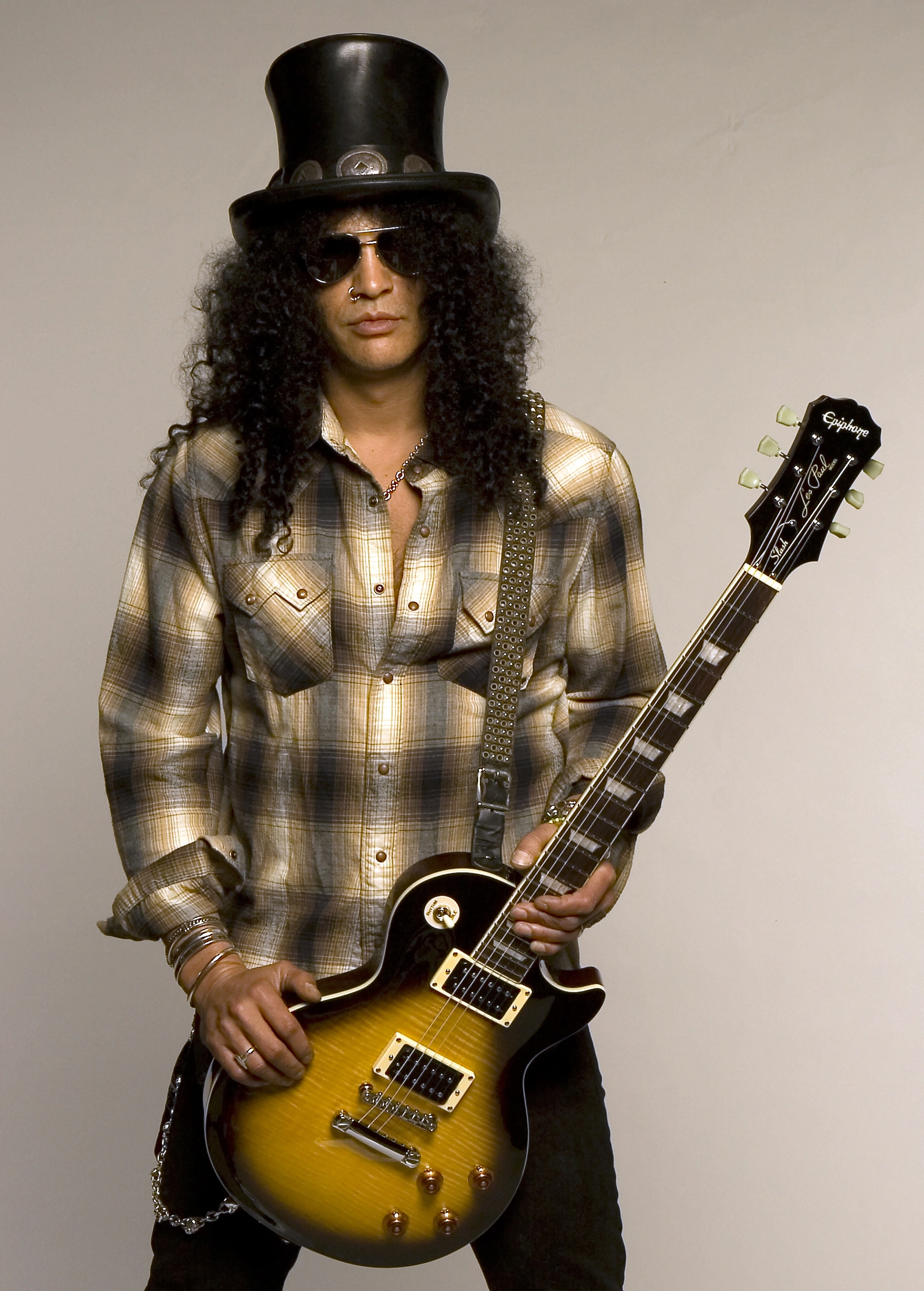
Slash built a paradoxical iconography: a musician who distrusts celebrity yet understands the power of an image. His top hat, curls, and Les Paul are not fashion trivia but a deliberate readability - he has argued, "To be truly iconic, you need to be able to be recognized in a silhouette". That self-awareness, rooted in a childhood around designers and visual artists, helped him survive an era when MTV rewarded the theatrical. But the silhouette serves the sound. His playing is lyric-first: bends that speak like voice, blues phrasing welded to hard-rock weight, and solos composed as melodies you can hum. In Guns N' Roses, that lyricism counterbalanced Axl Rose's volatility; in later projects, it became the stable center around which singers and drummers could rotate.Beneath the swagger sits a work ethic and a private, almost utilitarian psychology about music as regulation. He has said, "I really enjoy the therapeutic aspect of playing and writing music. It's a great way to express yourself and clear your mind". In that light, the long tours and relentless recording are not just career moves but self-maintenance - a way to keep intensity from curdling into chaos. He also frames success as a byproduct of commitment rather than a destination: "My philosophy is, as long as you enjoy what you're doing and you're giving it 100 percent, then everything else will fall into place". The themes that recur across his work - appetite, escape, loyalty, self-destruction, and the chase for a "good night" onstage - read as the ongoing negotiation between impulse and discipline, youth's reckless velocity and the adult need to harness it.
Legacy and Influence
Slash endures as one of rock's last universally recognized guitar heroes, a bridge between 1970s blues-based riff tradition and the late-1980s mainstream that briefly made guitars central again. His solos - especially on "Sweet Child o' Mine", "Paradise City", and "November Rain" - are canonical because they are both technically assured and emotionally legible, a reminder that virtuosity can be narrative. As a figure, he shaped the modern idea of the guitarist as brand without surrendering to pop plasticity: the hat-and-Les-Paul outline became shorthand for rock authenticity, even as his collaborations and post-GN'R reinventions showed adaptability. For subsequent players, his lesson is not speed but voice: cultivate a tone, write melodies, and let the instrument speak as if it has a biography of its own.Our collection contains 19 quotes written by Slash, under the main topics: Motivational - Wisdom - Music - Self-Discipline - Father.
Other people related to Slash: Scott Weiland (Musician)
Frequently Asked Questions
- What band was Slash in? Guns N' Roses'
- How old is Slash? He is 60 years old
Source / external links