
Steve Cropper Biography Quotes 9 Report mistakes
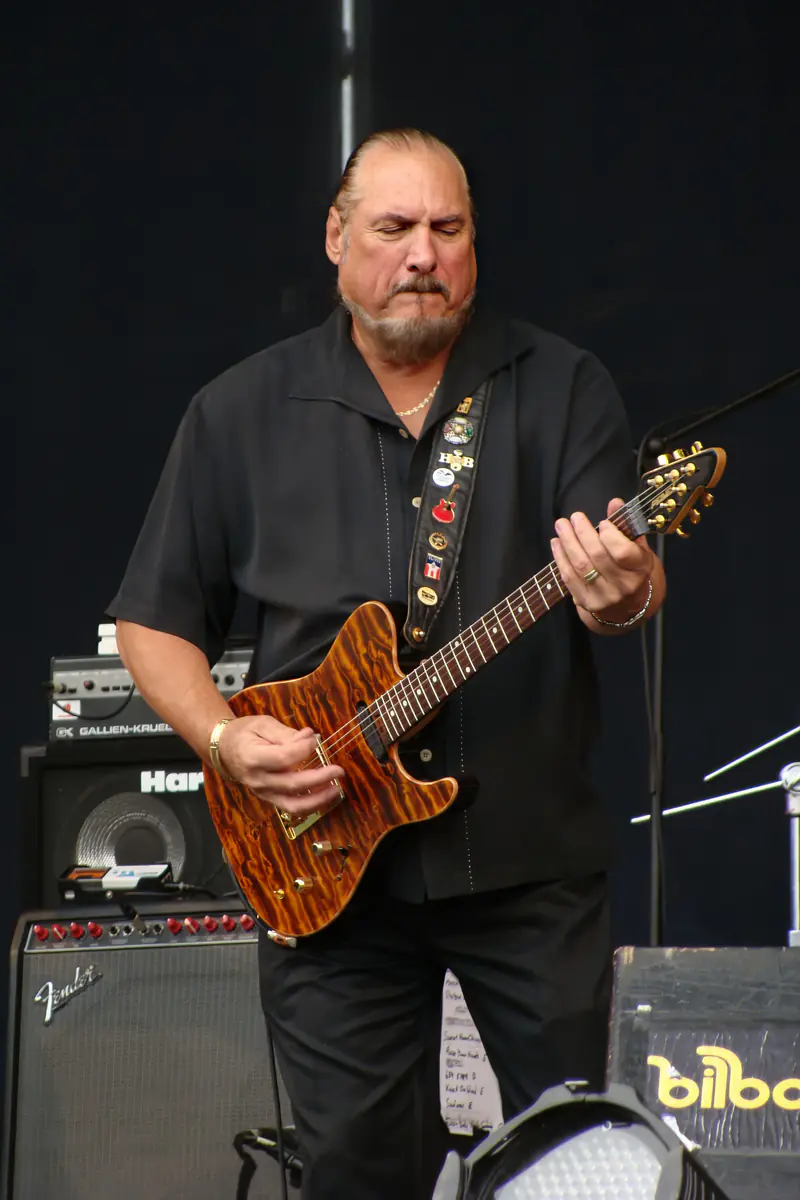
Attr: Alberto Cabello, CC BY 2.0
| 9 Quotes | |
| Born as | Steven Lee Cropper |
| Occup. | Musician |
| From | USA |
| Spouse | Pamela Jean Morris |
| Born | October 21, 1941 Dora, Missouri, USA |
| Age | 84 years |
Steven Lee Cropper, known to the world as Steve Cropper, was born in 1941 in the United States and came of age musically in Memphis, Tennessee. Drawn early to the guitar and the groove-heavy sounds playing on Southern radio, he found his way into bands with school friends and local players who were absorbed by rhythm and blues. As a teenager he joined a group that would become The Mar-Keys, an outfit tied closely to the nascent Stax Records scene because of its proximity to the label's studio and to the founders Jim Stewart and Estelle Axton. The Mar-Keys scored with the instrumental Last Night, putting Cropper on a professional path and placing him near the center of a dynamic, integrated musical community that was inventing a new vocabulary for soul music.
Stax Records and Booker T. & the M.G.'s
Cropper's real breakthrough came from his role in the Stax house band. Alongside organist Booker T. Jones, bassist Lewie Steinberg (later replaced by Donald Duck Dunn), and drummer Al Jackson Jr., he became a charter member of Booker T. & the M.G.'s. Their 1962 instrumental Green Onions, built on a slinky organ riff and Cropper's taut, perfectly timed guitar fills, emerged almost by accident from a studio jam and quickly became a signature of the era. Beyond their own hits, the M.G.'s set the rhythmic blueprint for countless records cut at Stax. Their feel embodied cooperation and economy: Jones's organ voicings, Jackson's metronomic backbeat, Dunn's melodic bass lines, and Cropper's clipped chords and concise leads worked together with uncanny intuition.
Songwriting, Sessions, and Production
From the early 1960s through the late 1960s, Cropper acted not only as guitarist but also as a songwriter, arranger, and producer. His rhythm parts and stinging single-note lines are heard on a long line of records by Otis Redding, Sam & Dave, Eddie Floyd, Wilson Pickett, Rufus Thomas, Carla Thomas, and many others. With Redding he co-wrote (Sittin' On) The Dock of the Bay, overseeing the posthumous mix that included the now-famous seagull and wave effects, and shaping a more reflective sound that widened the horizon of soul music. With Wilson Pickett he co-wrote In the Midnight Hour, calibrating the groove with an ear sharpened by countless hours in the studio. With Eddie Floyd he co-wrote Knock on Wood. On Sam & Dave records such as Soul Man and Hold On, I'm Comin', Cropper's parts provide a chiseled counterpoint to the ecstatic vocals, fitting seamlessly with the songwriting and production team of Isaac Hayes and David Porter and the brass power of The Memphis Horns, Wayne Jackson and Andrew Love.
Cropper's sensibility in the studio emphasized clarity, space, and feel over flash. He learned engineering basics alongside producers and label heads, became a trusted A&R ear for Stax, and was known for finding the one part that made a song sit right. His approach helped define the label's sound, where the interplay between players mattered as much as any single performance.
Transitions and New Ventures
As Stax evolved at the end of the 1960s, the business around the label shifted, and several key figures moved on. Cropper left the company around the turn of the 1970s. He established his own studio operations in Memphis under the TMI banner and continued to write, produce, and play on sessions for a broad range of artists. While Stax had been a singular incubator, Cropper's reputation as a reliable, tasteful collaborator only expanded. He adapted easily, working in different studios and cities, and he brought the Memphis approach, economy, groove, respect for the singer, to whatever project he undertook.
The Blues Brothers Era
A new chapter opened in the late 1970s when Dan Aykroyd and John Belushi turned their love of classic R&B into The Blues Brothers. Cropper, along with his longtime friend and bandmate Donald Duck Dunn, joined the group, bringing a veteran's depth to the horn-driven revue. The venture bridged generations, reviving interest in soul and blues for a mass audience. The band's recordings and relentless touring, aided at times by collaborators like bandleader Paul Shaffer and guitarist Matt Guitar Murphy, returned Cropper to large stages and movies while keeping the core values of the music intact: tight rhythm sections, sharp arrangements, and deep respect for the original artists.
Later Career
In subsequent decades, Cropper remained an in-demand session player and bandleader, appearing onstage and in studios with artists drawn to the feel he helped codify at Stax. He reunited periodically with Booker T. & the M.G.'s for special performances and projects, honoring the legacy they built together and the memories of Al Jackson Jr., whose life was tragically cut short in the 1970s, and of Donald Duck Dunn, who passed away years later. Cropper also pursued collaborative albums and guest appearances, including work with fellow veterans and younger musicians eager to connect with the roots of American soul and R&B. He spent considerable time in Nashville, a city where his understated authority fit easily among country, rock, and Americana circles, and he maintained a steady presence on the road and at festivals.
Style, Influence, and Legacy
Steve Cropper's guitar language relies on understatement, timing, and tone. He favors short, eloquent phrases, chord stabs that sit perfectly on the backbeat, and spare melodic hooks that listeners can hum. In a studio culture that often celebrated fireworks, he built a career on restraint and purpose. He was a team player who understood that a record is a conversation among musicians, a singer, and a song, and that the best contribution can be a single, unforgettable lick.
His influence reaches far beyond the Stax catalog. Generations of guitarists and producers cite him as a model for how to serve a song, and his name appears regularly in lists of the most important guitar players in popular music. Honors followed, including induction into the Rock and Roll Hall of Fame as a member of Booker T. & the M.G.'s and recognition by songwriter and musician organizations. Yet the truest measure of his impact is audible each time a band locks into a pocket that leaves room for the singer, the horns, and the groove.
By the time he reached later life, Cropper had become a guardian of a tradition he helped build. He mentored younger players, celebrated the memories of collaborators such as Otis Redding, Sam Moore and Dave Prater of Sam & Dave, Wilson Pickett, and Eddie Floyd, and kept alive the team ethic forged with Booker T. Jones, Al Jackson Jr., and Donald Duck Dunn. Whether on a brightly lit festival stage or in a studio control room, he embodied the idea that less can be more, that the right chord at the right time can change everything, and that American soul music, at its best, is a community endeavor.
Our collection contains 9 quotes who is written by Steve, under the main topics: Witty One-Liners - Music - Travel.
Other people realated to Steve: Dan Aykroyd (Comedian)
Source / external links