
Dave Winfield Biography Quotes 23 Report mistakes
| 23 Quotes | |
| Born as | David Mark Winfield |
|---|---|
| Occup. | Athlete |
| From | USA |
| Spouse | Tonya Winfield |
| Born | October 3, 1951 St. Paul, Minnesota, USA |
| Age | 74 years |
| Cite | |
Citation Formats
APA Style (7th ed.)
Dave winfield biography, facts and quotes. (2026, August 13). FixQuotes. https://fixquotes.com/authors/dave-winfield/
Chicago Style
"Dave Winfield biography, facts and quotes." FixQuotes. August 13, 2026. https://fixquotes.com/authors/dave-winfield/.
MLA Style (9th ed.)
"Dave Winfield biography, facts and quotes." FixQuotes, 13 Aug. 2026, https://fixquotes.com/authors/dave-winfield/. Accessed 29 Sep. 2026.
Early Life and Background
David Mark Winfield was born on October 3, 1951, in St. Paul, Minnesota, and grew up in a city where race, class, and northern urban aspiration shaped a young athlete's imagination as surely as any coach did. His father was largely absent from his life, and the emotional architecture of his childhood was built more by his mother, Arline, extended family, neighborhood discipline, and school structure than by any romantic mythology of sporting destiny. That absence mattered. It bred both self-reliance and a guardedness that would remain visible throughout his public career: Winfield often seemed composed, even formal, as if mastery were not merely a competitive tool but a means of holding life in order.
At St. Paul's Central High School he emerged not as a one-sport prodigy but as a rare all-around phenomenon, excelling in baseball, basketball, and football. The breadth of his gifts became one of the defining facts of his biography. He was tall, swift, and unusually coordinated, with the throwing arm and physical authority that would later make him one of baseball's most intimidating right fielders. Yet his rise also belonged to a specific American moment. In the years after the civil rights movement had altered public language more quickly than private behavior, Black athletes were both celebrated and scrutinized. Winfield learned early that talent opened doors, but dignity, restraint, and persistence were required to stay in the room.
Education and Formative Influences
Winfield attended the University of Minnesota, where his athletic range became almost unbelievable: he starred in baseball, was drafted by four professional leagues, and even helped the Golden Gophers basketball team reach the 1972 NCAA Final Four. In baseball he was dominant enough to be selected fourth overall in the 1973 MLB draft by the San Diego Padres, despite never having played in the minor leagues before reaching the majors. College refined more than his body. It taught him to navigate institutions, publicity, and racial expectation while balancing individual ambition against team identity. The university years also revealed a pattern that persisted throughout his life - he was drawn to challenge, impatient with limits, and conscious that excellence carried obligations beyond the field, especially for a prominent Black athlete in corporate, media-saturated modern sports.
Career, Major Works, and Turning Points
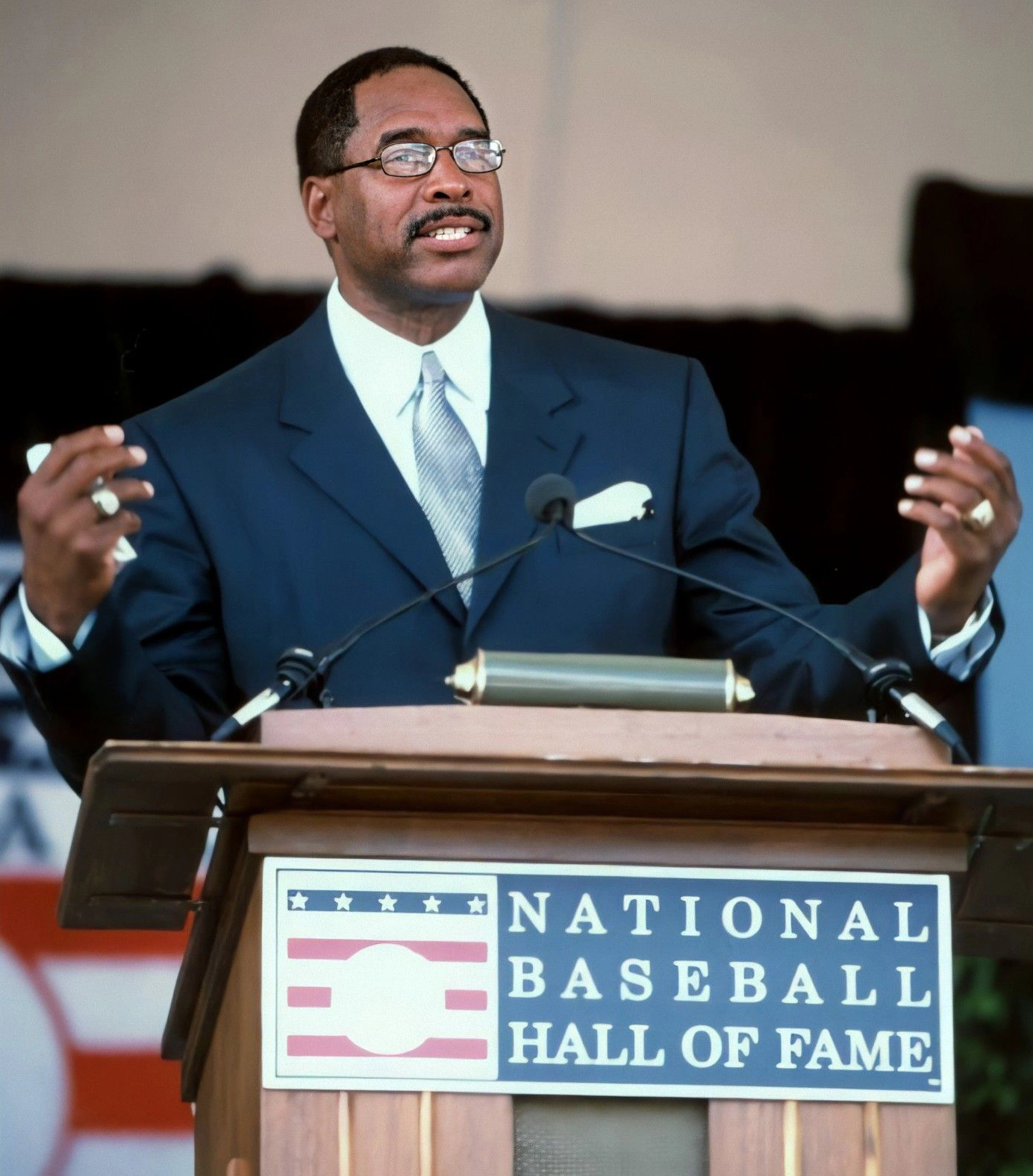
Winfield debuted with San Diego in 1973 and quickly became the franchise's first true superstar, combining power, speed, defense, and charisma in a way that made him both local icon and national attraction. By the late 1970s he was one of baseball's elite players, and in 1980 he signed a then-monumental 10-year contract with the New York Yankees, a move that magnified everything: his fame, his production, and the criticism that follows expensive stars in unforgiving markets. With the Yankees he made repeated All-Star teams, won Gold Gloves, and produced as a middle-of-the-order force, but October disappointments and George Steinbrenner's public attacks hardened his image into that of a player judged not only by performance but by narrative. A notorious 1983 incident in Toronto, when a warm-up throw accidentally killed a seagull, became tabloid absurdity and fed the sense that Winfield's career was lived under distortion. After legal and personal conflict with Steinbrenner, he was traded in 1990, revived with the California Angels, then became a crucial veteran presence for the 1992 world champion Toronto Blue Jays, helping secure Canada's first World Series title. He later played for Minnesota and Cleveland, reached 3, 000 hits and 400 home runs, and entered the Hall of Fame in 2001 on the first ballot, his plaque bearing the Yankees cap that symbolically reclaimed a complicated chapter.
Philosophy, Style, and Themes
Winfield's baseball style was regal but never ornamental. At 6-foot-6 he looked almost too large for grace, yet he moved with a basketball player's balance and a sprinter's economy. He was not simply a slugger; he was a complete right fielder whose arm changed baserunning decisions and whose presence altered games before the box score captured it. Beneath that physical command was a psychology built around calibrated tension. “You have to be like a clock spring, wound but not loose at the same time”. That sentence captures the essential Winfield paradox: public poise powered by internal compression. He understood elite sport not as swagger but as managed strain, a daily act of emotional engineering.
That mental framework also shaped his moral voice. “Everyone has a breaking point, turning point, stress point, the game is permeated with it. The fans don't see it because we make it look so efficient. But internally, for a guy to be successful, you have to be like a clock spring, wound but not loose at the same time”. He was describing not just baseball but his own career under scrutiny, racial coding, and executive hostility. His outlook was fundamentally didactic, even civic: “You have to go, understand that life and baseball is littered with all kinds of obstacles and problems along the way. You have to learn how to overcome them to be successful in life”. This is why his postgame seriousness was often misread. Winfield saw sport as apprenticeship in resilience, and fame as an arena in which character was tested as severely as talent.
Legacy and Influence
Winfield's legacy is unusually broad. Statistically, he belongs securely among the great all-around players of the late twentieth century: more than 3, 000 hits, 465 home runs, seven Gold Gloves, twelve All-Star selections, and impact across multiple franchises. Historically, he helped define the modern superstar athlete whose value extended beyond one city and whose career unfolded amid television pressure, free agency economics, and increasingly racialized media narratives. Through the Winfield Foundation and later executive and advisory roles, he also modeled a version of athletic adulthood grounded in philanthropy, education, and public responsibility. For younger players, especially Black outfielders navigating celebrity, he offered a template of grandeur without frivolity. His life in baseball was not a simple story of effortless dominance; it was the harder, more instructive story of an extraordinary talent learning to convert force into endurance, dignity into authority, and long trial into lasting stature.
Last updated August 2026 · Editorial standards
Our collection contains 23 quotes written by Dave, under the main topics: Witty One-Liners - Motivational - Training & Practice - Honesty & Integrity - Sports.
Source / external links