
Red Auerbach Biography Quotes 8 Report mistakes
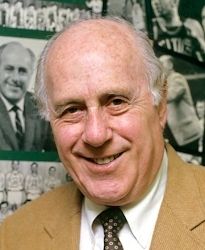
| 8 Quotes | |
| Occup. | Coach |
|---|---|
| From | USA |
| Born | September 20, 1917 |
| Died | October 28, 2006 |
| Aged | 89 years |
| Cite | |
Citation Formats
APA Style (7th ed.)
Red auerbach biography, facts and quotes. (2026, August 13). FixQuotes. https://fixquotes.com/authors/red-auerbach/
Chicago Style
"Red Auerbach biography, facts and quotes." FixQuotes. August 13, 2026. https://fixquotes.com/authors/red-auerbach/.
MLA Style (9th ed.)
"Red Auerbach biography, facts and quotes." FixQuotes, 13 Aug. 2026, https://fixquotes.com/authors/red-auerbach/. Accessed 11 Oct. 2026.
Early Life and Background
Arnold Jacob "Red" Auerbach was born on September 20, 1917, in Brooklyn, New York, to Jewish immigrant parents from Eastern Europe. He grew up in a city of crowded streets, ethnic neighborhoods, and relentless argument, where toughness was not an affectation but a civic language. The nickname "Red" came from his hair coloring in youth, but it also suited the heat of his personality: impatient with pretense, openly combative, and instinctively competitive. Brooklyn in the interwar years gave him a practical education in hierarchy and hustle. It was a place where talent mattered, but nerve and endurance mattered more, and those assumptions stayed with him for life.
Sports became the medium through which he translated urban intensity into order. At Eastern District High School he played basketball and absorbed the game's streetwise rhythms before entering a more organized world. He was not shaped by the romance of individual stardom so much as by the necessity of collective survival. That distinction would later define his teams. Even in youth, he showed the traits that would make him famous: contempt for excuses, a sharp eye for hidden ability, and an appetite for psychological advantage. He understood early that winning was not simply technical mastery; it was discipline, trust, and the ability to force others to play at your tempo.
Education and Formative Influences
Auerbach attended George Washington University in Washington, D.C., where he played guard and graduated in 1940. College deepened his understanding of basketball as a strategic system rather than a collection of moves. He then coached at St. Albans School and served in the U.S. Navy during World War II, experiences that reinforced habits of command, routine, and quick personnel judgment. By the time he entered professional coaching after the war - first in the Basketball Association of America and then the NBA, with the Washington Capitols and Tri-Cities Blackhawks - he had formed a durable creed: conditioning could weaponize tempo, smart passing could humble more glamorous scorers, and authority worked best when players knew exactly where they stood. The postwar game was still chaotic, often slow, and not yet fully integrated into modern professional culture; Auerbach saw in that instability an opportunity to impose clarity.
Career, Major Works, and Turning Points
His defining act began in 1950 when he became coach of the Boston Celtics. There he built not merely a winner but a dynasty. Early playoff frustrations gave way to a revolution after key personnel decisions: drafting Bob Cousy by happenstance through a dispersal process, trading for Bill Russell in 1956, and later adding K.C. Jones, Tom Heinsohn, Sam Jones, and John Havlicek. Auerbach's Celtics emphasized the fast break, outlet passing, suffocating rebounding, and a bench culture in which roles were exact and ego was subordinate. Boston won NBA titles in 1957, 1959-1966, and 1968-1969, with Auerbach coaching the first nine of those championships before moving into the front office. His 1966 decision to name Bill Russell player-coach made Russell the first Black head coach in major American professional sports - one of the most consequential personnel decisions in sports history. As general manager and later president, Auerbach kept shaping the franchise, helping bring in talents from Dave Cowens and Jo Jo White to Larry Bird, Kevin McHale, and Robert Parish. The cigar he lit when victory was secure became a symbol of competitive finality, but the real signature was organizational design: he made Boston a place where winning habits reproduced themselves across generations.
Philosophy, Style, and Themes
Auerbach's basketball mind was rooted in function, not ornament. He distrusted empty reputation and judged men by repeatable acts under pressure. His teams reflected the blunt wisdom of “An acre of performance is worth a whole world of promise”. He would have recognized that as a complete management philosophy. He was famous for volcanic sideline battles with referees, yet the rage was often instrumental - a way to protect players, shape momentum, and declare that passivity was unacceptable. Underneath the theater was a colder discipline. He valued players who knew their limits and maximized them, which is why “Just do what you do best”. fits so neatly with his use of specialists, role players, and stars who served a team scheme rather than a vanity project.
Psychologically, Auerbach was both hard-edged and unusually trusting for a control-minded leader. He believed dynasties were built on reliable interdependence, not paranoid supervision; “He who believes in nobody knows that he himself is not to be trusted”. That idea helps explain his loyalty to players who defended, ran, sacrificed shots, and accepted brutal honesty in exchange for respect. He could be profane, manipulative, and intimidating, but he was not random. His famous line that basketball resembled war because offense evolves first and defense must catch up captured his love of pressure, adaptation, and initiative. He wanted his teams attacking before opponents had organized themselves - physically in transition, mentally in expectation. Yet for all the machismo around him, his deepest style was not chaos but simplification: strip away vanity, identify what wins, repeat it until it becomes culture.
Legacy and Influence
Red Auerbach died on October 28, 2006, but by then his influence had spread far beyond Boston Garden. He helped define the modern coach-executive as culture-builder, talent evaluator, and political force within a franchise. His record included nine championships as head coach, more as an executive, and a central role in creating one of the most decorated institutions in American sports. Just as important, he pushed professional basketball toward a meritocratic future by trusting Black players in starring and leadership roles when much of the sport still lagged behind its own ideals. Later generations remembered the cigar, the glare, the gravelly certainty; historians remember a deeper achievement. Auerbach proved that sustained excellence comes from selecting the right people, giving them a system equal to their gifts, and demanding that winning become a shared moral habit rather than a seasonal event.
Last updated August 2026 · Editorial standards
Our collection contains 8 quotes written by Red, under the main topics: Motivational - Ethics & Morality - Honesty & Integrity - Sports - Live in the Moment.
Other people related to Red: Bob Cousy (Athlete), Bill Russell (Athlete)
Source / external links