
Louis Armstrong Biography Quotes 9 Report mistakes
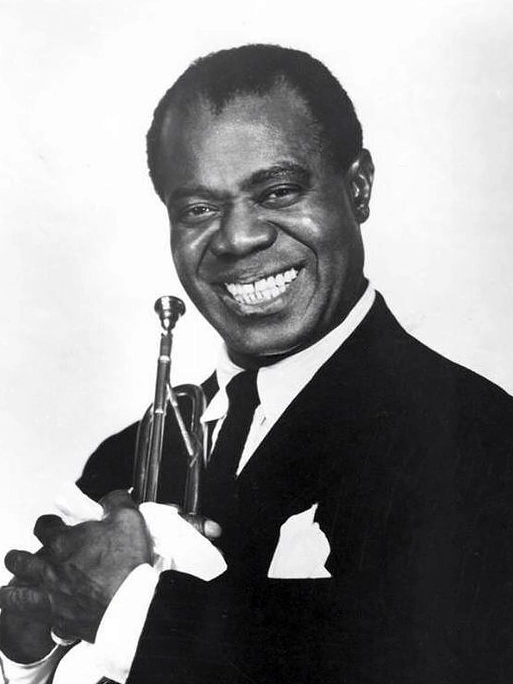
| 9 Quotes | |
| Born as | Louis Daniel Armstrong |
| Known as | Satchmo, Pops, Satchelmouth |
| Occup. | Musician |
| From | USA |
| Born | August 4, 1901 New Orleans, Louisiana, United States |
| Died | July 6, 1971 Corona, Queens, New York, United States |
| Cause | Heart attack |
| Aged | 69 years |
| Cite | |
Citation Formats
APA Style (7th ed.)
Louis armstrong biography, facts and quotes. (2026, March 23). FixQuotes. https://fixquotes.com/artists/louis-armstrong/
Chicago Style
"Louis Armstrong biography, facts and quotes." FixQuotes. March 23, 2026. https://fixquotes.com/artists/louis-armstrong/.
MLA Style (9th ed.)
"Louis Armstrong biography, facts and quotes." FixQuotes, 23 Mar. 2026, https://fixquotes.com/artists/louis-armstrong/. Accessed 25 Mar. 2026.
Early Life and Background
Louis Daniel Armstrong was born on August 4, 1901, in New Orleans, Louisiana, in a neighborhood shaped by poverty, vice districts, and the constant spillover of brass bands, parades, and church music. Raised largely by his mother, Mary Albert Armstrong, and with a father largely absent, he absorbed early lessons in hustle and humor as survival tactics. The city around him was a laboratory of sound-Creole dance music, ragtime, blues, and marching-band traditions braided together in the streets-and the young Armstrong learned that music could be both bread and belonging.A pivotal rupture came on New Year's Eve, 1912, when he fired a pistol into the air and was sent to the Colored Waif's Home for Boys. The institution was punitive, but it also placed instruments, discipline, and mentorship within reach; under the guidance of Peter Davis, Armstrong learned cornet and the rigors of ensemble playing. The experience left him with a lifelong capacity to turn constraint into swing: the smile was real, but it was also armor, a way of transmuting hardship into radiance without denying where he came from.
Education and Formative Influences
Armstrong's education was largely musical and practical, learned on bandstands, riverboats, and in the informal conservatory of New Orleans. He listened hard to the cornet kings Joe "King" Oliver and Freddie Keppard, and to the blues phrasing that bent notes like speech; he also learned from work songs, parades, and the rough etiquette of Storyville and its surrounding dance halls. When Oliver threw him early opportunities, Armstrong learned not only repertoire but leadership-how to cue a band, how to balance showmanship with time, and how to make a melody feel inevitable.Career, Major Works, and Turning Points
Armstrong left New Orleans for Chicago in 1922 to join Oliver's Creole Jazz Band, a move that placed him at the center of the Great Migration-era entertainment economy and the recording industry. After key early recordings with Oliver, he made a defining leap in 1924 by joining Fletcher Henderson in New York, where his hot phrasing and rhythmic drive reshaped big-band jazz from within. Returning to Chicago, he led his own small groups and recorded the landmark Hot Five and Hot Seven sessions (1925-1928), including "West End Blues" (1928), a statement of virtuosity and architecture that helped shift jazz toward the primacy of the soloist. Through the 1930s and 1940s he became an international star via radio, film, and relentless touring; he later formed the All Stars in 1947, presenting a more traditional small-group format to global audiences. His late-career pop crossover "Hello, Dolly!" topped the charts in 1964, and his gravel-and-gold vocal on "What a Wonderful World" (recorded 1967) became an enduring epitaph for his public persona. He died in Queens, New York, on July 6, 1971, after years of health problems, still identified with the stage as home.Philosophy, Style, and Themes
Armstrong's art was rooted in a democratic idea of sound: any melody could be transformed if the feeling was honest and the time was right. His improvisations expanded the harmonic and rhythmic vocabulary of jazz, but their deeper innovation was psychological-he played as if confidence could be manufactured in real time, chorus by chorus, until it became contagious. He insisted on a plainspoken standard for value: “There is two kinds of music, the good, and the bad. I play the good kind”. That blunt line was less anti-intellectual than anti-pretension, a defense of music as lived experience rather than social credential.His trumpet tone combined brilliance with vocal grit, and his phrasing treated rhythm as conversation: delays, accents, and bent pitches that sounded like laughter, argument, prayer. Armstrong also reframed singing, turning a weathered voice into an instrument of intimacy; his scat was not novelty but percussion, melody, and personality fused. The core belief was identity through sound-“You blows who you is”. -and it explains why his performances feel confessional even when wrapped in comedy. For Armstrong, jazz was not a definition to debate but a sensation that arrived in the body before language: “If you have to ask what jazz is, you'll never know”. The message, beneath the grin, was rigorous: know it by doing it, by risking yourself in public, by making time swing even when life does not.
Legacy and Influence
Armstrong's influence is foundational: he helped establish the soloist as the central force in jazz, set benchmarks for trumpet technique and rhythmic feel, and modeled how charisma can coexist with deep musicianship. His recordings became textbooks for generations-Dizzy Gillespie and Miles Davis studied him, as did singers who learned phrasing from his breath and timing from his pauses. Yet his legacy also carries the complexities of race, audience expectation, and survival in Jim Crow America: his genial stage persona opened doors while sometimes inviting misunderstanding, even as he privately bristled at injustice and publicly criticized segregation during the Little Rock crisis. Across decades and continents, he made a case that music could be both art and testimony-a sound that preserved New Orleans in exile and taught the world to hear swing as a way of being alive.Our collection contains 9 quotes written by Louis, under the main topics: Truth - Music - Life - Knowledge.
Other people related to Louis: Frank Sinatra (Musician), Billie Holiday (Musician), Lionel Hampton (Musician), Ella Fitzgerald (Musician), Jackson Browne (Musician), Bill Dixon (Musician), Stanley Crouch (Critic), Cab Calloway (Musician), Malcolm Arnold (Composer), Charles Mingus (Musician)
Source / external links