
Aaron McGruder Biography Quotes 15 Report mistakes
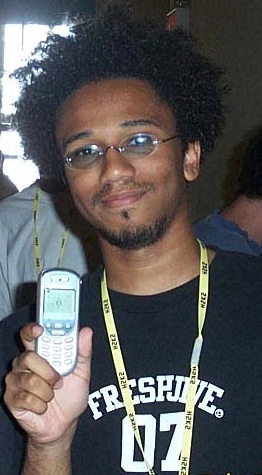
| 15 Quotes | |
| Occup. | Artist |
| From | USA |
| Born | May 29, 1974 Chicago, Illinois, USA |
| Age | 51 years |
| Cite | |
Citation Formats
APA Style (7th ed.)
Aaron mcgruder biography, facts and quotes. (2026, March 4). FixQuotes. https://fixquotes.com/authors/aaron-mcgruder/
Chicago Style
"Aaron McGruder biography, facts and quotes." FixQuotes. March 4, 2026. https://fixquotes.com/authors/aaron-mcgruder/.
MLA Style (9th ed.)
"Aaron McGruder biography, facts and quotes." FixQuotes, 4 Mar. 2026, https://fixquotes.com/authors/aaron-mcgruder/. Accessed 27 Mar. 2026.
Early Life and Background
Aaron McGruder was born May 29, 1974, in Chicago, Illinois, and grew up largely in the Washington, D.C. area, coming of age in a city where politics is not an abstraction but an everyday weather system. That proximity to power - and to the media machine that translates power for public consumption - became his earliest subject matter. As a Black kid watching the post-civil-rights promise harden into the tough-on-crime 1990s, he absorbed how quickly public language turns moral and punitive, and how easily culture can be sold as consensus.His family later moved to Columbia, Maryland, a planned suburb whose tidy surfaces made racial and class tensions feel especially coded. The contrast between official narratives of progress and the lived reality of inequality helped shape his instinct for satire as a form of truth-telling. McGruder learned to hear the gap between what institutions say and what they do; the sharper the public performance, the more he listened for the subtext.
Education and Formative Influences
McGruder attended the University of Maryland, College Park, where he studied African American Studies and began drawing a comic strip that fused campus argument, hip-hop sensibility, and political critique into a single voice. The period mattered: the Clinton era culture wars, the rise of 24-hour cable news, and the early internet all rewarded hot takes and performative outrage, while also offering new lanes for independent creators. In that climate, McGruder refined a style that treated the newspaper comic not as a comfort object but as an editorial page with punchlines.Career, Major Works, and Turning Points
He launched The Boondocks in 1996 and soon syndicated it nationally, building a devoted readership around characters like Huey and Riley Freeman - children who spoke with the fluency of activists, cynics, and consumers at once. After the September 11 attacks and the start of the War on Terror, his strip intensified its focus on propaganda, policing, and national mythology, drawing controversy and occasional pullbacks by newspapers. A major turning point came with the Adult Swim animated adaptation (premiered 2005), which expanded his reach and sharpened the work's cultural footprint through episodes that treated Black politics, media spectacle, and American violence as recurring national rituals. McGruder also wrote and produced television, later developing Black Jesus (2014), a deliberately abrasive satire that tested how far American audiences would tolerate blasphemy in the service of social critique.Philosophy, Style, and Themes
McGruder's central obsession is not politics as party alignment but politics as storytelling - the way authority manufactures the frame before the facts arrive. He has consistently argued for journalism stripped of symbolic coercion: “I don't want the news to be patriotic. I don't want to see flags on the lapels of the anchors. I don't want any of that”. That sentence is less a media preference than a psychological diagnosis: he distrusts the emotional uniforms that ask viewers to pre-agree, and he writes from the fear that civic identity can be weaponized into compliance. His satire treats patriotism, in its televised form, as an editing choice that precedes thought.Stylistically, McGruder blends the bluntness of street conversation with the structure of a debate, often placing radical analysis in the mouths of children to expose adult rationalizations. His work is intentionally confrontational, animated by the belief that liberal democracy frequently fails the people it congratulates itself for protecting: “We have essentially a worthless democracy”. Even his craft persona is part of the story - the artist as driven, procrastinating, and perpetually in the red with time: “One, I push my deadlines closer than anybody else, or let's say it this way: I'm really late”. The joke reads as self-deprecation, but it also hints at urgency - as if the news cycle is always about to outrun the cartoonist trying to pin it down.
Legacy and Influence
McGruder helped remake the possibilities of mainstream American satire by proving that a Black-led, explicitly political comic could live in syndication and then thrive in adult animation without sanding down its anger. The Boondocks influenced a generation of writers and animators who treat race, media, and state power as legitimate subjects for comedy rather than special-episode exceptions, and it expanded how audiences understand the comic strip as a venue for cultural criticism. His enduring impact lies in the refusal to soothe: he trained viewers to interrogate the frames around the story, not just the story itself, and to recognize that laughter can be a tool for seeing - and surviving - a country that often sells myth as news.Our collection contains 15 quotes written by Aaron, under the main topics: Witty One-Liners - Truth - Justice - Music - Sarcastic.
Source / external links