
Abigail Adams Biography Quotes 13 Report mistakes
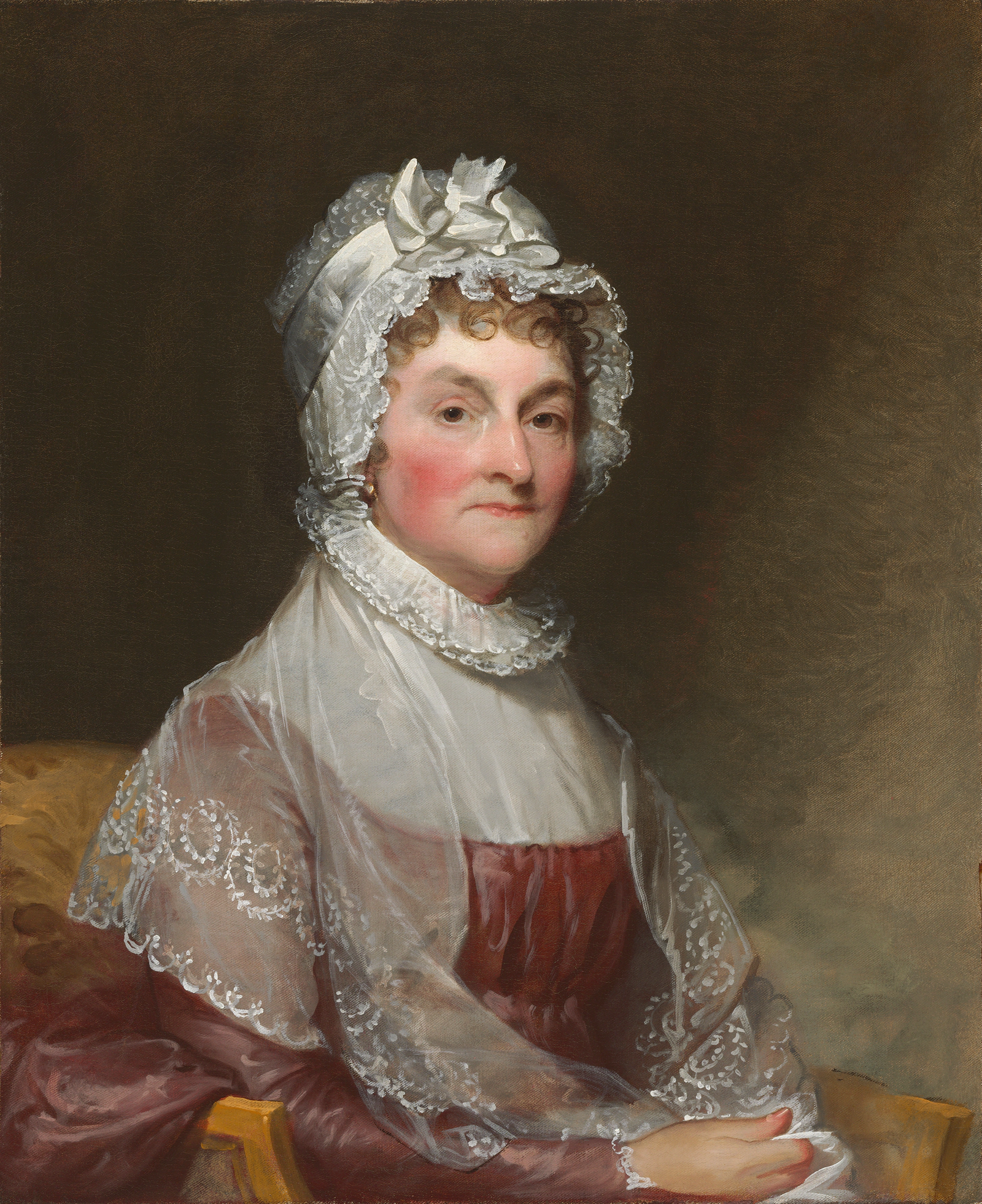
Attr: Gilbert Stuart
| 13 Quotes | |
| Born as | Abigail Smith |
| Occup. | First Lady |
| From | USA |
| Born | December 22, 1744 Weymouth, Massachusetts |
| Died | October 28, 1818 Quincy, Massachusetts |
| Aged | 73 years |
| Cite | |
Citation Formats
APA Style (7th ed.)
Abigail adams biography, facts and quotes. (2026, February 11). FixQuotes. https://fixquotes.com/authors/abigail-adams/
Chicago Style
"Abigail Adams biography, facts and quotes." FixQuotes. February 11, 2026. https://fixquotes.com/authors/abigail-adams/.
MLA Style (9th ed.)
"Abigail Adams biography, facts and quotes." FixQuotes, 11 Feb. 2026, https://fixquotes.com/authors/abigail-adams/. Accessed 26 Mar. 2026.
Early Life and Background
Abigail Smith was born on December 22, 1744, in Weymouth, Massachusetts, into a New England world where Congregational faith, local governance, and household economy were tightly braided. Her father, Rev. William Smith, minister of the First Church in Weymouth, and her mother, Elizabeth Quincy Smith, placed her within the interlinked clerical and merchant gentry of the Massachusetts Bay colony. The Quincy connections and the Smith parsonage meant books, visitors, and argument - an early apprenticeship in how ideas travel through families and factions.Sickly in childhood and often kept from formal schooling, she grew up learning by necessity: reading at home, watching the labor of women that made public life possible, and absorbing the moral seriousness of provincial religion. That mix formed a temperament both dutiful and intellectually hungry. Before the Revolution, Massachusetts politics were already sharpening around taxation and imperial authority; her adolescence unfolded as ordinary life became permeated with pamphlets, sermons, and talk of rights.
Education and Formative Influences
Denied extended formal education because of health and convention, Abigail effectively built her own curriculum through voracious reading, correspondence, and the expectations of a minister's household. She read history, theology, poetry, and the political literature circulating in the 1760s and 1770s, and she measured herself against the limits imposed on women rather than accepting them as natural. Early friendships, especially with her cousin Mary Cranch, reinforced habits of reflective writing. When she married John Adams on October 25, 1764, the partnership quickly became a school of politics: law, elections, and imperial crisis entered the marriage not as distant topics but as daily decisions with costs.Career, Major Works, and Turning Points
Abigail Adams never held office, yet she performed a public function through private means, turning the household into a political outpost. During the Revolution she managed the Adams farm in Braintree (later Quincy), supervised finances and tenants, and endured scarcity and smallpox inoculation while John served the Continental Congress and later diplomatic posts in Europe. Her letters - especially to John Adams from 1774 onward - became her major work, a sustained chronicle of war, governance, and family. She lived in Paris and London during John Adams's diplomatic service, then returned to the United States as the new republic took shape. As First Lady (1797-1801) during John Adams's presidency, she navigated partisan ferocity, the Quasi-War with France, and the pressures of public display in the unfinished capital. After the bitter election of 1800 and retirement to Quincy, she continued extensive correspondence, including with Thomas Jefferson in later years, while witnessing her son John Quincy Adams rise to national leadership.Philosophy, Style, and Themes
Her political philosophy begins in mistrust of unchecked authority and ends in an ethic of responsibility. She could sound like a theorist of power while writing from a kitchen table: “I am more and more convinced that man is a dangerous creature and that power, whether vested in many or a few, is ever grasping, and like the grave, cries, 'Give, give.'”. That suspicion was not abstract. It grew from watching how war empowers committees, how parties harden into tribes, and how domestic law can turn marriage into a small autocracy. Her insistence on constitutional restraint was paired with a practical sense that liberty must be built into ordinary relations, not merely declared.Her style is intimate and analytic - plainspoken, quick to irony, and psychologically exact. She pressed the Revolution to include women not as symbols but as citizens, warning that exclusion breeds resistance: “If particular care and attention is not paid to the ladies, we are determined to foment a rebellion, and will not hold ourselves bound by any laws in which we have no voice, or representation”. Education, for her, was the hinge between private virtue and public competence, a theme sharpened by her own self-taught life: “If we mean to have heroes, statesmen and philosophers, we should have learned women”. Across grief, distance, and political defeat, she returns to the same inner argument - that a republic survives only if it cultivates judgment, and that judgment requires both learning and moral courage.
Legacy and Influence
Abigail Adams endures as a foundational witness to the American Revolution and early republic, not because she was merely adjacent to power, but because she interpreted it from the inside with unusual clarity. Her correspondence is now treated as essential political literature: a record of how policy reverberates through households, how women sustained wartime economies, and how republican ideals collided with inherited hierarchies. As a First Lady she helped define the role as civic partner rather than decorative consort, and as a thinker she supplied later generations of reformers with language for rights, representation, and women's education. Her life, spanning 1744-1818, links colonial New England to a consolidating nation - and her voice keeps the founding era morally unsettled in the best way, pressing it toward the equality it proclaimed.Our collection contains 13 quotes written by Abigail, under the main topics: Witty One-Liners - Motivational - Ethics & Morality - Wisdom - Freedom.
Other people related to Abigail: Alice S. Rossi (Sociologist), Joseph J. Ellis (Writer), David McCullough (Historian)
Source / external links