
Abraham Cowley Biography Quotes 11 Report mistakes
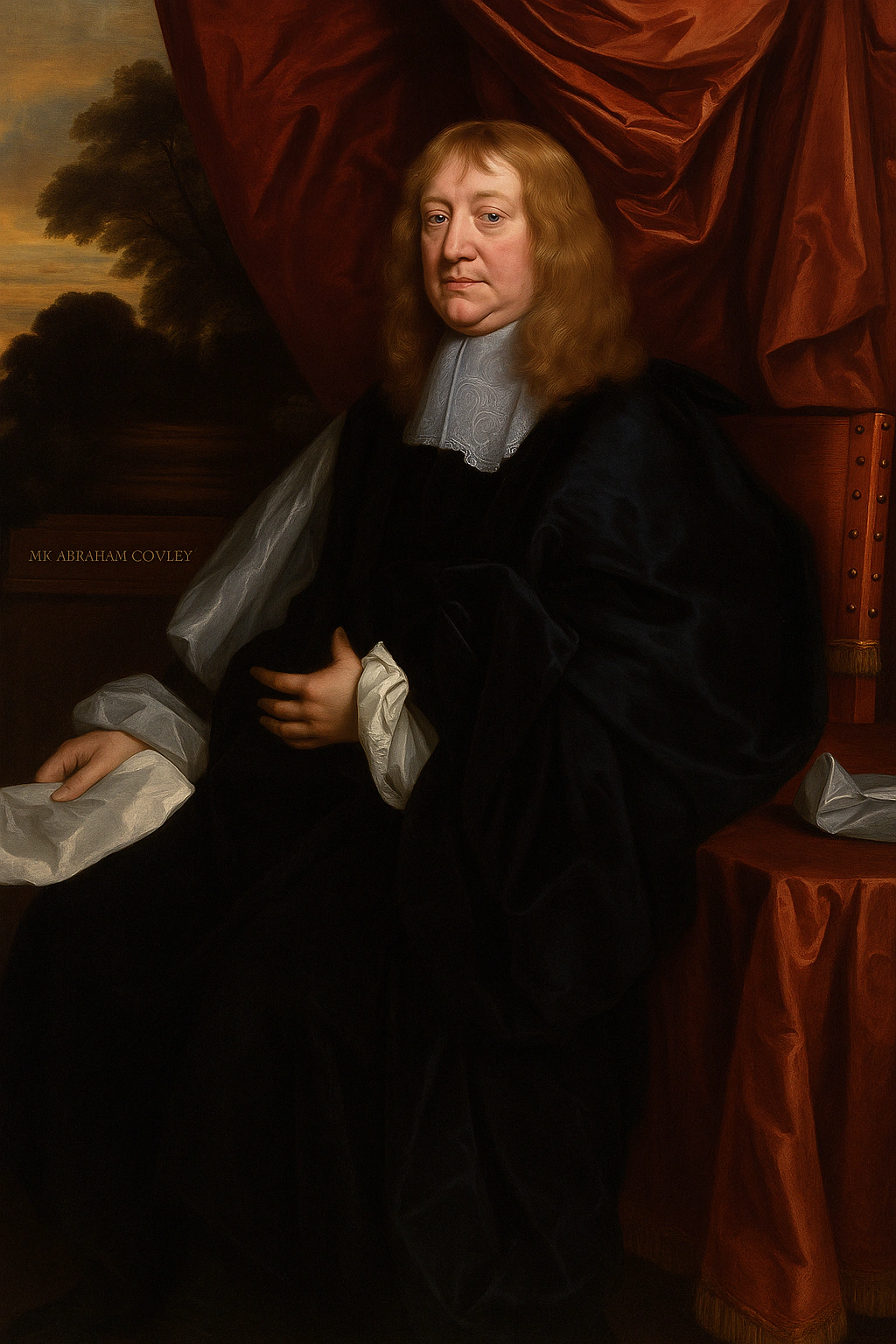
Attr: Peter Lely
| 11 Quotes | |
| Occup. | Poet |
| From | England |
| Born | 1618 AC London, England |
| Died | July 28, 1667 London, England |
| Cite | |
Citation Formats
APA Style (7th ed.)
Abraham cowley biography, facts and quotes. (2026, February 11). FixQuotes. https://fixquotes.com/authors/abraham-cowley/
Chicago Style
"Abraham Cowley biography, facts and quotes." FixQuotes. February 11, 2026. https://fixquotes.com/authors/abraham-cowley/.
MLA Style (9th ed.)
"Abraham Cowley biography, facts and quotes." FixQuotes, 11 Feb. 2026, https://fixquotes.com/authors/abraham-cowley/. Accessed 26 Mar. 2026.
Early Life and Background
Abraham Cowley was born in London in 1618, the posthumous son of a wealthy stationer. His father died shortly before his birth, leaving the household governed by his mother and by the citys mercantile expectations - a practical world that sat uneasily beside the boys early absorption in books. London in Cowleys childhood was crowded, theatrical, and unstable: the memory of plague cycles and the widening rift between court culture and reforming piety formed an atmosphere in which language itself felt contested, and the future seemed a matter of factions.
Precocity was his first public identity. As a schoolboy he produced verse that looked upward toward classical polish and courtly wit rather than toward homiletic plain style, and he learned early that a poem could be both a private instrument and a social credential. That double use - inward consolation and outward negotiation - would persist through the dislocations of civil war, exile, and the difficult peace that followed the Restoration.
Education and Formative Influences
Cowley attended Westminster School and then Trinity College, Cambridge, where he moved through a curriculum steeped in Latin poets, rhetoric, and the new prestige of learned experiment. He published his early collection Poetical Blossoms (1633) while still very young, a sign not only of talent but of a temperament willing to submit imagination to form. At Cambridge he absorbed the metaphysical manner associated with John Donne and later judged by many through Ben Jonsons stricter lens - a manner of argumentative lyric, quick analogy, and intellectual surprise - while also cultivating a lasting interest in natural philosophy that would later surface in his essays and in his praise of scientific inquiry.
Career, Major Works, and Turning Points
The English Civil War made Cowleys career a series of forced adaptations. He wrote The Guardian (1641), a comedy staged at Cambridge, then attached himself to the royalist cause and followed the court into displacement; in the 1640s and 1650s he lived largely in Paris, serving the exiled Queen Henrietta Maria and acting as a ciphering secretary in royalist correspondence. During these years he produced The Mistress (1647), love lyrics whose ingenuity often masks political bereavement, and the Pindarique Odes (1656), whose irregular structures sought grandeur adequate to upheaval. After the Restoration he returned to England hoping for reward, but the settlement brought less than he imagined. Worn by disappointment and illness, he withdrew to rural Chertsey, where he pursued a quieter life of reading, gardening, and writing; he died on 28 July 1667 and was buried in Westminster Abbey, a public honor that contrasted with his private sense of having missed the full measure of worldly recompense.
Philosophy, Style, and Themes
Cowleys inner life turns on a paradox: he loved the world as material for thought, yet suspected the world as a theatre of vanities. This tension gives his work its distinctive movement - the mind racing through comparisons, then pulling back into moral appraisal. Even when he writes of retreat, it is not ignorant withdrawal but a hard-won posture toward experience: “Solitude can be used well by very few people. They who do must have a knowledge of the world to see the foolishness of it, and enough virtue to despise all the vanity”. The sentence reads like self-indictment as much as advice, as if he knew solitude was an aspiration that required the very social bruises he spent years collecting.
His style is classically ambitious but emotionally modern in its self-scrutiny. Cowley helped carry the metaphysical habit into the later seventeenth century, marrying learned allusion to a conversational candor that could pivot from metaphysics to weariness in a line. Beneath the wit lies a temperament that treats time as both torment and abstraction, a mind searching for a standpoint beyond political reversals and personal disappointment: “Nothing is to come, and nothing past: But an eternal now, does always last”. Yet he never entirely renounces human need; he repeatedly returns to consolation as a practical technology for survival, admitting how thin it can be and how necessary: “Hope! of all ills that men endure, the only cheap and universal cure”. In these pressures - retreat versus engagement, timelessness versus history, consolation versus disillusion - Cowleys poems and essays reveal a man attempting to make a livable philosophy out of loss.
Legacy and Influence
Cowley was celebrated in his lifetime as one of Englands leading wits and later became a pivotal figure in the story of poetic taste: the Augustans admired his learning while faulting his "metaphysical" strain, and Samuel Johnsons famous Life of Cowley helped define both Cowleys reputation and the category that would eclipse it. Yet his influence proved durable in subtler ways: his Pindaric experiments opened a path for later ode writers, his essays on retirement shaped the English ideal of cultivated withdrawal, and his union of curiosity with moral judgment anticipated the tone of later reflective prose. He stands now as a poet formed by civil war and exile who tried, through disciplined ingenuity, to translate a fractured century into patterns the mind could endure.
Our collection contains 11 quotes written by Abraham, under the main topics: Ethics & Morality - Wisdom - Love - Mortality - Hope.
Frequently Asked Questions
- Abraham Cowley The Wish: “The Wish” is a poem where Cowley imagines a modest, retired country life, expressing his desire for quiet, independence, and freedom from courtly ambitions.
- Abraham Cowley teach me to Love: “Teach Me to Love” is a love poem by Cowley in which the speaker asks to be taught how to love wisely and virtuously rather than with merely passionate desire.
- Abraham Cowley essays: Cowley’s prose work “Several Discourses by Way of Essays” includes essays such as “Of Solitude,” “Of Liberty,” and “Of Agriculture,” reflecting his views on retirement and rural life.
- Abraham Cowley Davideis: “Davideis” is Cowley’s unfinished religious epic poem about the life of King David, written in heroic couplets and aiming to be a Christian epic in the classical style.
- Abraham Cowley dead poets society: Abraham Cowley is not featured in the film “Dead Poets Society,” but he is a 17th‑century English metaphysical poet sometimes studied alongside that era’s writers.
- Abraham Cowley pronunciation: Abraham Cowley is pronounced AY-bruh-ham KOH-lee.
- Abraham Cowley poems: Abraham Cowley is known for poems such as “The Mistress,” “Davideis,” “The Wish,” “Of Solitude,” and “Hymn to Light,” blending metaphysical wit with classical elegance.
Source / external links