
Abraham Lincoln Biography Quotes 115 Report mistakes
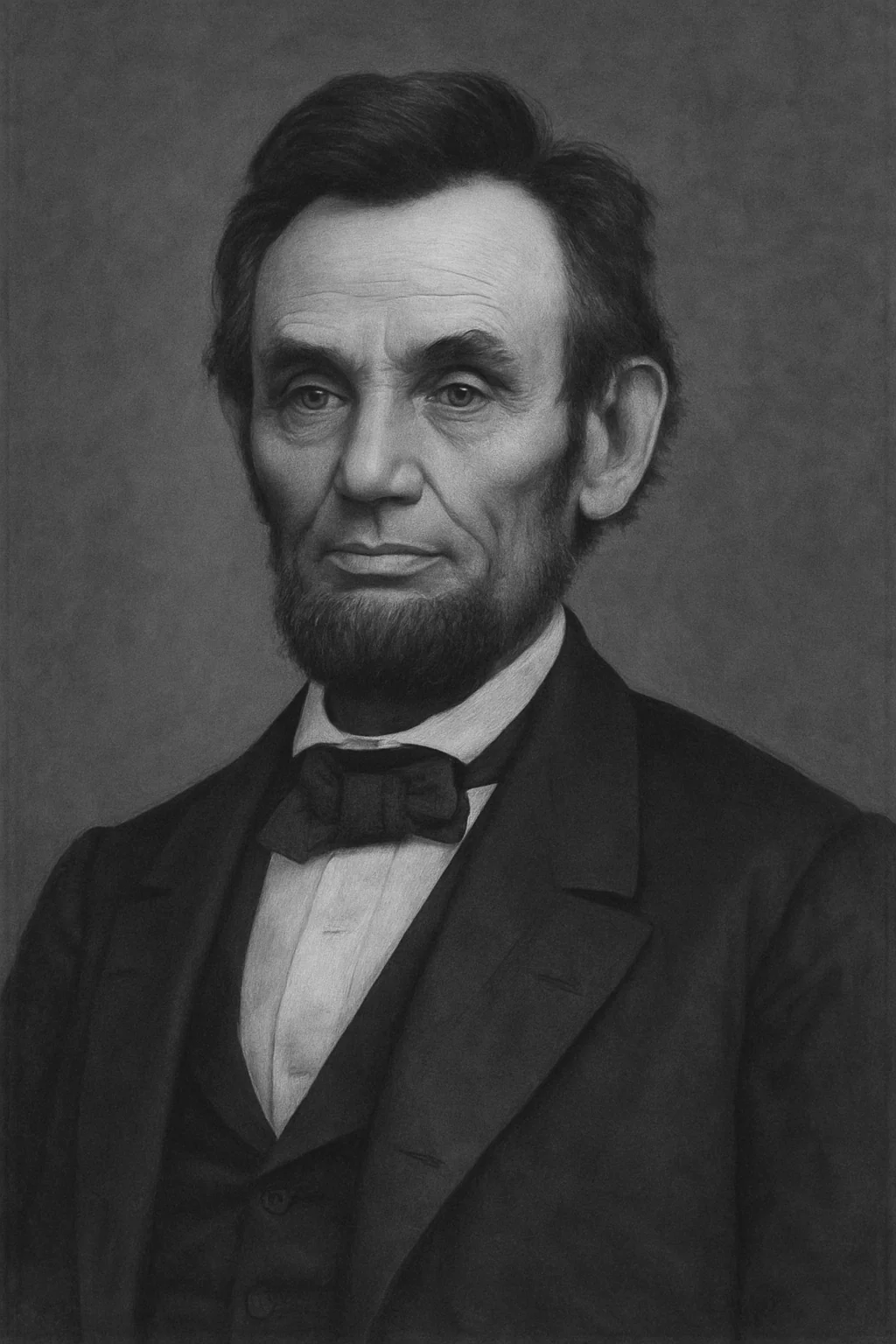
| 115 Quotes | |
| Occup. | President |
| From | USA |
| Born | February 12, 1809 |
| Died | April 15, 1865 |
| Aged | 56 years |
| Cite | |
Citation Formats
APA Style (7th ed.)
Abraham lincoln biography, facts and quotes. (2026, February 1). FixQuotes. https://fixquotes.com/authors/abraham-lincoln/
Chicago Style
"Abraham Lincoln biography, facts and quotes." FixQuotes. February 1, 2026. https://fixquotes.com/authors/abraham-lincoln/.
MLA Style (9th ed.)
"Abraham Lincoln biography, facts and quotes." FixQuotes, 1 Feb. 2026, https://fixquotes.com/authors/abraham-lincoln/. Accessed 25 Mar. 2026.
Early Life and Background
Abraham Lincoln was born on February 12, 1809, in a one-room log cabin at Sinking Spring Farm near Hodgenville, Kentucky, the second child of Thomas Lincoln and Nancy Hanks Lincoln. His earliest memories were formed in a borderland of thin soil, insecure titles, and hard manual labor, where debt and illness could erase small gains. In 1816 the family crossed the Ohio River to Indiana, joining the rough migration that also carried slavery debates westward. When Nancy died in 1818, likely of milk sickness, the nine-year-old Lincoln absorbed a lesson that never left him: life was precarious, and endurance was not a virtue you praised so much as a discipline you practiced.In 1819 Thomas married Sarah Bush Johnston, who encouraged the boy's reading and steadied the household. Lincoln grew into unusual physical strength and an inward, bookish intensity that neighbors remembered as both humorous and melancholy. The Lincolns moved again in 1830 to Macon County, Illinois, and the next year Abraham struck out on his own, working at New Salem on the Sangamon River. There, among store ledgers, boat landings, and courthouse talk, he began to reshape himself from hired hand into citizen-arguer - someone who could translate frontier experience into public language.
Education and Formative Influences
Lincoln had little formal schooling, but he educated himself with relentless purpose, reading the King James Bible, Aesop, Bunyan, Defoe, and especially Shakespeare and political speeches. He studied surveying and law, joined a local militia during the Black Hawk War in 1832, and learned how quickly crowd emotion could turn into violence or panic. Elected to the Illinois legislature in 1834 and admitted to the bar in 1836, he developed his habits of logic, story, and moral reasoning in dusty courtrooms and long rides on the Eighth Judicial Circuit, absorbing the contradictions of a republic expanding across Indigenous dispossession while arguing over slavery's future.Career, Major Works, and Turning Points
Lincoln rose from Whig legislator to one-term congressman (1847-1849), then returned to law until the Kansas-Nebraska Act of 1854 reopened slavery's expansion and pulled him back into politics. The Lincoln-Douglas debates of 1858, though ending in his Senate defeat, made him a national figure by forcing the nation to choose between popular sovereignty and the premise that slavery was a moral and political wrong. Elected 16th president in 1860 as Southern states seceded, he navigated civil war, constitutional crisis, and personal grief, issuing the Emancipation Proclamation on January 1, 1863 as a war measure that also redefined Union purpose. His best-known writings - the Gettysburg Address (1863) and Second Inaugural (1865) - compressed battlefield horror, democratic theory, and moral accounting into language meant to bind wounds without forgetting causes. He was assassinated at Ford's Theatre on April 14, 1865, and died the next morning, April 15, in Washington, D.C.Philosophy, Style, and Themes
Lincoln's inner life was a sustained contest between fatalism and responsibility. He did not present himself as a prophet; he presented himself as a steward under judgment, wary of claiming heaven for a faction. “Sir, my concern is not whether God is on our side; my greatest concern is to be on God's side, for God is always right”. That sentence is less piety than psychological guardrail: it blocks the intoxication of righteousness that civil war breeds, and it explains his willingness to revise policy when reality and conscience collided. His theology was spare, his moral language biblical, and his governing style pragmatic, but his pragmatism was anchored to the idea that the Union was more than a contract - it was a test of whether self-government could survive its own hatreds.His prose style combined frontier clarity with lawyerly structure and Shakespearean cadence, using parable and antithesis to make complex choices feel inevitable. Even his humor functioned as emotional ballast, a way to keep despair from freezing action. “Am I not destroying my enemies when I make friends of them?” The line reveals a mind that saw politics not as catharsis but as conversion, and it underwrites his insistence on reconstruction without extermination of the defeated. Beneath the famous patience was a directional will: “I walk slowly, but I never walk backward”. That is Lincoln's governing temperament in miniature - cautious steps, fixed end, and a refusal to retreat from the central claim that the nation could not endure half slave and half free.
Legacy and Influence
Lincoln remade the presidency by expanding federal power to preserve the Union while tethering that power to constitutional argument, elections, and public persuasion. His wartime measures remain disputed - suspension of habeas corpus, military tribunals, sweeping executive action - yet his lasting achievement is the moral and political redefinition of the United States around emancipation and equal citizenship, later cemented in the Thirteenth Amendment. Globally, he became a symbol of democratic resolve under internal fracture, and domestically he remains the American benchmark for civic rhetoric: grief disciplined into meaning, victory restrained by humility, and national purpose expressed in sentences ordinary people can carry into their own storms.Our collection contains 115 quotes written by Abraham, under the main topics: Witty One-Liners - Motivational - Ethics & Morality - Truth - Wisdom.
Other people related to Abraham: Dale Carnegie (Writer), Henry B. Adams (Historian), Phillips Brooks (Clergyman), Henry Clay (Statesman), Edward Everett (Statesman), Salmon P. Chase (Politician), Daniel Day-Lewis (Actor), Doris Kearns Goodwin (Historian), Andre Kostelanetz (Musician), Henry Villard (Journalist)
Abraham Lincoln Famous Works
- 1865 Second Inaugural Address (Speech)
- 1863 The Gettysburg Address (Speech)
- 1863 The Emancipation Proclamation (Document)
- 1861 First Inaugural Address (Speech)
- 1858 The Lincoln-Douglas Debates (Debate Transcripts)