
Abraham Zapruder Biography Quotes 7 Report mistakes
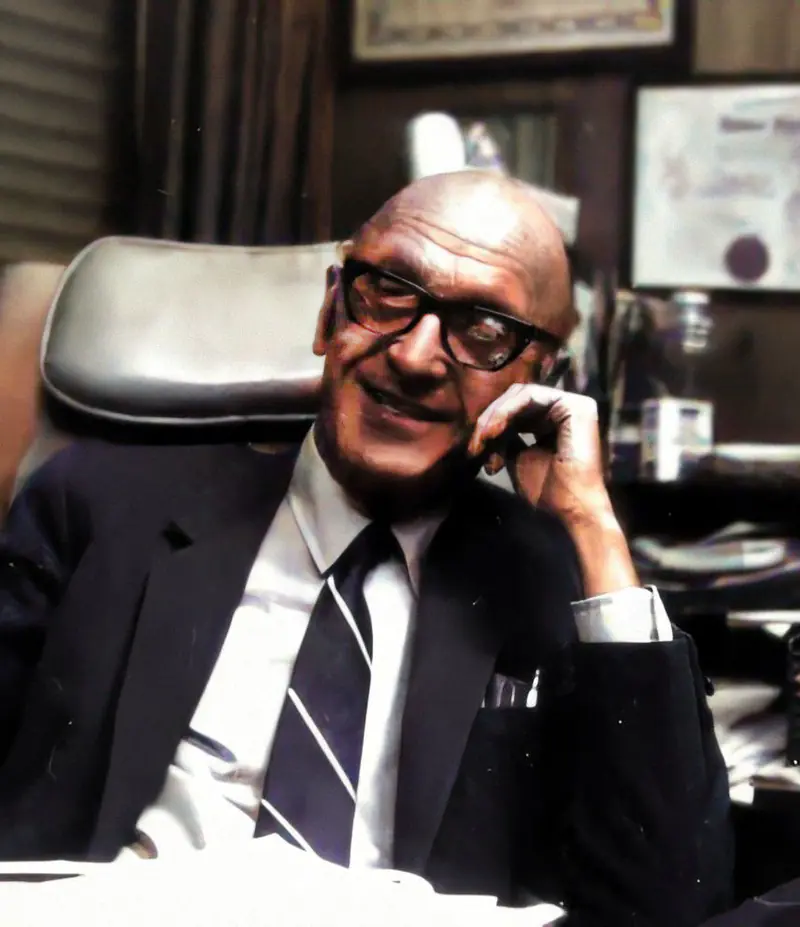
| 7 Quotes | |
| Occup. | Businessman |
| From | Ukraine |
| Born | May 15, 1905 Kovel, Ukraine |
| Died | August 30, 1970 Dallas, Texas, USA |
| Aged | 65 years |
Abraham Zapruder was born in 1905 in Kovel, then part of the Russian Empire and now within Ukraine. Raised in a Jewish family amid political turmoil and recurrent violence in the region, he immigrated to the United States as a teenager. He settled first in New York City, where he learned the garment trade from the ground up. The craft, precision, and steady labor of dressmaking suited his temperament and provided a path into the American middle class. In time he became a naturalized citizen and married Lillian, with whom he built a family that included their children, Myrna and Henry. The values he brought from his upbringing, discretion, a strong work ethic, and care for community, remained evident throughout his life.
Career in Dallas
In the early 1940s he moved to Dallas, Texas, where the apparel industry was growing. By the late 1950s he co-founded Jennifer Juniors, a dress manufacturing firm that specialized in women's fashions. As a designer and executive, he was known for attention to detail and for treating employees with courtesy. His office at 501 Elm Street, near Dealey Plaza, placed him at a crossroads of downtown life. Among his close associates was Erwin Schwartz, who worked with him in business matters, and his assistant, Marilyn Sitzman, who managed office affairs and supported him in day-to-day operations. Zapruder cultivated reliable relationships with suppliers and customers and earned a reputation for fairness in negotiations.
Citizenship and Community
Zapruder was active in civic and Jewish community life in Dallas. Friends and family described him as modest, quietly patriotic, and wary of publicity. He enjoyed amateur photography and home movies, a popular pastime of the era, often documenting family events and work gatherings. The small 8 mm camera he used would later place him, unexpectedly and unwillingly, at the center of one of the most scrutinized moments in American history.
November 22, 1963
When President John F. Kennedy and First Lady Jacqueline Kennedy visited Dallas, the motorcade's route passed directly by Zapruder's office. Expecting a historic moment, he brought his Bell & Howell 8 mm camera to work. Shortly before the motorcade arrived, he and Marilyn Sitzman walked to a concrete pedestal on the north side of Elm Street in Dealey Plaza. He climbed onto it for a clear vantage point while Sitzman stood behind him, steadying him so he would not lose balance as he filmed.
As the open limousine carrying President Kennedy and Texas Governor John Connally approached, Zapruder began filming. The sequence he captured lasted only seconds but recorded the gunfire that wounded Governor Connally and fatally wounded the President. Shaken and distraught, Zapruder hurried back to his office. He immediately sought to cooperate with authorities and with journalists while trying to manage the shock felt by his colleagues, including Sitzman and Schwartz, who helped him in the chaotic hours that followed.
Processing and Disposition of the Film
Working with the Secret Service, specifically the Dallas agent in charge, Forrest Sorrels, Zapruder took the original 8 mm film to the local Kodak facility for processing. From there, three copies were produced at the Jamieson Film Company so investigators could review the footage without handling the original. The film quickly became crucial evidence for law enforcement and for the federal investigation into the assassination.
That weekend, representatives of the press converged on Dallas. Richard B. Stolley of Life magazine negotiated directly with Zapruder and Schwartz for publication rights. Zapruder insisted that the most graphic images be handled with sensitivity and that his cooperation not be sensationalized. Life acquired rights to publish frames in print and later secured broader rights to the film. Zapruder donated his first payment to the widow and children of Dallas police officer J. D. Tippit, who had been killed the same day, reflecting his wish that any proceeds serve a public good rather than personal gain.
Public Role and Reluctant Fame
Although suddenly known to the wider public, Zapruder remained a reluctant figure in the spotlight. He gave statements and testimony when asked and worked with investigators, including those associated with the Warren Commission, which treated the film as a central piece of evidence. He continued to manage his business and shield his family, Lillian, Myrna, and Henry, from unwanted attention. Friends observed that the experience weighed on him; he had recorded a national tragedy and felt a responsibility to ensure the images were used with care.
Later Years and Death
Zapruder returned to as normal a routine as possible in the years after the assassination. He maintained his leadership at Jennifer Juniors and preserved cordial relations with associates who had been present during the events, particularly Marilyn Sitzman and Erwin Schwartz, whose help he valued during the difficult aftermath. In 1970 he died in Dallas after an illness, remembered by family and colleagues as a kind, steady, and conscientious man whose life's work had been in fashion, not in film.
Posthumous Developments
Following his death, his film remained a subject of intense public and scholarly interest. Life magazine had custody for a time, and images from the frames were reproduced in official investigations and historical studies. The film's evidentiary value, paired with ethical questions about privacy and the depiction of violence, provoked debates that extended well beyond Dallas. Years later, the federal government deemed the film an assassination record of exceptional significance, and custodianship moved to the National Archives so that it could be preserved and made accessible within the framework of public records law. These steps occurred after Zapruder's lifetime, but they underscored how a brief home movie, shot by a quiet garment manufacturer standing on a small pedestal with the help of his assistant, became an enduring document in the nation's collective memory.
Legacy
Abraham Zapruder's legacy rests on a paradox. He was a businessman whose everyday concerns were fabric, fit, and delivery schedules, yet he produced the most analyzed amateur film in history. The people around him, his wife Lillian and their children, his assistant Marilyn Sitzman, his colleague Erwin Schwartz, investigators like Forrest Sorrels, and journalists such as Richard Stolley, shaped the immediate fate of the film and helped him navigate the turmoil. His decision to cooperate with authorities, his insistence on responsible handling of the images, and his charitable gesture toward Officer Tippit's family reflected his character. In American public life, his name has become shorthand for the power and burden of citizen eyewitnesses: ordinary individuals who, by chance, capture extraordinary events and, in doing so, alter how history is seen and understood.
Our collection contains 7 quotes who is written by Abraham, under the main topics: Writing - Mortality - Movie - Work - Police & Firefighter.
Abraham Zapruder Famous Works
- 1963 Zapruder film (Non-fiction)
Source / external links