
Adam Bandt Biography Quotes 8 Report mistakes
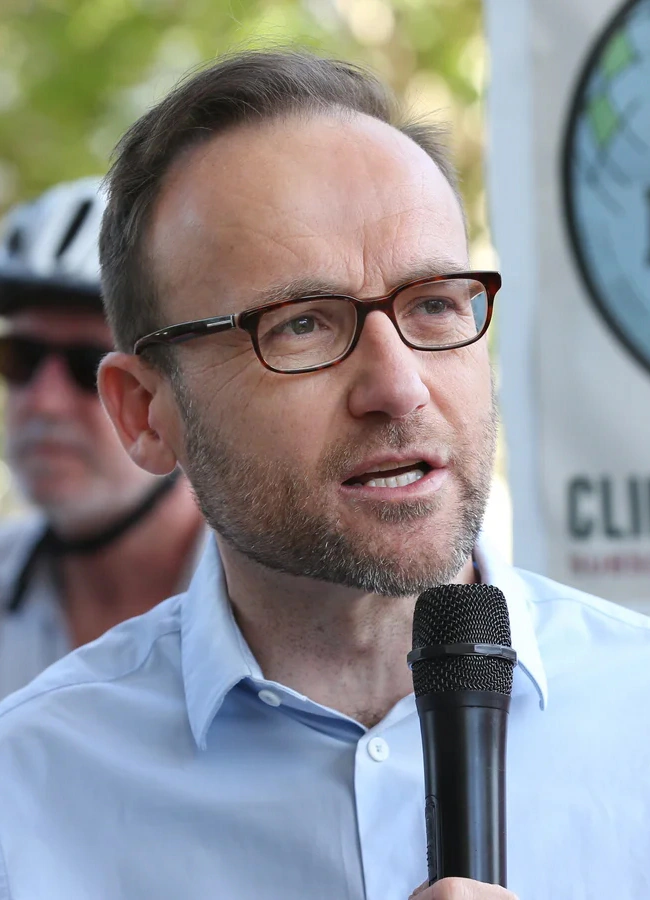
Attr: The Guardian
| 8 Quotes | |
| Born as | Adam Paul Bandt |
| Occup. | Politician |
| From | Australia |
| Spouse | Claudia Perkins (2013) |
| Born | March 11, 1972 Adelaide, South Australia, Australia |
| Age | 54 years |
| Cite | |
Citation Formats
APA Style (7th ed.)
Adam bandt biography, facts and quotes. (2026, March 17). FixQuotes. https://fixquotes.com/authors/adam-bandt/
Chicago Style
"Adam Bandt biography, facts and quotes." FixQuotes. March 17, 2026. https://fixquotes.com/authors/adam-bandt/.
MLA Style (9th ed.)
"Adam Bandt biography, facts and quotes." FixQuotes, 17 Mar. 2026, https://fixquotes.com/authors/adam-bandt/. Accessed 26 Mar. 2026.
Early Life and Background
Adam Paul Bandt was born on 11 March 1972 in Adelaide, South Australia, and grew up in a Catholic, lower-middle-class family whose habits of thrift, duty, and argument would leave a lasting mark on his politics. His father worked as a social worker and his mother was involved in social concerns shaped by church life; from that mix Bandt absorbed both institutional literacy and a sympathy for people whose lives were constrained by forces larger than themselves. He was one of four siblings, and his childhood unfolded in suburban Australia during the long afterlife of postwar social democracy - a world of state schools, union memory, and widening economic uncertainty.
That background matters because Bandt's later public persona - lawyerly, combative, and morally framed rather than merely technocratic - reflects an upbringing in which fairness was not an abstraction but a daily measure of whether institutions were doing their job. He came of age as Australia was being remade by deregulation, privatisation, and the neoliberal turn of the 1980s and 1990s. For many in his generation, politics no longer looked like a stable contest between two broad parties but a narrowing field in which climate risk, housing insecurity, and inequality were becoming impossible to ignore. Bandt's eventual place in the Greens was rooted in that historical shift.
Education and Formative Influences
Bandt attended Mercedes College in Adelaide before moving into higher education with a seriousness that foreshadowed his later command of policy detail. He studied at Murdoch University in Western Australia and later earned a law degree at Monash University in Melbourne. Student politics, legal training, and the intellectual atmosphere of the late 1990s shaped him more than any single doctrine. He was drawn to civil liberties, labour rights, and environmental justice at a time when globalisation protests, refugee debates, and the Iraq War were exposing the moral limits of bipartisan centrism. Work as an industrial and public interest lawyer deepened his sense that law could protect vulnerable people but also stabilise unequal power. Before entering parliament he taught in legal academia and campaigned on refugee rights, workers' rights, and climate action, building the hybrid identity that would define him: part movement activist, part legislator, part strategist of parliamentary leverage.
Career, Major Works, and Turning Points
Bandt entered electoral politics through the Victorian Greens and won the federal seat of Melbourne in 2010, becoming the first Green elected to the House of Representatives at a general election - a breakthrough in a chamber long dominated by Labor and the Coalition. His arrival coincided with the hung parliament of Julia Gillard, when the Greens' parliamentary support gave them unusual influence, especially on climate policy. Bandt became associated with the carbon pricing era, then with the bitter backlash that followed its repeal and the return of culture-war politics around energy. After years as one of the Greens' most visible federal figures, he became co-deputy leader and, in 2020, leader of the Australian Greens following Richard Di Natale's resignation. Under Bandt, the party sought to move from protest identity toward disciplined bargaining power: pressing Labor from the left on housing, renters' rights, environmental approvals, tax fairness, and social spending while trying to expand beyond inner-city strongholds. The 2022 election, which brought a surge of Greens lower-house seats in Brisbane, was a turning point that seemed to vindicate his long effort to fuse climate urgency with cost-of-living politics.
Philosophy, Style, and Themes
Bandt's politics are built on a simple but radical premise: democratic institutions should materially improve ordinary life, not merely manage decline. He speaks in the idiom of redistribution and public obligation rather than market inevitability. “Governments are supposed to make people's lives better”. That sentence captures both his moral impatience and his rhetorical discipline. Unlike some Green politicians whose language can drift toward ethical witness alone, Bandt habitually translates values into state action - rents, Medicare, wages, public housing, emissions caps. “Build homes people can afford, cap rent increases”. is not just a slogan but a window into his political psychology: he wants structural conflict made visible and then legislated against.
His style is adversarial but strategic. Bandt treats parliament as a site where numbers can convert marginal ideas into concessions, and his public language often signals conditionality rather than purity. “A power-sharing deal with Labor would usher in a golden era of progressive reform”. reveals the core of his method: not romantic opposition, but leverage. At the same time, his environmental politics remain uncompromising on the basic diagnosis of the age. Calls to “Stop new coal and gas projects”. are central to his identity because they express the belief that climate breakdown is not one issue among many but the boundary condition of modern politics. The tension that defines Bandt is therefore productive: he is animated by movement ideals yet obsessed with the machinery of votes, amendments, and negotiated outcomes.
Legacy and Influence
Bandt's historical significance lies less in executive power than in how he helped redefine what a minor party could be in twenty-first-century Australia. He has pushed the Greens from symbolic environmentalism toward a broader left program tying climate to class, housing, health, and democratic accountability. In doing so he has influenced Labor's policy debate, widened the electorate for Green politics among younger urban voters and renters, and normalised the idea that crossbench power can shape national direction. Supporters see him as one of the clearest parliamentary voices for a post-carbon, more egalitarian Australia; critics see a tactician whose maximal demands can harden stalemate. Either way, Bandt has become a consequential figure of his era - an interpreter of generational anger, a skilled negotiator in a fragmented parliament, and a politician whose career tracks Australia's struggle to reconcile prosperity, justice, and planetary limits.
Our collection contains 8 quotes written by Adam, under the main topics: Justice - Freedom - Equality - Health - Decision-Making.
Frequently Asked Questions
- Greens leader Adam Bandt: Leader of the Australian Greens since 2020; MP for Melbourne
- Adam Bandt - news: See latest coverage on ABC News, The Guardian Australia, SBS, or his official channels
- Adam Bandt election: First elected in 2010; re-elected in 2013, 2016, 2019, 2022
- Adam Bandt electorate: Melbourne (VIC)
- Adam Bandt salary: About A$230k base MP salary, plus a loading as Greens leader
- Adam Bandt wealth: Not publicly disclosed; see the parliamentary Register of Interests
- Adam Bandt wife: Claudia Perkins
- How old is Adam Bandt? He is 54 years old
Source / external links