
Adam Petty Biography Quotes 4 Report mistakes
| 4 Quotes | |
| Occup. | Celebrity |
| From | USA |
| Born | July 10, 1980 |
| Died | May 12, 2000 |
| Aged | 19 years |
| Cite | |
Citation Formats
APA Style (7th ed.)
Adam petty biography, facts and quotes. (2026, February 11). FixQuotes. https://fixquotes.com/authors/adam-petty/
Chicago Style
"Adam Petty biography, facts and quotes." FixQuotes. February 11, 2026. https://fixquotes.com/authors/adam-petty/.
MLA Style (9th ed.)
"Adam Petty biography, facts and quotes." FixQuotes, 11 Feb. 2026, https://fixquotes.com/authors/adam-petty/. Accessed 6 Mar. 2026.
Early Life and Family Legacy
Adam Petty grew up inside one of American motorsport's most storied families. He was the son of NASCAR driver and team owner Kyle Petty and Pattie Petty, the grandson of seven-time NASCAR Cup Series champion Richard Petty, and the great-grandson of pioneering champion Lee Petty. The family home base and Petty Enterprises shop culture in North Carolina gave him an upbringing with racing in the air, tools on the benches, and the history of the sport in everyday conversation. From a young age, Adam learned that the family name was both an opportunity and a responsibility, and he embraced the expectation with a calm, upbeat confidence. Richard Petty's presence, along with Kyle's day-to-day guidance, framed Adam's path as a fourth-generation racer who wanted to earn his own way.Early Steps in Racing
Like many stock car drivers, Adam's development began in smaller cars and regional circuits where he learned car control, race craft, and how to communicate with a crew. He progressed quickly through the ladder, showing poise and maturity beyond his years. What made him stand out was not only raw speed but also a willingness to learn. Kyle coached him on the subtleties of feedback and patience over a race distance, while Richard offered big-picture counsel about how to carry himself in the garage and treat competitors. Crew members around the Petty organization remembered his openness and steady demeanor, traits that would help him adapt as he climbed to heavier, faster cars.Rise Through the NASCAR Ranks
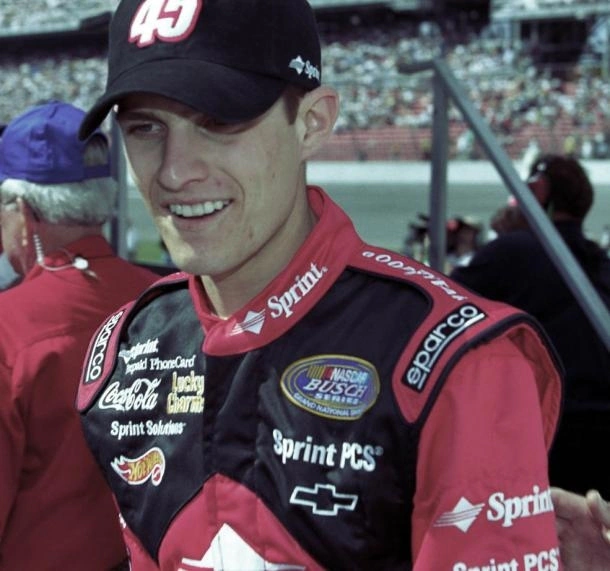
By the late 1990s Adam was competing in national-level stock car events, working within the Petty Enterprises framework. He gained experience in the NASCAR Busch Series (now the Xfinity Series), where fields were deep and veterans were plentiful. He approached it as school at speed, absorbing details about setup, tire wear, and traffic management. In that period he also prepared for the top level of the sport, making select starts as he and the team planned a fuller future together. The No. 45 became associated with his efforts, a number that would later be carried in his memory. For the Petty family, seeing Adam's name on an entry list symbolized a bridge from history to the next era.Personality and Presence
Within the garage, Adam was known for a friendly, approachable manner that fit the Petty family reputation. He met fans with an easy smile and treated team members and rivals with the same steady respect. Those who worked alongside him noted how he balanced ambition with humility; he was eager to compete at the highest level but never forgot that every lap offered a lesson. Pattie and Kyle Petty were steadfast presences at the track, and Richard Petty's visits were both sentimental and practical, reinforcing that Adam's progress was a shared family endeavor rooted in decades of racing experience.Tragic Accident
In 2000, while practicing for a national series race at New Hampshire, Adam suffered a fatal crash. The suddenness of the accident shocked the NASCAR community. He was only nineteen, poised on the threshold of a long-anticipated career. His death echoed profoundly because it touched a family that had helped build the sport and because it underscored the ever-present risks of high-speed competition. Later that season, another driver, Kenny Irwin Jr., lost his life at the same track, deepening the urgency that the community felt around safety. For the Pettys, it was an unimaginable personal loss; for the wider sport, it became a call to action.Family, Team, and Community Response
In the aftermath, Kyle and Pattie Petty became the center of a movement to turn grief into purpose. The Petty family, friends, and colleagues across NASCAR rallied around them. Kyle returned to the driver's seat and adopted Adam's number, an act of remembrance that kept his son's ambition visible on Sundays. Crew members continued to speak of Adam's promise, reinforcing the idea that potential, even if unrealized, could still inspire. The family's endurance in public, led by Kyle and supported by Richard, steadied others who were hurting and made space for a constructive conversation about how to make the sport safer.Safety and the Sport's Evolution
Adam Petty's death became part of a pivotal era in which NASCAR intensified its commitment to safety. Discussions and subsequent measures accelerated around head-and-neck restraints, cockpit and seat design, energy-absorbing barriers, and more rigorous crash data analysis. While no single event can claim credit for the sweeping changes that followed, the loss of a rising young driver from a foundational racing family helped concentrate attention and resolve. The sport that the Pettys had helped to popularize evolved in the years that followed, with advances that have since protected countless drivers.Legacy and Philanthropy
Kyle and Pattie Petty chose to honor Adam by doing something that would uplift children and families. They founded Victory Junction, a camp for children with serious medical conditions, to give young people a chance to experience joy, adventure, and community in a medically safe environment. The idea drew support from across NASCAR and the broader philanthropic world, reflecting the respect the Petty family commanded and the affection so many had for Adam. Kyle's long-running charity motorcycle ride, already known for its generosity, increasingly became a fundraising and awareness engine for the camp. Richard Petty lent his time and stature, as always, to help the cause. In the years since, Victory Junction has stood as a living tribute to Adam's spirit, transforming loss into lasting good.Enduring Memory
Adam Petty's story is often told at the intersection of family, heritage, and hope. He represented continuity in a lineage that began with Lee Petty and reached national prominence with Richard Petty, then modernized through Kyle's tenure as a driver and team leader. Adam carried that history with clarity and optimism, aiming to build his own record without relying solely on a famous last name. Those who knew him remember a young competitor who studied hard, treated people well, and loved the craft of racing. The number his father carried after him, the camp built in his name, and the safety improvements that gained momentum in the wake of his passing remain tangible markers of his impact.Why His Life Still Matters
For fans of the sport and for those who value the way families transmit purpose across generations, Adam Petty's life stands as a reminder that promise itself can be powerful. The guidance of Kyle and Pattie Petty, the example set by Richard Petty, and the deep-rooted culture of Petty Enterprises formed the foundation from which Adam stepped toward a future he never had the chance to fully realize. In remembering him, people often find not only sadness but also a renewed commitment to care for others, to improve safety, and to build institutions like Victory Junction that change lives. In this way, Adam's brief career continues to shape the sport he loved and the communities that rallied in his name.Our collection contains 4 quotes written by Adam, under the main topics: Sports - Father.
Source / external links