
Adlai E. Stevenson Biography Quotes 79 Report mistakes
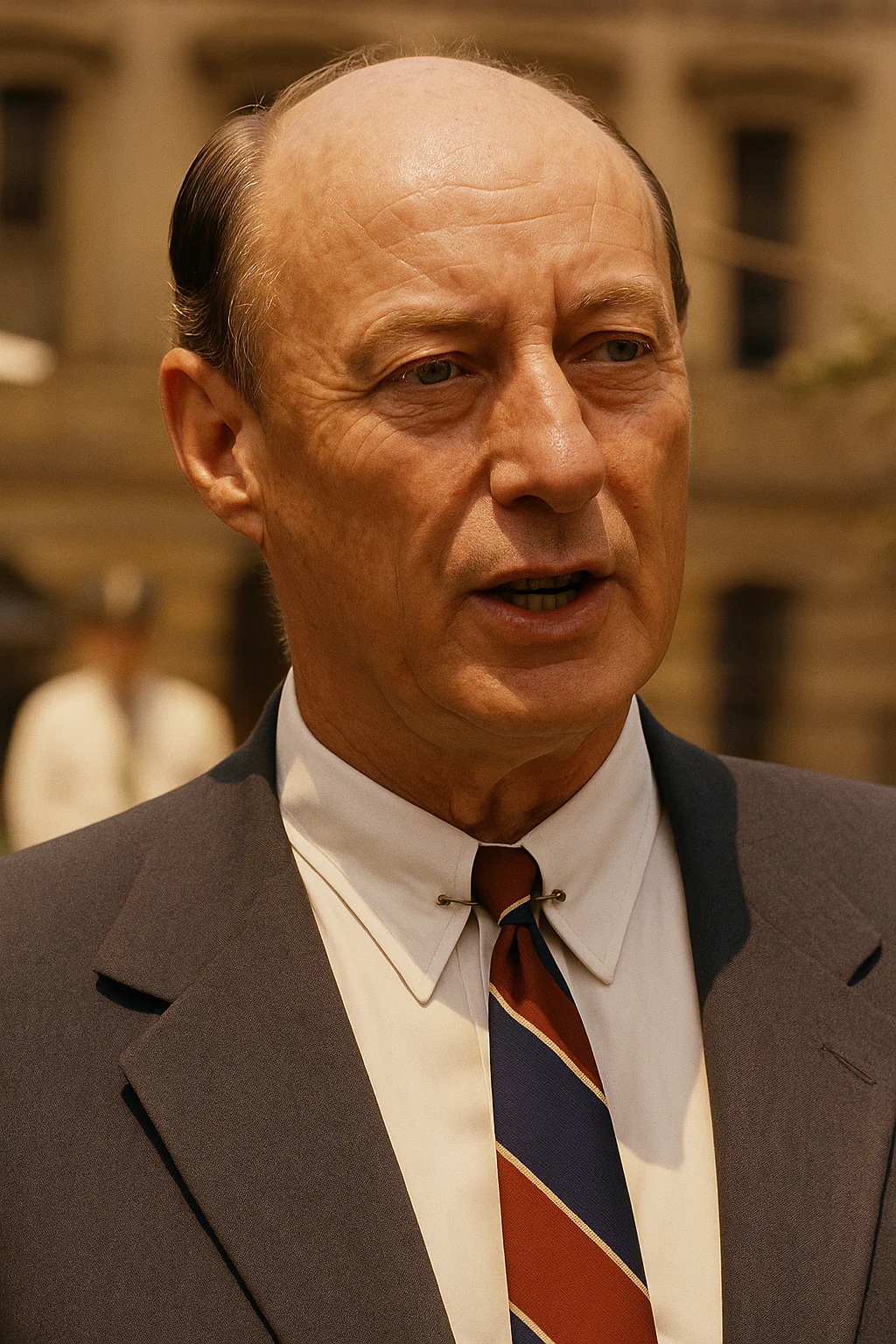
Attr: Warren K. Leffler
| 79 Quotes | |
| Born as | Adlai Ewing Stevenson II |
| Known as | Adlai Stevenson II |
| Occup. | Politician |
| From | USA |
| Born | February 5, 1900 Los Angeles, California, USA |
| Died | July 14, 1965 London, England |
| Cause | heart attack |
| Aged | 65 years |
| Cite | |
Citation Formats
APA Style (7th ed.)
Adlai e. stevenson biography, facts and quotes. (2026, February 2). FixQuotes. https://fixquotes.com/authors/adlai-e-stevenson/
Chicago Style
"Adlai E. Stevenson biography, facts and quotes." FixQuotes. February 2, 2026. https://fixquotes.com/authors/adlai-e-stevenson/.
MLA Style (9th ed.)
"Adlai E. Stevenson biography, facts and quotes." FixQuotes, 2 Feb. 2026, https://fixquotes.com/authors/adlai-e-stevenson/. Accessed 1 Apr. 2026.
Early Life and Background
Adlai Ewing Stevenson II was born on February 5, 1900, in Los Angeles while his family, prominent in Illinois Democratic politics, was temporarily in California. He was raised mainly in Bloomington, Illinois, under the long shadow of a celebrated name: his grandfather, Adlai E. Stevenson I, had been vice president under Grover Cleveland. The family lived with a sense of public duty that was both inheritance and expectation, and Stevenson absorbed early the idea that politics could be a moral vocation rather than a mere contest for power.A defining wound arrived in adolescence. In 1912, a gun Stevenson was handling discharged and killed a friend, Ruth Merwin - a tragedy that haunted him and deepened his reflex toward caution, responsibility, and self-scrutiny. The event did not make him timid so much as inward: he became a man who weighed consequences, distrusted easy bravado, and sought redemption through competence. It helped form the peculiar Stevenson blend of wit and gravity that later made him a compelling, sometimes melancholy, spokesman for liberal internationalism.
Education and Formative Influences
Stevenson attended The Choate School, served briefly in the U.S. Navy during World War I, and studied at Princeton University, graduating in 1922. He trained in law at Harvard and finished at Northwestern University School of Law. His education was less about credentialism than about learning the language of institutions - courts, diplomacy, executive power - and it fed his appetite for argument, nuance, and public speech. Journalism also sharpened him: after Princeton he worked for newspapers, cultivating a reporter's eye for human motive and a stylist's ear for cadence, traits that later distinguished him from the era's more purely partisan rhetoricians.Career, Major Works, and Turning Points
Stevenson practiced law in Chicago and entered Democratic government service during the New Deal era, working in Washington and helping draft speeches and policy. During World War II he served in federal agencies and, in 1945, was on the U.S. delegation at the founding conference of the United Nations in San Francisco, a formative moment for his lifelong faith in international cooperation. His rise to national prominence came as governor of Illinois (1949-1953), where he pushed governmental modernization, cleaner administration, and civil-liberties minded reform while navigating postwar labor unrest and machine politics. Drafted into the 1952 presidential race, he became the Democratic nominee against Dwight D. Eisenhower, and ran again in 1956, losing both times but establishing a distinctive intellectual, anti-demagogic voice within Cold War liberalism. Appointed U.S. ambassador to the United Nations by President John F. Kennedy in 1961, Stevenson faced the hardest theater of the Cold War: decolonization debates, nuclear brinkmanship, and the Cuban Missile Crisis, where his insistence on proof and procedure met history's demand for speed. He died suddenly in London on July 14, 1965, after a heart attack, still serving as ambassador.Philosophy, Style, and Themes
Stevenson believed democracy was sustained less by slogans than by legitimacy - the felt sense that government deserved obedience because it earned trust. In speeches and private letters alike he returned to the fragility of consent, warning that democratic power collapses when citizens assume their institutions are merely instruments of insiders. “Public confidence in the integrity of the Government is indispensable to faith in democracy; and when we lose faith in the system, we have lost faith in everything we fight and spend for”. The line reads like a creed forged from his own life: a man scarred by an early accident, wary of moral shortcuts, and determined to build politics around accountability rather than personality. Even his law training served this ethic of repair over glory, a view he summed up in the skeptical quip, “Law is not a profession at all, but rather a business service station and repair shop”. - a revealing metaphor for a politician who preferred institutional maintenance to revolutionary theater.His style married courtroom precision to literary irony, often deploying humor as a scalpel rather than a shield. Stevenson could be self-deprecating, but the deeper impulse was to puncture the cult of inevitability that tempts leaders into rashness. “On the plains of hesitation lie the blackened bones of countless millions who at the dawn of victory lay down to rest, and in resting died”. Coming from a man sometimes caricatured as overly deliberative, the sentence exposes the tension at his core: he feared recklessness, but he feared paralysis too. That psychological duality - conscience pulling against urgency - shaped his UN years, where he tried to make words, evidence, and multilateral procedure carry weight in a world that often preferred raw force.
Legacy and Influence
Stevenson never reached the presidency, yet he left an imprint on American political culture as the emblematic "thinking liberal" of the 1950s and early 1960s - a national figure who treated foreign policy as a moral and institutional project, not just an extension of military power. His candidacies helped keep an internationalist, civil-liberties conscious Democratic tradition alive between Truman and the Great Society; his UN ambassadorship offered a model of public diplomacy that valued reasoned argument even when it could not compel outcomes. The enduring Stevenson is less a record of electoral victories than a standard of intellectual seriousness, civic trust, and humane restraint that later politicians invoked whenever American democracy seemed tempted by cynicism or simplification.Our collection contains 79 quotes written by Adlai, under the main topics: Witty One-Liners - Ethics & Morality - Wisdom - Justice - Never Give Up.
Other people related to Adlai: Arthur Joseph Goldberg (Statesman)
Frequently Asked Questions
- Adlai Stevenson political views: Liberal, internationalist Democrat; pro-UN and diplomacy, anti-McCarthyism, supportive of civil rights and arms control.
- Adlai Stevenson V: A later namesake and descendant in the Stevenson family.
- Adlai E Stevenson School: Various schools named for him, including Stevenson High School (IL) and Stevenson College at UC Santa Cruz.
- Adlai Stevenson II: American politician (1900–1965); Illinois governor, two-time Democratic presidential nominee, later U.N. ambassador.
- What was Adlai Stevenson famous for: Illinois governor, 1952/1956 Democratic presidential nominee, and U.N. ambassador; famed for his UN role in the Cuban Missile Crisis.
- Adlai Stevenson cause of death: Heart attack in London in 1965.
- Adlai E Stevenson High School: Name of several U.S. high schools (notably in Lincolnshire, IL, and the Bronx, NY) named for Adlai E. Stevenson II.
- How old was Adlai E. Stevenson? He became 65 years old
Source / external links