
Adolf Hitler Biography Quotes 41 Report mistakes
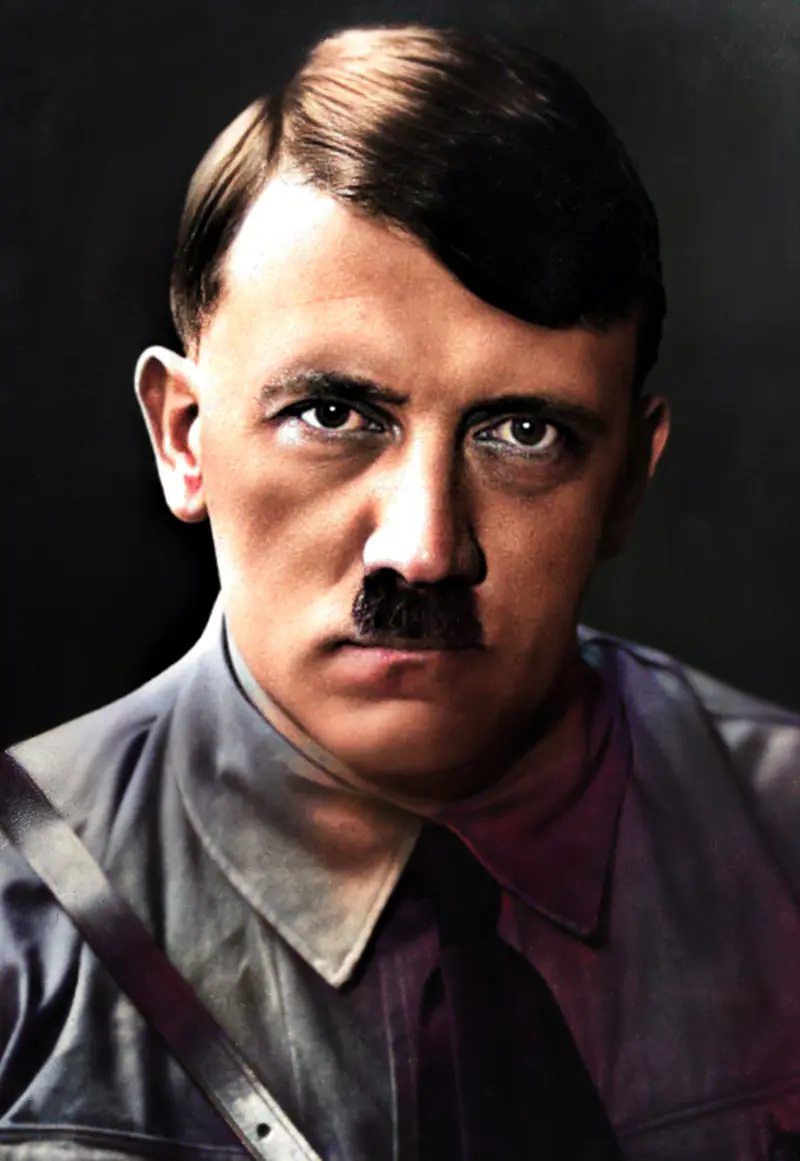
| 41 Quotes | |
| Known as | Führer |
| Occup. | Criminal |
| From | Germany |
| Spouse | Eva Braun |
| Born | April 20, 1889 Braunau am Inn, Austria, Hungary |
| Died | April 30, 1945 Berlin, Germany |
| Cause | Suicide |
| Aged | 56 years |
Adolf Hitler was born on April 20, 1889, in Braunau am Inn, a small border town in Austria-Hungary facing Bavaria. He grew up in a household shaped by his father Alois Hitler, a customs official whose discipline and volatility clashed with his son's desire for autonomy, and by his mother Klara, whose devotion Hitler later mythologized as the purest human bond he knew. The family moved repeatedly through the Linz area; the boy absorbed a provincial, German-national atmosphere in a multiethnic empire where identity politics were daily, not abstract.
The early traumas and disappointments that later hardened into grievance were personal before they became political. Alois died in 1903; Klara died of breast cancer in 1907 after painful treatment, leaving Hitler unmoored at 18. His adolescence combined grandiosity with retreat - a self-image as a future artist or architect coexisted with long periods of idleness and resentment toward authority, school, and any structure that demanded steady effort rather than dramatic self-justification.
Education and Formative Influences
Hitler's formal education was uneven: he attended the Realschule in Linz but performed poorly and left without completing a standard academic path. His formative education became self-directed and opportunistic - readings in German nationalism, racial pseudo-science, and popular social Darwinism mingled with opera, especially Wagner, and a fascination with monumental architecture and staging. After failing twice to enter the Academy of Fine Arts Vienna (1907 and 1908), he lived in Vienna's men shelters and cheap rooms, supporting himself by selling small watercolors; in the imperial capital he encountered mass politics, street antisemitism, and the performative power of demagogic speech, lessons he would later weaponize.
Career, Major Works, and Turning Points
In 1913 Hitler moved to Munich; the First World War became his crucial catalyst. He served as a runner in the Bavarian Army, was wounded, and received medals, experiencing the war as purpose and fraternity; Germany's 1918 defeat and revolution he interpreted as betrayal. In 1919 he joined the German Workers' Party, soon reshaping it into the National Socialist German Workers' Party (NSDAP) and developing the swastika symbolism and ritualized rallies that turned politics into liturgy. After the failed Beer Hall Putsch in Munich (November 1923), imprisonment at Landsberg gave him time to dictate Mein Kampf (1925-1926), fusing autobiography with a program of racial hierarchy, antisemitic conspiracy, and expansionist "living space". Through propaganda, electoral strategy, and elite backroom deals amid Weimar crisis, he was appointed chancellor on January 30, 1933; within months he destroyed constitutional limits, opened the first concentration camp at Dachau, purged rivals in the Night of the Long Knives (1934), and merged state and party into a personal dictatorship as Fuhrer. His regime pursued rearmament, remilitarized the Rhineland (1936), annexed Austria (1938), dismembered Czechoslovakia, and invaded Poland on September 1, 1939, triggering World War II; it escalated into the Holocaust and a continent-wide war of occupation and annihilation. As defeat closed in, Hitler remained in Berlin, married Eva Braun in the bunker, and died by suicide on April 30, 1945, leaving Europe shattered and Germany divided.
Philosophy, Style, and Themes
Hitler's inner life was governed by a need for certainty and control that translated into a political worldview of permanent struggle. He treated history as a racial competition in which compassion was weakness and compromise decay, a stance that made violence seem not merely permissible but virtuous. The psychological engine was grievance elevated into metaphysics: personal failure and national humiliation were transmuted into a narrative of enemies within and without, with Jews cast as the master explanation that simplified complexity and licensed cruelty.
His style fused theatrical intuition with calculated cynicism about mass persuasion. "I use emotion for the many and reserve reason for the few". This was not a stray remark but a method: rallies, symbols, and radio speeches were designed to dissolve individuals into a collective body whose loyalty bypassed critical thought. He embraced propaganda as a weapon against reality itself - "Make the lie big, make it simple, keep saying it, and eventually they will believe it". Beneath the choreography sat contempt for democratic agency, a belief that politics worked best when citizens were reduced to spectators - "What luck for rulers that men do not think". These lines illuminate a psychology that prized domination over dialogue and victory over truth, turning language into a tool for consent and terror alike.
Legacy and Influence
Hitler's legacy is inseparable from criminality on a vast scale: aggressive war, the Holocaust, and state-sponsored mass murder that reshaped international law, ethics, and memory. The ruins of the Third Reich helped produce the United Nations system, the Genocide Convention, the Universal Declaration of Human Rights, and the Nuremberg Trials' framework for crimes against humanity, while also hardening Cold War borders and accelerating decolonization debates about race and empire. His enduring influence is negative but potent: he stands as a case study in how modern bureaucracy, media, and charismatic politics can converge into totalitarian violence, and why democratic societies must defend institutions, truth-seeking, and pluralism against the seductions of spectacle and scapegoating.
Our collection contains 41 quotes who is written by Adolf, under the main topics: Ethics & Morality - Wisdom - Truth - Justice - Leadership.
Other people realated to Adolf: Benito Mussolini (Politician), Joseph Goebbels (Criminal), Spike Milligan (Comedian), Heinrich Himmler (Criminal), David Lloyd George (Statesman), Martin Bormann (Soldier), Heinz Guderian (Soldier), Mackenzie King (Statesman), Hjalmar Schacht (Economist), Dorothy Thompson (Journalist)
Frequently Asked Questions
- Adolf Hitler family today: No surviving descendants
- Adolf Hitler cause of death: Suicide by gunshot
- Adolf Hitler family: Had no known direct descendants
- Adolf Hitler son: None
- Adolf Hitler children: None
- Adolf Hitler full name: Adolf Hitler
- Adolf Hitler born: April 20, 1889
- How old was Adolf Hitler? He became 56 years old
Adolf Hitler Famous Works
- 1928 Zweites Buch (Book)
- 1925 Mein Kampf (Book)
Source / external links