
Adrienne Rich Biography Quotes 21 Report mistakes
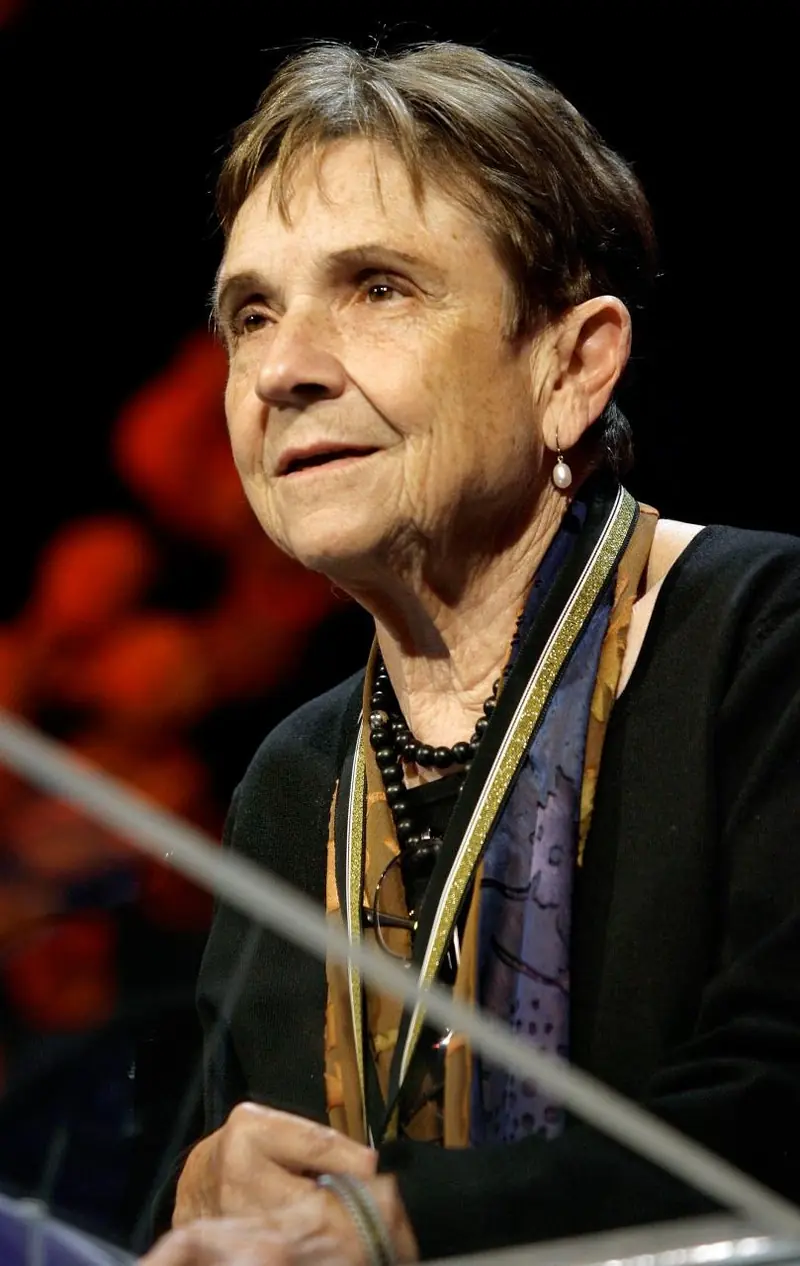
| 21 Quotes | |
| Born as | Adrienne Cecile Rich |
| Occup. | Poet |
| From | USA |
| Born | May 16, 1929 Baltimore, Maryland, United States |
| Died | March 27, 2012 Santa Cruz, California |
| Aged | 82 years |
Adrienne Cecile Rich was born on May 16, 1929, in Baltimore, Maryland, into a household where language, science, and music were equally alive. Her father, Arnold Rice Rich, a distinguished pathologist and professor at Johns Hopkins, expected rigor and achievement; her mother, Helen Elizabeth (Jones) Rich, a pianist and composer, modeled the discipline and vulnerability of artistic work. The combination set an early template for the tension that would course through Rich's writing: between order and experiment, authority and dissent. She was a serious student and voracious reader, steeped in canonical poetry. After preparatory schooling in Baltimore, she entered Radcliffe College, then the women's coordinate institution of Harvard, and graduated in 1951. Even before finishing, she had begun to win attention for poems of exacting formal grace.
Emergence as a Poet
Her debut collection, A Change of World (1951), was chosen by W. H. Auden for the Yale Younger Poets Prize, a national endorsement that instantly placed her among the most promising American poets of her generation. The early poems, meticulously crafted in meter and rhyme, reflected the training and expectations of mid-century literary culture. The Diamond Cutters (1955) extended that idiom. But Rich's restlessness was already evident: she sought a voice capacious enough to hold private experience and public crisis, domestic life and political upheaval. Through steady work, she moved from an apprenticeship under high formal standards to a searching engagement with the pressures of contemporary life.
Personal Life and Turning Points
In 1953 Rich married Alfred Haskell Conrad, an economist who taught at Harvard, and the couple had three sons. The demands of motherhood and the constraints placed on women in the 1950s and early 1960s formed a crucible for her changing art. Snapshots of a Daughter-in-Law (1963) signaled a break with purely formal poise: the poems were sharper, more openly critical of patriarchal norms, and less beholden to inherited structures. The marriage came under strain, and by 1970 Rich and Conrad had separated. Later that year Conrad died by suicide, a loss that shadowed her work and life, and that she addressed with characteristic honesty and care for the complexities of grief.
Political Awakening and Feminist Thought
The long 1960s remade Rich's poetics. Moving to New York and engaging with antiwar activism, civil rights, and the women's liberation movement, she shifted toward a wilder, more exploratory line. Leaflets (1969) registered the turmoil of the Vietnam era; Diving into the Wreck (1973) consolidated her transformation and became one of the defining books of the decade. When the collection won the 1974 National Book Award for Poetry, Rich accepted in a collective spirit, reading a statement she had prepared with fellow nominees Audre Lorde and Alice Walker and dedicating the award to the shared struggle of women. Alongside the poetry, her essays helped articulate a feminist critique that reshaped literary and political discourse. Of Woman Born: Motherhood as Experience and Institution (1976) scrutinized the social structures surrounding maternity; On Lies, Secrets, and Silence (1979) gathered key essays on art, power, and gender; and Compulsory Heterosexuality and Lesbian Existence (1980) offered a framework that would become foundational in feminist and queer theory.
Identity, Community, and Partnerships
Rich's work over these decades braided personal revelation with commitments to collective life. She wrote about Judaism and diaspora, reflecting on her father's heritage and the complexities of assimilation and conscience, notably in the essay Split at the Root. In the mid-1970s she came out as a lesbian, a declaration both intimate and political. Her partnership with the Jamaican-born writer Michelle Cliff, which began in 1976 and endured for the rest of Rich's life, provided companionship and editorial collaboration. Together they were active in feminist and lesbian literary communities and small-press endeavors, bringing new voices into view and arguing for a literature accountable to lived realities.
Mature Work and Public Stature
The Dream of a Common Language (1978) and A Wild Patience Has Taken Me This Far (1981) deepened her idiom for desire, friendship, and resistance, while Blood, Bread, and Poetry (1986) collected essays that linked poetics to social ethics. An Atlas of the Difficult World (1991) charted a national landscape of fracture and endurance; Dark Fields of the Republic (1995) responded to the late-century moment with a hard-earned, lucid hope. Across these books, Rich's style remained recognizably hers: tensile yet inviting, a voice that could turn from granular observation to sweeping indictment and back again without losing its integrity. She received many honors, including a MacArthur Fellowship, and in 1997 she refused the National Medal of Arts, stating that she could not accept an award from an administration whose politics she believed harmed the very public life to which art must answer. The refusal was consistent with her decades-long insistence that literary prestige means little if severed from citizenship and responsibility.
Teaching, Editing, and Influence
Beyond the page, Rich taught and lectured widely, bringing poetry into classrooms, community centers, and activist spaces. Her presence in seminars and public readings was catalytic for younger writers, including those who, like Audre Lorde and Muriel Rukeyser in overlapping circles, treated poetry as a site of inquiry and mobilization rather than mere ornament. Rich's editorial work and her encouragement of small presses helped sustain a literary ecosystem hospitable to experimentation and to voices historically kept at the margins. She returned repeatedly to the task of re-reading the tradition, writing influential essays on figures such as Emily Dickinson, and modeling how critique could become a form of care for the archive.
Form, Method, and Themes
Rich's career traces a visible arc from formalist beginnings to a flexible, restive line capable of carrying anger, tenderness, theory, and narrative. She wielded the long poem, the sequence, and the essay-poem with a mastery that made structure feel like discovery. Her themes included the institutions of family and state; the economies of labor and neglect; the politics of sexuality and identity; and the difficult, necessary work of solidarity. She wrote not only about harm and constraint but about the conditions under which love, friendship, and art can flourish. Accuracy, for Rich, was an ethical as well as an aesthetic demand: she wanted words to meet the world without euphemism.
Later Years and Final Works
Settling for many years in California, Rich continued to publish with undiminished urgency. Fox (2001) and The School Among the Ruins (2004) confronted the early twenty-first century's wars and inequalities, while Tonight No Poetry Will Serve (2011) distilled a lifetime's arguments into lines that were both honed and searching. Even as rheumatoid arthritis increasingly limited her physically, she remained a public intellectual and a working poet, insisting that attention to language was a form of attention to life. She died on March 27, 2012, in Santa Cruz, California, at the age of 82, widely mourned by readers, students, and fellow poets.
Legacy
Adrienne Rich's influence crosses genres and generations. She helped make it possible to speak from the intersections of gender, sexuality, class, and race without apology, and she showed that a poem could be both a crafted artifact and a political act. In the company of writers such as Audre Lorde and Alice Walker, and in dialogue with early mentors like W. H. Auden even as she changed the terms of that inheritance, she expanded the field of American poetry and criticism. Her books remain alive in classrooms, reading groups, and private lives, where new readers find in her insistence on truth-telling a model for their own speech. Few poets have matched her blend of technical intelligence, moral courage, and civic presence. For many, her work continues to be not just literature to be studied, but a resource for thinking and living in common.
Our collection contains 21 quotes who is written by Adrienne, under the main topics: Ethics & Morality - Truth - Art - Love - Deep.
Other people realated to Adrienne: Audre Lorde (Poet), Sylvia Plath (Poet), Muriel Rukeyser (Poet), June Jordan (Writer), Mary Daly (Theologian), Susan Griffin (Writer)
Adrienne Rich Famous Works
- 1993 What is Found There: Notebooks on Poetry and Politics (Non-fiction)
- 1991 An Atlas of the Difficult World (Poetry Collection)
- 1984 The Fact of a Doorframe (Poetry Collection)
- 1978 The Dream of a Common Language (Poetry Collection)
- 1976 Of Woman Born (Non-fiction)
- 1973 Diving into the Wreck (Poetry Collection)
- 1951 Aunt Jennifer's Tigers (Poem)
Source / external links