
Agatha Christie Biography Quotes 32 Report mistakes
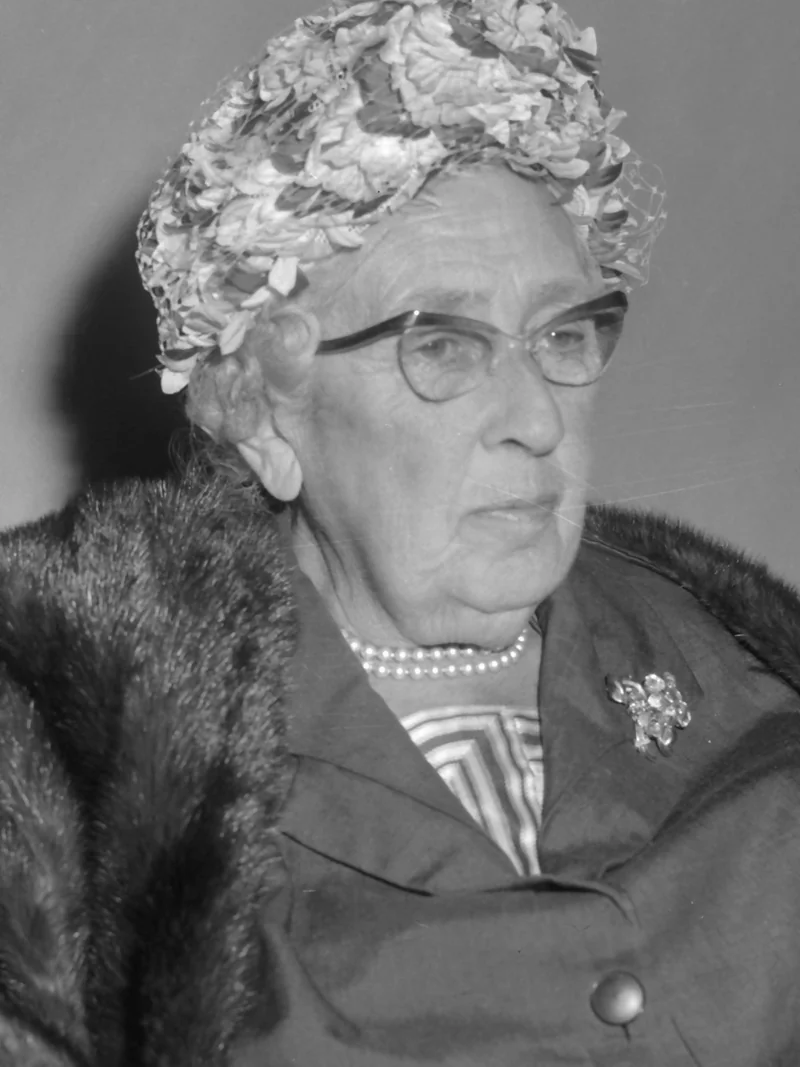
| 32 Quotes | |
| Born as | Agatha Mary Clarissa Miller |
| Known as | Mary Westmacott |
| Occup. | Writer |
| From | England |
| Born | September 15, 1890 Torquay, Devon, England |
| Died | January 12, 1976 Wallingford, Oxfordshire, England |
| Aged | 85 years |
| Cite | |
Citation Formats
APA Style (7th ed.)
Agatha christie biography, facts and quotes. (2026, February 11). FixQuotes. https://fixquotes.com/authors/agatha-christie/
Chicago Style
"Agatha Christie biography, facts and quotes." FixQuotes. February 11, 2026. https://fixquotes.com/authors/agatha-christie/.
MLA Style (9th ed.)
"Agatha Christie biography, facts and quotes." FixQuotes, 11 Feb. 2026, https://fixquotes.com/authors/agatha-christie/. Accessed 5 Mar. 2026.
Early Life and Background
Agatha Mary Clarissa Miller was born on 1890-09-15 in Torquay, Devon, into an affluent, socially secure household whose rhythms were shaped by late-Victorian comfort and Edwardian expectation. Her father, Frederick Alvah Miller, was an American-born businessman; her mother, Clara Boehmer Miller, cultivated imagination and private performance, encouraging stories, games, and a belief that inner life mattered as much as public accomplishment. That protected domestic world, with its servants and seaside routines, formed Christie's lifelong sense of ordinary surfaces concealing private dramas.The early death of her father in 1901 tightened the bond between mother and daughter and left Christie with a sharpened awareness of money, dependency, and social appearance - themes that would later animate her country-house murders and anxious inheritances. Shy yet observant, she developed the habit that became her signature: watching people closely without insisting on being the center of the room, storing away speech patterns, vanities, and the small evasions by which respectable life protects itself.
Education and Formative Influences
Christie was educated largely at home, then at schools in Torquay and Paris, where she absorbed music and languages more than formal literary training; she played piano, attempted singing, and read omnivorously. Her formative influences were a blend of stage-managed gentility and the loosening prewar world, plus the early detective tradition - Poe, Conan Doyle, and the puzzle-story ethos that prized fairness, clues, and the reader's right to compete. When World War I arrived, she joined the Voluntary Aid Detachment and later worked in a hospital dispensary, gaining practical knowledge of drugs and poisons that would become an unusually exact tool in her fiction.Career, Major Works, and Turning Points
In 1914 she married Archibald Christie, an army officer, and during the war began writing her first detective novel; The Mysterious Affair at Styles (1920) introduced Hercule Poirot and announced a new kind of English puzzle-plot, meticulous yet brisk. Success accelerated through the 1920s with works such as The Murder of Roger Ackroyd (1926), which famously tested the rules of narration; the same year brought personal crisis when Archie left her, followed by her highly publicized 11-day disappearance in December 1926, an episode that exposed the pressure behind her controlled public image. Divorced in 1928, she rebuilt her life through work and travel; in 1930 she married archaeologist Max Mallowan, joining expeditions in Iraq and Syria that fed novels like Murder in Mesopotamia (1936) and Death on the Nile (1937). Over ensuing decades she created Miss Marple, wrote enduring stage work (The Mousetrap, opened 1952), and maintained astonishing productivity into late life, dying on 1976-01-12 in Oxfordshire after becoming the best-selling novelist of her century.Philosophy, Style, and Themes
Christie's technique was engineering disguised as ease: limited casts, everyday dialogue, domestic detail, and a strict economy of clue and misdirection. Her calm prose is not an absence of psychology but a method of control - a way to keep terror legible, soluble, and contained. She repeatedly insisted that invention could come from the humble margins of life, and her work ethic turned that belief into practice: “The best time to plan a book is while you're doing the dishes”. The line is more than a joke; it reveals a mind that treated creativity as portable and disciplined, as if the imagination must learn to operate under ordinary constraints.Her books are driven by skepticism about identity and trust, especially within polite society where motive hides behind manners. “Very few of us are what we seem”. That principle governs her plots and her view of human nature: the murderer is often the plausible caregiver, the overlooked spinster, the charming nephew, the person whose social role discourages scrutiny. Money, inheritance, and the quiet coercions of family life recur because they are socially acceptable reasons to lie, and Christie's England - from village teas to empire-era travel - becomes a theater where civility is both mask and weapon.
Legacy and Influence
Christie professionalized the modern whodunit, setting standards for fair-play clueing, structural surprise, and the detective as a moral instrument rather than an action hero. Her characters - Poirot with his foreign precision and Miss Marple with her village anthropology - became archetypes, while her plots continue to shape novels, television, film, and interactive mysteries worldwide. In an age of two world wars and the end of empire, she offered a paradoxical comfort: not that evil is rare, but that it is intelligible, traceable, and answerable to reason - a lasting compact with readers that made her both a chronicler of her era's anxieties and a timeless architect of suspense.Our collection contains 32 quotes written by Agatha, under the main topics: Witty One-Liners - Motivational - Ethics & Morality - Wisdom - Truth.
Other people related to Agatha: Peter Ustinov (Actor), Margery Allingham (Writer), Charles Dance (Actor)
Agatha Christie Famous Works
- 1977 An Autobiography (Autobiography)
- 1975 Curtain: Poirot's Last Case (Novel)
- 1973 Postern of Fate (Novel)
- 1971 Nemesis (Novel)
- 1961 The Pale Horse (Novel)
- 1952 The Mousetrap (Play)
- 1950 A Murder is Announced (Novel)
- 1942 The Body in the Library (Novel)
- 1942 Five Little Pigs (Novel)
- 1941 Evil Under the Sun (Novel)
- 1939 And Then There Were None (Novel)
- 1937 Death on the Nile (Novel)
- 1936 The ABC Murders (Novel)
- 1934 Murder on the Orient Express (Novel)
- 1932 Peril at End House (Novel)
- 1926 The Murder of Roger Ackroyd (Novel)
- 1925 The Witness for the Prosecution (Short Story)
- 1924 The Man in the Brown Suit (Novel)
- 1922 The Secret Adversary (Novel)
- 1920 The Mysterious Affair at Styles (Novel)
Source / external links