
Al Oerter Biography Quotes 4 Report mistakes
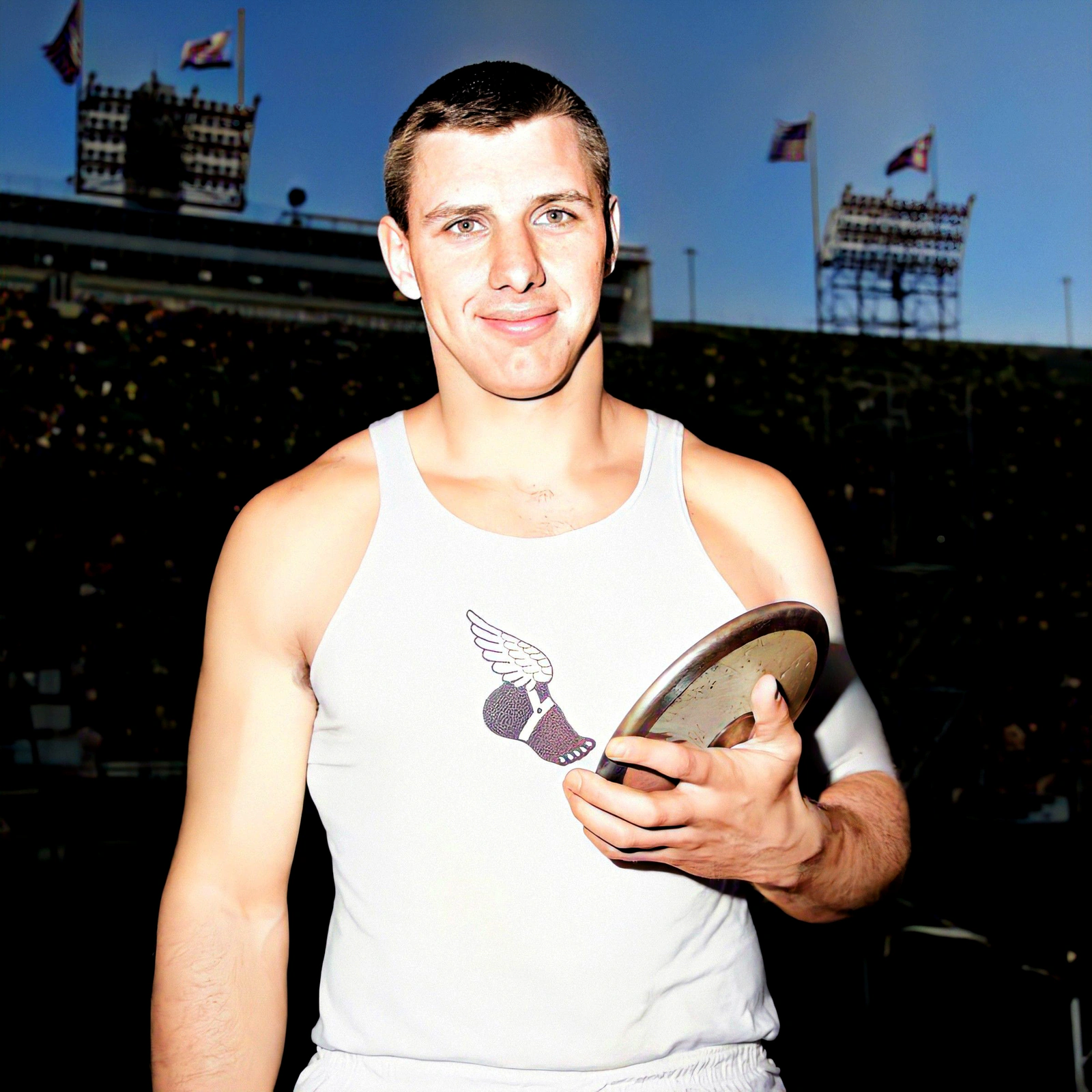
| 4 Quotes | |
| Born as | Alfred Adolph Oerter Jr. |
| Occup. | Athlete |
| From | USA |
| Born | September 19, 1936 Astoria, New York, U.S. |
| Died | October 1, 2007 Fort Myers, Florida, U.S. |
| Aged | 71 years |
| Cite | |
Citation Formats
APA Style (7th ed.)
Al oerter biography, facts and quotes. (2026, February 11). FixQuotes. https://fixquotes.com/authors/al-oerter/
Chicago Style
"Al Oerter biography, facts and quotes." FixQuotes. February 11, 2026. https://fixquotes.com/authors/al-oerter/.
MLA Style (9th ed.)
"Al Oerter biography, facts and quotes." FixQuotes, 11 Feb. 2026, https://fixquotes.com/authors/al-oerter/. Accessed 12 Feb. 2026.
Early Life and Background
Alfred Adolph Oerter Jr. was born on September 19, 1936, in Astoria, Queens, New York City, a waterfront borough where immigrant ambition and postwar American confidence met in the same crowded streets. The son of a working-class family, he grew up amid the clang of industry and the discipline of Catholic schooling, absorbing a New York ethic that prized toughness, punctuality, and a certain stoic humor. His size and coordination made him a natural athlete, but it was his patience - an ability to repeat hard things until they became second nature - that quietly marked him as different.The era shaped him: the 1940s and 1950s celebrated measurable excellence, from factory output to split times. In that culture, the discus was an oddity, a classical event practiced in public parks and school yards, far from the glamour sports. Oerter came to it not as a romantic antiquarian but as a competitor drawn to the stark clarity of a result you could not debate: a distance, a line, a tape pulled tight. That clarity would become the emotional center of his life - a place where he could convert private pressure into public proof.
Education and Formative Influences
Oerter attended Sewanhaka High School on Long Island, where he began to stand out in track and field, then went on to the University of Kansas, one of the United States key throwing hubs, in a period when American collegiate athletics served as both laboratory and proving ground. Under structured coaching and surrounded by shot-putters and throwers who treated technique like engineering, he refined the slow, repeatable mechanics of the discus: the controlled sprint inside the circle, the timing of hips and shoulders, and the calm release that turns violence into flight. The discipline of training - thousands of nearly identical repetitions - shaped his temperament as much as his muscles, teaching him to trust process over mood and to treat setbacks as data.Career, Major Works, and Turning Points
Oerter became the dominant Olympic discus thrower of his generation by doing something no one had done before or has matched since: winning four consecutive Olympic gold medals in the same event. He took gold at Melbourne 1956, then defended it at Rome 1960, Tokyo 1964, and Mexico City 1968, setting an Olympic record each time and peaking when the stakes were highest. His 1968 victory became the defining chapter - achieved while injured, amid the altitude and spectacle of Mexico City, with an athlete's body that seemed held together by will and careful pain management. After stepping away, he returned in later years, qualifying for the 1980 Olympic team at an age when most throwers were long retired, only to be denied competition by the US-led boycott of the Moscow Games. That disappointment sharpened his sense that greatness is not owned by a single moment; it is assembled over decades.Philosophy, Style, and Themes
Oerter looked like a power thrower, but his true instrument was restraint. He trained with a craftsman's caution, protecting rhythm and timing, then unleashed force only at the instant it could be converted into distance. This was not just biomechanics - it was psychology. The discus circle became a controlled environment where he could rehearse pressure until it lost the power to surprise him. His humor sometimes deflated the event's obscurity - "I don't think the discus will ever attract any interest until they let us start throwing them at each other". The joke is revealing: he understood the distance between public attention and private effort, and he made peace with being excellent in a quiet corner of sport.Beneath the understatement was an interior, almost monastic competition ethic. "I never set out to beat the world. I just set out to do my absolute best". That sentence captures his self-concept: less conqueror than custodian, responsible for maintaining a standard. And the standard was personal and cumulative: "I don't compete with other discus throwers. I compete with my own history". In that frame, each season was a conversation with earlier versions of himself - the fearless teenager, the reigning champion, the injured veteran - and winning meant continuity. This inward orientation explains his late-career resurgence and his capacity to perform under pain: he was not chasing applause so much as coherence, the feeling that he had met his own demand.
Legacy and Influence
Oerter died on October 1, 2007, in the United States, but his biography continues to function as a blueprint for durable excellence: mastery built on repetition, technical honesty, and calm under scrutiny. In Olympic history he stands as a rare symbol of continuity across changing decades - from the 1950s amateur ideal through the televised, politicized Games of the 1960s and beyond. For throwers, he remains a benchmark of championship timing and competitive nerve; for the wider sports public, he represents a quieter heroism, the athlete who made a small event feel immense by treating each throw as a referendum on character.Our collection contains 4 quotes written by Al, under the main topics: Witty One-Liners - Motivational - Fitness.
Source / external links