
Alan Bean Biography Quotes 13 Report mistakes
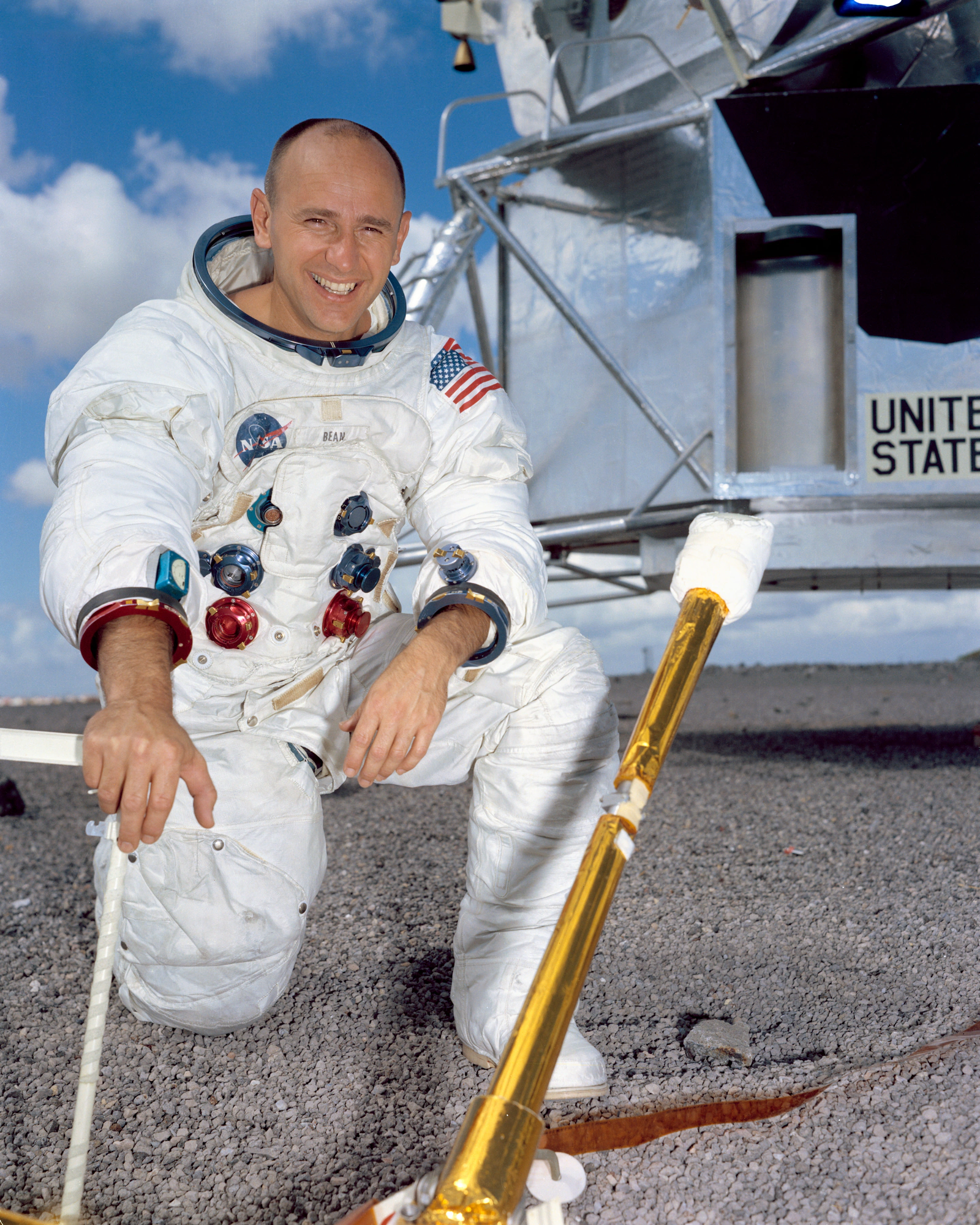
| 13 Quotes | |
| Born as | Alan LaVern Bean |
| Occup. | Astronaut |
| From | USA |
| Born | March 15, 1932 Wheeler, Texas, USA |
| Died | May 26, 2018 Houston, Texas, USA |
| Cause | Complications from a stroke |
| Aged | 86 years |
| Cite | |
Citation Formats
APA Style (7th ed.)
Alan bean biography, facts and quotes. (2026, February 25). FixQuotes. https://fixquotes.com/authors/alan-bean/
Chicago Style
"Alan Bean biography, facts and quotes." FixQuotes. February 25, 2026. https://fixquotes.com/authors/alan-bean/.
MLA Style (9th ed.)
"Alan Bean biography, facts and quotes." FixQuotes, 25 Feb. 2026, https://fixquotes.com/authors/alan-bean/. Accessed 31 Mar. 2026.
Early Life and Background
Alan LaVern Bean was born on March 15, 1932, in Wheeler, a small town in the Texas Panhandle whose flat horizons and big skies quietly prefigured the two worlds he would inhabit - the disciplined geometries of flight and the luminous, nearly abstract landscape of the Moon. He grew up during the long tail of the Great Depression and the mobilization of World War II, in a culture that prized mechanical skill, self-reliance, and calm competence. Those traits became his public signature: unshowy, steady, and unusually attentive to the physical feel of machines and materials.
Family moves took him through West Texas and shaped a boyhood of heat, wind, and distance, where sports and drawing competed with the early romance of aviation. Friends and later colleagues often described him as easygoing, but that surface masked a private intensity: a desire to do things precisely, to see for himself, and to make durable records of fleeting experience. In Bean, the frontier myth of the American Southwest blended with the mid-century faith that technology could turn imagination into hardware - and hardware into history.
Education and Formative Influences
Bean attended the University of Texas at Austin, earning a Bachelor of Science in Aeronautical Engineering in 1955, at a moment when engineering education was being refitted for the jet age and, soon, the space race. Commissioned in the US Navy, he trained as a naval aviator and became a test pilot, a profession that demanded equal parts nerve and method: fly close to the edge, then write it down so others could fly safely. That habit of translating sensation into description later fed both his astronaut work and his art, as did the era's broader pressures - Sputnik, Cold War competition, and the conviction that national prestige could be measured in miles above Earth.
Career, Major Works, and Turning Points
Selected by NASA in 1963 as part of Astronaut Group 3, Bean served in the Apollo program when it was simultaneously a technical crash course and a national obsession. His defining flight came with Apollo 12 in November 1969, as lunar module pilot alongside commander Charles "Pete" Conrad; they achieved a pinpoint landing in Oceanus Procellarum near Surveyor 3 and completed two moonwalks, returning with samples and the kinds of operational observations that made later landings safer. A small accident - Bean accidentally pointing a TV camera at the Sun and damaging it - became a lesson in how a single moment can erase a public window into history even as the work continues. After Apollo, he flew again as commander of Skylab 3 in 1973, spending 59 days in orbit conducting solar, Earth, and biomedical research, then rose to senior management at Johnson Space Center before retiring from NASA in 1981 to pursue painting full time - the second career that would make him, in a different way, a chronicler of exploration.
Philosophy, Style, and Themes
Bean's inner life was defined by a rare dual commitment: to the rigor of measurement and to the unruly truth of perception. As an astronaut, he belonged to an institution that demanded checklists, error budgets, and procedural discipline; as an artist, he sought the emotional residue that procedures cannot capture - glare on visors, the powdery cling of regolith, the way silence feels when it has weight. His work repeatedly returned to the paradox of the Moon as both destination and symbol: a place physically "out there", yet psychologically intimate, because the experience of standing on it rearranges what "home" means. “It's hard not to be excited when you're going to find a way to land on the Moon”. In his telling, the excitement was never naive; it was the charge that discipline exists to serve, the fuel that makes training bearable and risk rational.
After leaving NASA, Bean treated painting less as retirement than as obligation, as if the Apollo era had given him a responsibility no archive could fulfill. “But I'm the only one who can paint the moon, because I'm the only one who knows whether that's right or not”. That sentence reveals his psychology: a quiet but absolute claim of eyewitness authority, mixed with the humility of craft - the sense that "right" is not a slogan but a thousand small decisions about color temperature, shadow edge, and the way dust dulls reflected light. He often incorporated mixed media into his canvases, sometimes embedding lunar checklists or rubbing surfaces to evoke the abrasive grit of regolith, trying to make viewers feel the Moon as matter, not metaphor. “But I found that being an artist and doing accurate work is very difficult”. Accuracy, for Bean, was not photorealism; it was fidelity to lived sensation, the kind that survives when photographs fail.
Legacy and Influence
Bean died on May 26, 2018, in Houston, Texas, closing a life that bridged the heroic age of lunar exploration and a later era hungry for personal meaning inside public triumph. In spaceflight history, he remains the fourth person to walk on the Moon and a key Skylab commander; in cultural history, he became the Apollo artist who most insistently translated astronaut memory into enduring images, offering a counter-archive to engineering reports and iconic photographs. His paintings - exhibited widely and collected by enthusiasts of space history - helped recast astronauts not only as operators of national hardware but as witnesses with inner lives, keeping the Moon vivid for generations who know it only through screens and stories.
Our collection contains 13 quotes written by Alan, under the main topics: Wisdom - Art - Nature - Overcoming Obstacles - Time.
Source / external links