
Alassane Ouattara Biography Quotes 10 Report mistakes
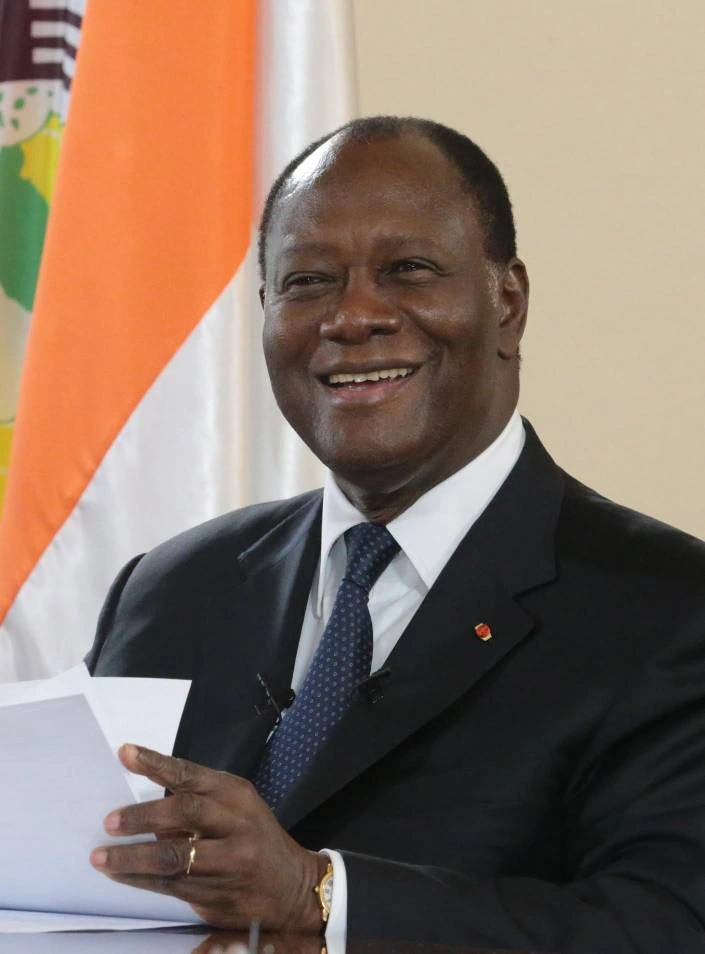
| 10 Quotes | |
| Born as | Alassane Dramane Ouattara |
| Occup. | President |
| From | Ivory Coast |
| Spouse | Dominique Ouattara |
| Born | January 1, 1942 Dimbokro, Ivory Coast |
| Age | 84 years |
| Cite | |
Citation Formats
APA Style (7th ed.)
Alassane ouattara biography, facts and quotes. (2026, February 11). FixQuotes. https://fixquotes.com/authors/alassane-ouattara/
Chicago Style
"Alassane Ouattara biography, facts and quotes." FixQuotes. February 11, 2026. https://fixquotes.com/authors/alassane-ouattara/.
MLA Style (9th ed.)
"Alassane Ouattara biography, facts and quotes." FixQuotes, 11 Feb. 2026, https://fixquotes.com/authors/alassane-ouattara/. Accessed 23 Mar. 2026.
Early Life and Background
Alassane Dramane Ouattara was born on January 1, 1942, in Dimbokro in what was then French West Africa, a territory being reshaped by late-colonial administration, cash-crop capitalism, and the rising politics of independence. He came of age as Ivory Coast moved from empire to nationhood under Felix Houphouet-Boigny, whose bargain of political stability in exchange for rapid, export-led growth formed the backdrop to Ouattara's earliest assumptions about statecraft: order mattered, markets mattered, and legitimacy was inseparable from the ability to deliver.The social map of post-independence Ivory Coast was also a map of migration, ethnicity, and religion, with north-south disparities hardened by the cocoa economy and by the administrative concentration of power in Abidjan. That context would later turn personal biography into public controversy. When debates over "Ivoirite" and citizenship intensified in the 1990s, Ouattara's northern roots and family history became politicized, making him not only a technocrat and politician but a symbol in a struggle over who counted as Ivorian - and who was permitted to inherit the nation.
Education and Formative Influences
Ouattara studied economics abroad, earning degrees in the United States, including a PhD in economics from the University of Pennsylvania. His formation coincided with the high age of development economics and the later turn to stabilization and structural adjustment, and he absorbed the language of productivity, incentives, and macroeconomic credibility. Those tools, sharpened in international institutions, would become both his comparative advantage and, for critics, evidence of distance from everyday hardship - a tension that followed him from policy desks to the presidency.Career, Major Works, and Turning Points
He rose through international finance, joining the International Monetary Fund and later becoming its Deputy Managing Director, a perch from which he learned how currency regimes, debt, and investor confidence constrain political ambition. Recruited back to Abidjan at a moment of economic strain, he served as Prime Minister (1990-1993) under President Houphouet-Boigny, overseeing austerity-era reforms and navigating labor unrest and political liberalization. After Houphouet-Boigny's death, succession battles and the 1999 coup fractured the ruling order; Ouattara became leader of the Rally of the Republicans (RDR) and repeatedly faced exclusion from presidential contests. The decisive turning point came with the disputed 2010 election: internationally recognized as the winner, he faced incumbent Laurent Gbagbo's refusal to concede, triggering a violent crisis that ended with Gbagbo's arrest in 2011 and Ouattara's inauguration. He won reelection in 2015 and again in 2020 after a contested third-term bid, while also confronting jihadist spillover risks, economic expectations, and the unfinished work of reconciliation.Philosophy, Style, and Themes
Ouattara's governing philosophy is rooted in an economist's conviction that legitimacy is built through results - roads, electricity, schools, jobs - and through restoring the state's capacity to pay, plan, and attract capital. His public language repeatedly ties national belonging to participation and shared effort: “My priority is the economic and social development of Ivory Coast. It is a process that will require the participation of all Ivorians”. Psychologically, this emphasis reveals a leader shaped by years in institutions where consensus is engineered and progress is measured, yet it also discloses a vulnerability: the fear that technocracy without broad inclusion becomes brittle in a society scarred by identity politics.His style mixes managerial discipline with a steady appeal to unity, reflecting the memory of how quickly political competition slid into communal suspicion in the 2000s. “We must work together to build a prosperous, united, and peaceful Ivory Coast”. The sentence reads like a slogan, but it is also a personal defense against the biography that opponents turned into a wedge; unity is not abstract for him but a condition of political survival and national coherence. He also frames Ivory Coast as a node in a global system of trade, risk, and collective threats, arguing that sovereignty is strengthened, not diminished, by cooperation: “In a world that is increasingly interconnected, no country can afford to be isolated. We must work together to address the challenges that we face, including poverty, disease, and climate change”. Underneath is the imprint of IMF-era thinking - that isolation is expensive - coupled with the post-crisis imperative to reassure neighbors and investors that the country is predictable again.
Legacy and Influence
Ouattara's legacy is inseparable from the arc of Ivory Coast's recent history: the restoration of state authority after civil conflict, years of strong growth and infrastructure expansion, and the reassertion of Abidjan as a regional economic hub, alongside persistent criticism over inequality, political detentions, and the strains placed on democratic norms by constitutional maneuvering and contested elections. For supporters, he is the technocrat-president who stabilized a broken republic and reconnected it to global finance; for detractors, he embodies a model of development that can outrun reconciliation. Either way, he has helped define West African debates about how to rebuild after polarization - and about whether prosperity can heal a nation without fully confronting the politics that once tore it apart.Our collection contains 10 quotes written by Alassane, under the main topics: Freedom - Learning - Peace - Human Rights - Vision & Strategy.
Source / external links