
Albert Camus Biography Quotes 90 Report mistakes
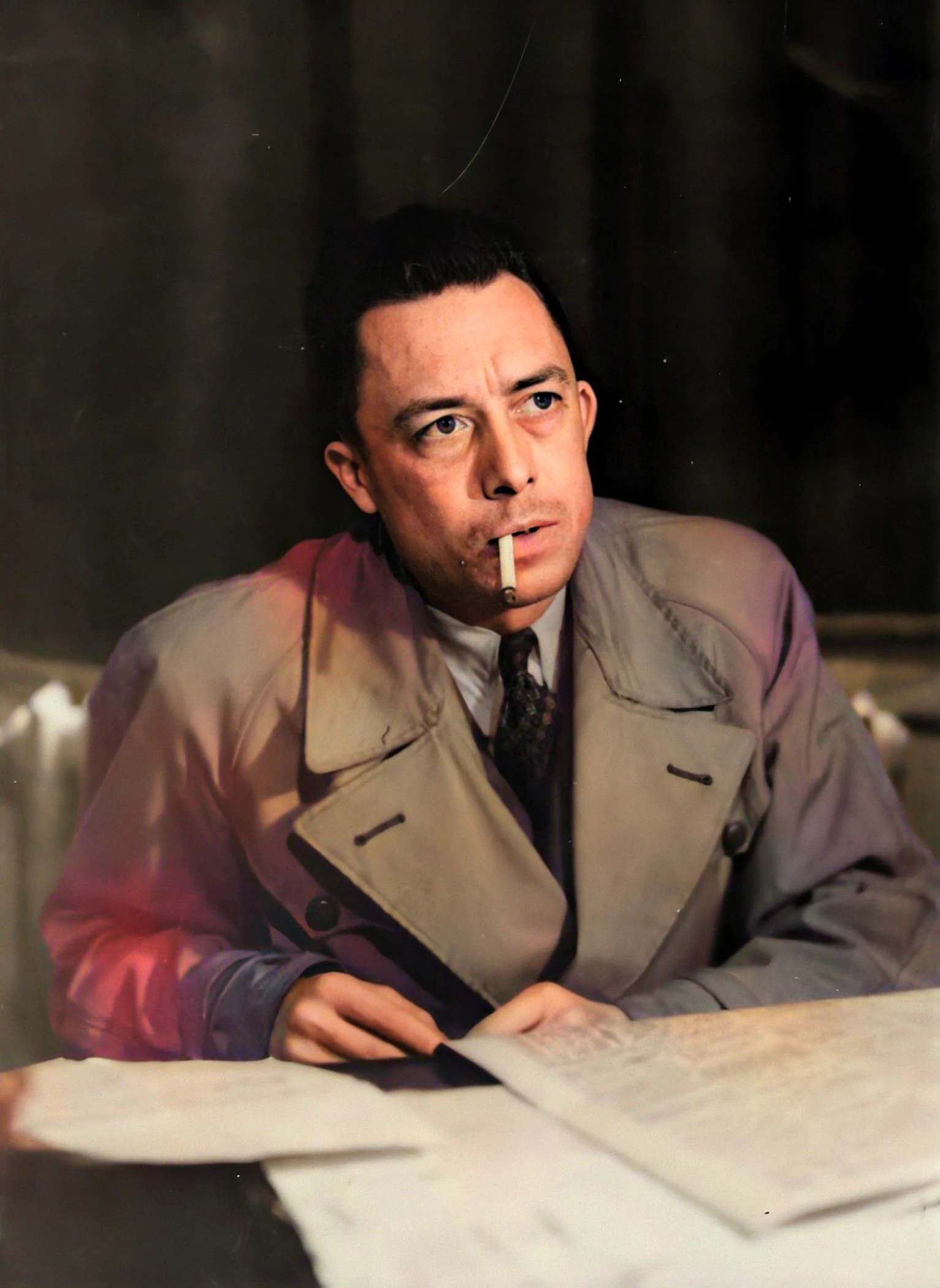
| 90 Quotes | |
| Occup. | Philosopher |
| From | France |
| Born | November 7, 1913 |
| Died | January 4, 1960 |
| Aged | 46 years |
| Cite | |
Citation Formats
APA Style (7th ed.)
Albert camus biography, facts and quotes. (2026, February 1). FixQuotes. https://fixquotes.com/authors/albert-camus/
Chicago Style
"Albert Camus biography, facts and quotes." FixQuotes. February 1, 2026. https://fixquotes.com/authors/albert-camus/.
MLA Style (9th ed.)
"Albert Camus biography, facts and quotes." FixQuotes, 1 Feb. 2026, https://fixquotes.com/authors/albert-camus/. Accessed 12 Feb. 2026.
Early Life and Background
Albert Camus was born on November 7, 1913, in Mondovi, French Algeria (now Drean), into the precarious world of colonists who were neither fully at home in France nor fully rooted in North Africa. His father, Lucien Camus, a farmworker turned soldier, died of wounds from the Battle of the Marne in 1914, leaving Camus with an inherited absence that would harden into one of his central questions: how to live when meaning is not guaranteed by history, family, or Providence.Raised in the working-class district of Belcourt in Algiers, Camus grew up amid sunlit streets and material scarcity, in a household dominated by his largely silent, partially deaf mother, Catherine, and the strict authority of his grandmother. The contrast between poverty and the sensual richness of the Mediterranean - sea, heat, soccer fields, theater - formed an inner double register: tenderness without rhetoric, and lucid attention to what is immediately given. That early economy of words and abundance of sensation became, later, his ethical and stylistic signature.
Education and Formative Influences
Camus was pulled into formal learning by a decisive adult ally: his primary school teacher, Louis Germain, who helped him secure scholarships and later received Camus Nobel gratitude. At the University of Algiers he studied philosophy while confronting tuberculosis (diagnosed in 1930), an illness that repeatedly interrupted plans and intensified his sense that time is finite and morality cannot be postponed. He read the French moralists, Nietzsche, and the Greeks; acted and directed in student theater; and joined (briefly) the Algerian Communist Party in the mid-1930s, drawn less by dogma than by the urgent misery of Arab and Berber laborers. Disillusionment with ideological discipline, and the colonial reality that French republican ideals did not reach everyone, pushed him toward a more solitary, skeptical humanism.Career, Major Works, and Turning Points
Camus entered public life through journalism and theater in Algiers, then left for metropolitan France on the eve of World War II. In Paris he worked at the newspaper Paris-Soir and, during the German occupation, became a key writer and later editor for the Resistance paper Combat, forging a reputation for moral clarity without revolutionary romanticism. His breakthrough came in 1942 with the novel The Stranger and the essay The Myth of Sisyphus, paired statements of the Absurd: the world offers no final explanation, yet humans continue to demand one. Postwar fame widened with The Plague (1947), a parable of collective ordeal and decency; The Rebel (1951), a critique of political murder that provoked a famous rupture with Jean-Paul Sartre and much of the Parisian left; and the novel The Fall (1956), a dark monologue of self-indictment. Awarded the Nobel Prize in Literature in 1957, he found the honor shadowed by the Algerian War and by his own divided loyalties. He died suddenly on January 4, 1960, in a car crash near Villeblevin, France, with an unpublished manuscript, The First Man, later revealing how strongly his imagination still returned to Belcourt and his mother.Philosophy, Style, and Themes
Camus is often grouped with existentialists, yet he resisted the label because he refused systems that convert suffering into metaphysical profit. His Absurd begins as a psychological fact: the mind seeks coherence, the world remains indifferent, and the resulting friction can breed either despair or revolt. He distrusted heroic postures and ideological absolution; the ethical task, for him, was to stay lucid and still act. His writing returns to limits - of knowledge, of power, of innocence - and asks what kind of decency is possible when certainty fails. The journalist in him demanded that lofty ideals be tested against bodies, prisons, hunger, and executions; the Mediterranean sensualist in him insisted that joy and beauty are not distractions but evidence that life, though ungrounded, can still be loved.His prose mirrors that ethic: spare, classical, and sunlit, with violence arriving like weather. The Stranger turns emotional opacity into a moral provocation; The Plague makes everyday perseverance the measure of heroism; The Fall exposes the vanity of virtue performed for applause. Camus psychology is clearest when he argues against moral anesthesia: "A man without ethics is a wild beast loosed upon this world". He also diagnosed how political language launders cruelty, warning that "The welfare of the people in particular has always been the alibi of tyrants". And against both isolation and submission, he held up a modest ideal of solidarity that is neither command nor obedience: "Don't walk behind me; I may not lead. Don't walk in front of me; I may not follow. Just walk beside me and be my friend". In these lines is the core of his revolt - not salvation, but companionship under a pitiless sky.
Legacy and Influence
Camus enduring influence lies in making moral seriousness compatible with doubt, and in defending human limits against the intoxicating logic of ends that justify means. He remains a touchstone for readers navigating political extremism, state violence, and the temptation to excuse cruelty as history's necessity; his insistence on measured rebellion helped shape postwar liberal and social-democratic conscience even as it angered radicals. In literature, his fusion of fable, reportage, and classical restraint has affected novelists, dramatists, and essayists across languages. The posthumous The First Man re-centered him not as an abstract thinker but as a son of Algeria, marked by poverty and silence, searching for justice without surrendering to ideology - a philosopher of the sun who never stopped arguing that clarity and compassion are the only honest answers to the Absurd.Our collection contains 90 quotes written by Albert, under the main topics: Witty One-Liners - Ethics & Morality - Wisdom - Truth - Art.
Other people related to Albert: Simone Weil (Philosopher), Walter Kaufmann (Philosopher), Julien Benda (Philosopher), Maurice Merleau-Ponty (Philosopher)
Albert Camus Famous Works
- 1956 The Fall (Novel)
- 1951 The Rebel (Essay)
- 1947 The Plague (Novel)
- 1942 The Stranger (Novel)
- 1942 The Myth of Sisyphus (Essay)
Source / external links