
Albert Einstein Biography Quotes 160 Report mistakes
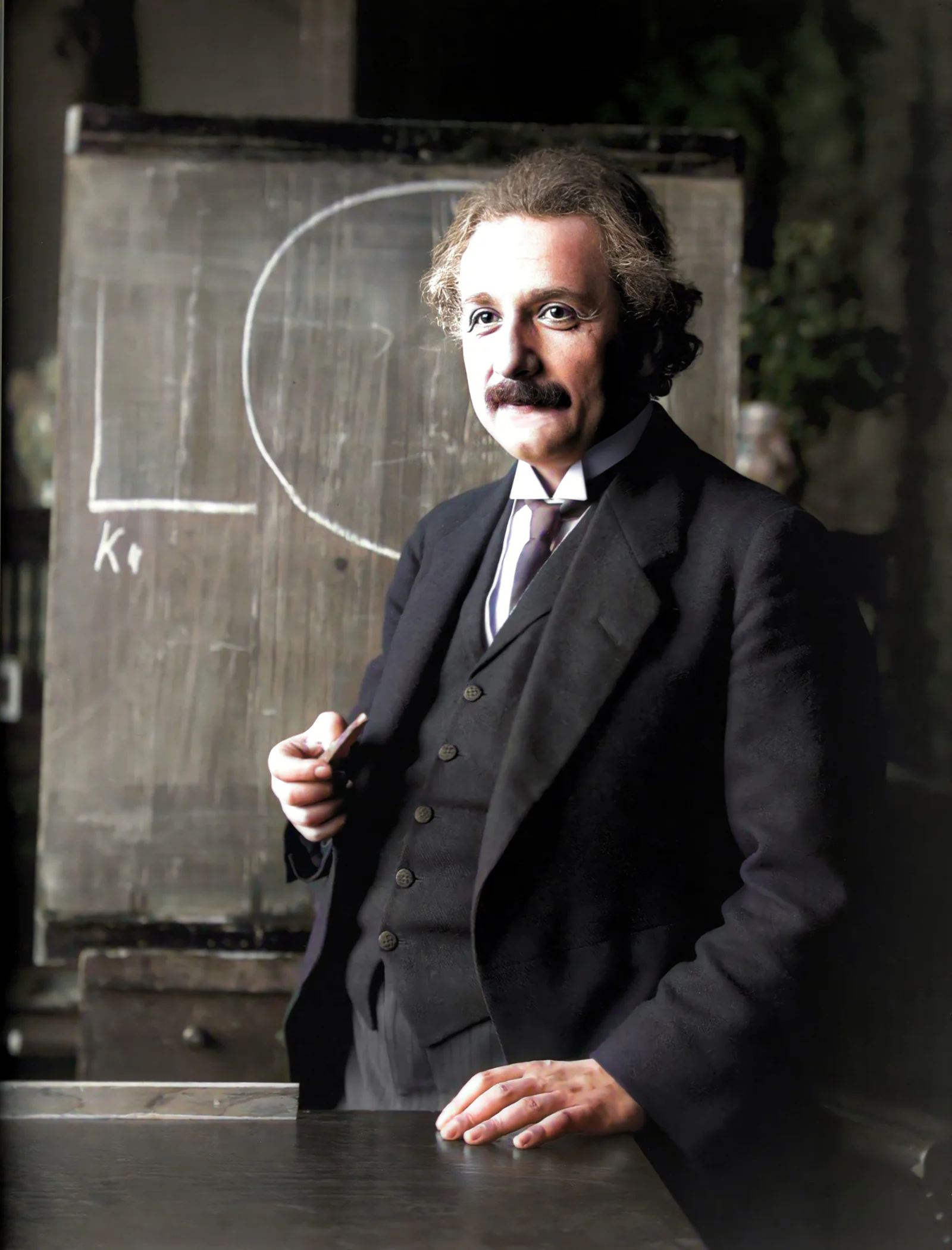
| 160 Quotes | |
| Occup. | Physicist |
| From | Germany |
| Spouses | Mileva Marić (1903-1919) Elsa Löwenthal (1919-1936) |
| Born | March 14, 1879 Ulm, Württemberg, Germany |
| Died | April 18, 1955 Princeton, New Jersey, USA |
| Cause | Aortic aneurysm |
| Aged | 76 years |
| Cite | |
Citation Formats
APA Style (7th ed.)
Albert einstein biography, facts and quotes. (2026, February 1). FixQuotes. https://fixquotes.com/authors/albert-einstein/
Chicago Style
"Albert Einstein biography, facts and quotes." FixQuotes. February 1, 2026. https://fixquotes.com/authors/albert-einstein/.
MLA Style (9th ed.)
"Albert Einstein biography, facts and quotes." FixQuotes, 1 Feb. 2026, https://fixquotes.com/authors/albert-einstein/. Accessed 12 Feb. 2026.
Early Life and Background
Albert Einstein was born on 1879-03-14 in Ulm, in the Kingdom of Wurttemberg, German Empire, into a secular Jewish family shaped by the ambitions and anxieties of modernizing Central Europe. His father, Hermann Einstein, and uncle Jakob ran small electrical businesses; his mother, Pauline Koch, brought music into the home, and the violin became both discipline and refuge. When the family moved to Munich, Einstein grew up amid the new prestige of engineering and industry, yet he remained wary of authority and drill, an instinct that would later harden into a principled distrust of militarism and herd thinking.As a boy he was quiet, inward, and stubbornly independent - prone to long silences, private puzzles, and sudden leaps of curiosity. A compass reportedly shown to him in childhood crystallized a lifelong fascination with unseen order: forces acting through space without touch. That sense of hidden structure, paired with an early discomfort in rigid classrooms, formed a personality split between reverence for rational law and impatience with imposed rules. When the family business faltered, the Einsteins relocated to Italy, and Albert, still a teenager, left Germany on his own terms, shedding both a school he disliked and a national culture he felt was sliding toward conformity.
Education and Formative Influences
Einstein studied at the Swiss Federal Polytechnic in Zurich (ETH), graduating in 1900, and became a Swiss citizen in 1901. His closest intellectual companions included Michele Besso and a small circle that debated physics, philosophy, and politics; his reading ranged from Maxwell to Mach and Spinoza, fertilizing a style that prized conceptual clarity over mere calculation. After a frustrating search for academic work, he secured a stable post in 1902 at the Swiss Patent Office in Bern, where the steady evaluation of inventions sharpened his feel for operational definitions - what, exactly, can be measured and compared - while leaving his evenings free for theory.Career, Major Works, and Turning Points
In 1905, his annus mirabilis, Einstein published four papers that remade physics: the light quantum explanation of the photoelectric effect, the statistical account of Brownian motion, the special theory of relativity, and mass-energy equivalence, E=mc^2; he completed a doctorate the same year. Academic posts followed - Zurich, Prague, back to Zurich, then Berlin in 1914 - and amid war and personal turmoil he finished general relativity in 1915, redefining gravity as spacetime curvature. The 1919 eclipse expeditions led by Arthur Eddington confirmed light-bending and made Einstein a global emblem of scientific modernity. He won the 1921 Nobel Prize in Physics for the photoelectric effect, not relativity, yet by then his name stood for the upheaval of time, space, and certainty. With the rise of Nazism he left Germany in 1933 for the Institute for Advanced Study in Princeton; in 1939 he signed a letter to Franklin D. Roosevelt warning of nuclear chain reactions, then spent his later years advocating international control of atomic weapons while pursuing, unsuccessfully, a unified field theory.Philosophy, Style, and Themes
Einstein's inner life revolved around a near-religious devotion to intelligibility - the conviction that nature is coherent enough to be understood, yet strange enough to demand new concepts. His work repeatedly moved against the temptation to multiply mechanisms; he hunted invariants, symmetries, and simple postulates that could carry enormous explanatory weight. "Any intelligent fool can make things bigger and more complex... It takes a touch of genius - and a lot of courage to move in the opposite direction". That courage was psychological as much as technical: he could tolerate isolation, doubt, and ridicule while waiting for an idea to click into necessity.His public persona as a gentle sage hid a sharper edge: impatience with cant, nationalism, and obedience, and a constant, sometimes humorous self-scrutiny. "A question that sometimes drives me hazy: am I or are the others crazy?" The line captures a mind that treated consensus as data, not as proof - a stance that helped him break with classical absolutes. Yet he was not a nihilist; he believed in objective truth and moral responsibility, even when measurement faltered. "Everything that can be counted does not necessarily count; everything that counts cannot necessarily be counted". In science this meant respecting empirical test while refusing to confuse the measurable with the meaningful; in life it meant defending human dignity, supporting civil rights in America, and warning that technical power without ethical seriousness leads to catastrophe.
Legacy and Influence
Einstein altered the architecture of physics: relativity underpins modern cosmology, black holes, gravitational waves, GPS timekeeping, and the energy-mass logic behind nuclear processes, while his quantum insights helped launch a revolution he later criticized for its indeterminacy. Beyond equations, he became a model of the socially engaged intellectual - an immigrant scientist confronting dictatorship, antisemitism, and the moral shock of atomic weapons, insisting that scientific brilliance does not excuse civic silence. His enduring influence lies in the combination: a radical imagination disciplined by rigor, and a conscience alert to the human consequences of ideas.Our collection contains 160 quotes written by Albert, under the main topics: Witty One-Liners - Motivational - Ethics & Morality - Wisdom - Truth.
Other people related to Albert: Max Born (Mathematician), John Archibald Wheeler (Physicist), Gaston Bachelard (Philosopher), David Bohm (Scientist), Ernst Mach (Physicist), Gilbert Murray (Diplomat), Marston Morse (Mathematician), Paul Robeson (Actor), James Jeans (Physicist), Wilhelm Reich (Psychologist)
Frequently Asked Questions
- Einstein Nobel Prize: He won the Nobel Prize in Physics in 1921 for the photoelectric effect.
- Albert Einstein family: He was married twice and had three children.
- Albert Einstein age: Einstein was born in 1879, so he would be 144 years old today.
- Albert Einstein death age: Einstein died at the age of 76.
- Albert Einstein childhood: He was born in Ulm, Germany, and showed an early interest in science and mathematics.
- Albert Einstein famous for: He is famous for the theory of relativity and the equation E=mc².
- Albert Einstein inventions: Einstein didn't invent machines but developed theories like relativity which influenced modern physics.
- How old was Albert Einstein? He became 76 years old
Albert Einstein Famous Works
- 1950 Out of My Later Years (Book)
- 1938 The Evolution of Physics (Book)
- 1934 Einstein's Essays in Science (Book)
- 1922 The Meaning of Relativity (Book)
- 1916 The Theory of Relativity (Book)