
Aldous Huxley Biography Quotes 90 Report mistakes
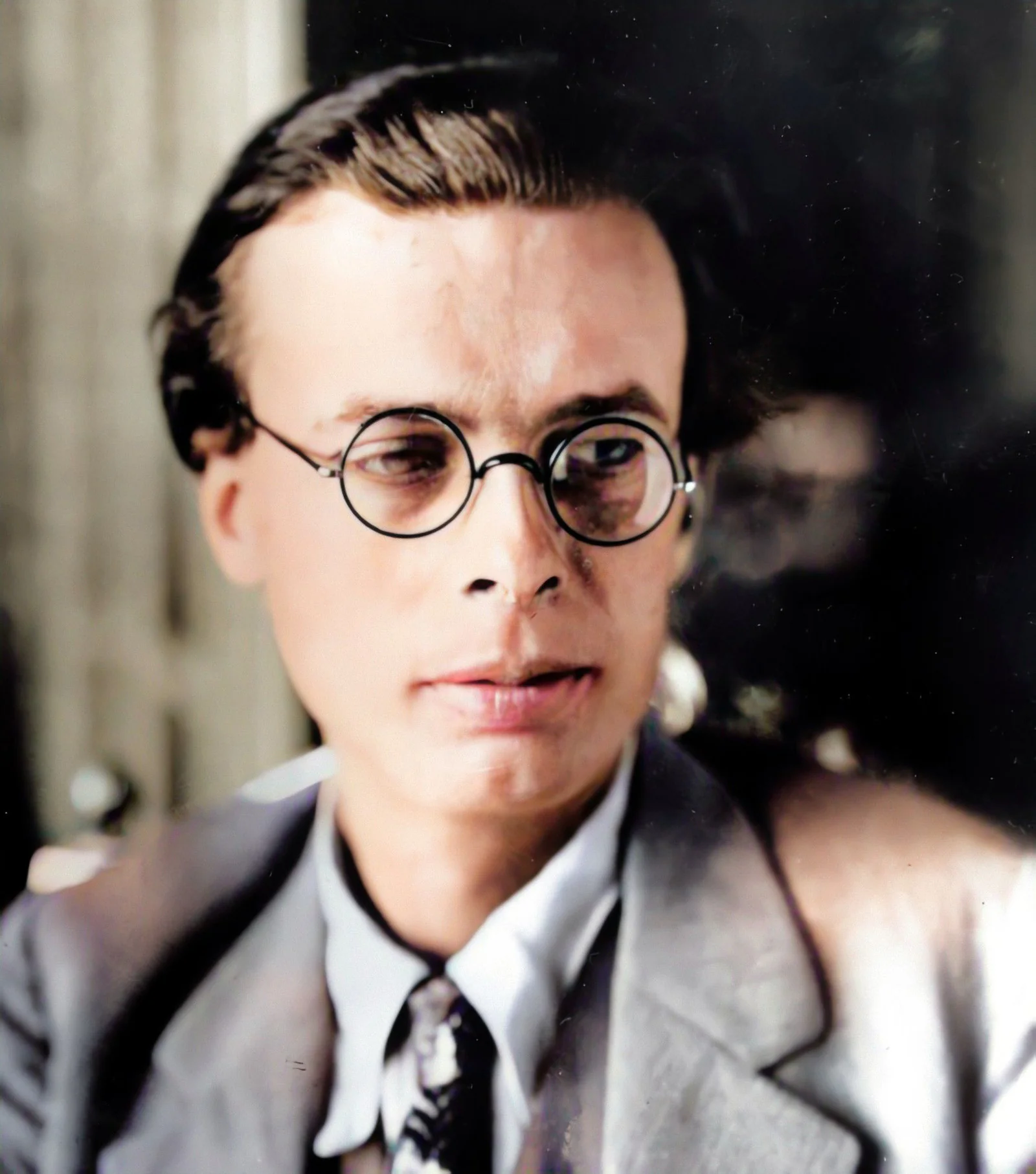
| 90 Quotes | |
| Born as | Aldous Leonard Huxley |
| Occup. | Novelist |
| From | England |
| Born | July 26, 1894 Godalming, Surrey, England |
| Died | November 22, 1963 Los Angeles County, California, USA |
| Aged | 69 years |
| Cite | |
Citation Formats
APA Style (7th ed.)
Aldous huxley biography, facts and quotes. (2026, February 1). FixQuotes. https://fixquotes.com/authors/aldous-huxley/
Chicago Style
"Aldous Huxley biography, facts and quotes." FixQuotes. February 1, 2026. https://fixquotes.com/authors/aldous-huxley/.
MLA Style (9th ed.)
"Aldous Huxley biography, facts and quotes." FixQuotes, 1 Feb. 2026, https://fixquotes.com/authors/aldous-huxley/. Accessed 5 Mar. 2026.
Early Life and Background
Aldous Leonard Huxley was born on 1894-07-26 in Godalming, Surrey, into a family where ideas were a kind of weather. His grandfather was T. H. Huxley, the combative Darwinian known as "Darwin's bulldog"; his father, Leonard Huxley, edited the Cornhill Magazine; his mother, Julia Arnold Huxley, came from the Arnold literary-educational dynasty and ran a school. The household mixed Victorian scientific confidence with late-imperial anxiety, training him early to hear the public voice of progress and the private murmurs of doubt.That doubleness sharpened under loss. His mother died in 1908 when he was fourteen, a rupture he later treated as a formative wound rather than a melodrama. In 1911 he was struck by keratitis punctata, nearly blinded for many months and left with permanently impaired sight. The experience changed his temperament from youthful sociability to an inward, analytic watchfulness: he learned to live by attention, to turn sensation into thought, and to suspect that "normal" perception - social as much as visual - is a fragile, easily managed thing.
Education and Formative Influences
Huxley attended Eton College, where illness cut him off from the usual athletic and military pathways that shaped many of his generation on the eve of World War I; he instead became a voracious reader and an editor of mind rather than body. At Balliol College, Oxford (from 1913), he read English literature, absorbing the ironies of Pope and Swift, the moral introspection of the Victorians, and the new modernist pressure on form. Barred by eyesight from combat service, he watched the war as a cultural catastrophe that discredited easy faith in rational improvement, pushing him toward satire, skepticism, and an almost scientific curiosity about how societies manufacture belief.Career, Major Works, and Turning Points
After early poems and essays, Huxley emerged in the 1920s as a sharp chronicler of postwar Britain: Crome Yellow (1921), Antic Hay (1923), and Point Counter Point (1928) anatomized the bright talk and spiritual anemia of the educated classes, using comedy as an instrument of diagnosis. His turn to global, systemic warning arrived with Brave New World (1932), a dystopia built from Fordist production, behaviorist psychology, and pleasure as social control; it established him as one of the century's central novelists of ideas. In 1937 he moved to California, drawn by health, climate, and a new cultural frontier, and there his interests widened into mysticism, comparative religion, and the ethics of power. The Perennial Philosophy (1945) argued for a shared spiritual core across traditions; The Devils of Loudun (1952) explored mass hysteria and political manipulation; The Doors of Perception (1954) and Heaven and Hell (1956) examined consciousness through mescaline with a cool, literate phenomenology. His late novel Island (1962) reimagined utopia as education, attention, and humane limits - a deliberate counterpoint to his earlier nightmare. He died in Los Angeles on 1963-11-22, the same day the modern media age convulsed around the assassination of John F. Kennedy, an irony for a writer who had warned that distraction can eclipse reality.Philosophy, Style, and Themes
Huxley's style was a fusion of essayist clarity and novelist orchestration: he liked to stage debates inside scenes, letting characters function as instruments in a larger argument while still granting them the humiliations of appetite and vanity. Satire, for him, was not cruelty but hygiene - a way to keep language from lying too smoothly. Yet behind the brilliance lay a recurring fear that human beings drift into unfreedom not by chains but by comforts, habits, and managed appetites. “Most human beings have an almost infinite capacity for taking things for granted”. That sentence is not a throwaway aphorism in his worldview - it is the psychological engine of Brave New World, where citizens accept their engineered fate because it is familiar, pleasant, and never asks for inner work.He distrusted the myth of linear improvement because he had watched the 20th century marry science to propaganda and industry to slaughter. “Technological progress has merely provided us with more efficient means for going backwards”. The backward motion he meant was spiritual and ethical: the return to tribalism, cruelty, and mechanized conformity wearing the mask of modernity. His later turn toward contemplation and the "perennial" was not escapism so much as counter-programming - an attempt to rehabilitate attention, silence, and disciplined compassion as political acts. “People intoxicate themselves with work so they won't see how they really are”. In Huxley, that diagnosis connects factory schedules to inner avoidance, suggesting that tyranny can be internalized as busyness, and that freedom begins with the courage to perceive oneself without anesthesia.
Legacy and Influence
Huxley endures because he mapped the pressure points where private psychology becomes public fate: distraction, pleasure, and the surrender of judgment to systems that promise ease. Brave New World remains a primary reference for debates about genetic engineering, pharmaceutical mood management, surveillance-by-entertainment, and the commodification of desire, while Island continues to inspire educators and reformers seeking humane alternatives to both authoritarianism and empty consumer freedom. His nonfiction helped seed mid-century interest in comparative spirituality and consciousness studies, influencing writers from George Orwell (as foil and counterpart) to later science-fiction and countercultural thinkers. More than a prophet of doom, he was a diagnostician of consent - and his deepest challenge remains unsettlingly current: not whether power can coerce us, but how readily we cooperate when it flatters our weaknesses.Our collection contains 90 quotes written by Aldous, under the main topics: Witty One-Liners - Motivational - Ethics & Morality - Wisdom - Truth.
Other people related to Aldous: Huston Smith (Theologian), Albert Hofmann (Scientist), Frieda von Richthofen (Celebrity), Elspeth Huxley (Writer)
Aldous Huxley Famous Works
- 1962 Island (Novel)
- 1954 The Doors of Perception (Non-fiction)
- 1936 Eyeless in Gaza (Novel)
- 1932 Brave New World (Novel)
- 1928 Point Counter Point (Novel)
- 1923 Antic Hay (Novel)
- 1921 Crome Yellow (Novel)
Source / external links