
Aleksandr Solzhenitsyn Biography Quotes 40 Report mistakes
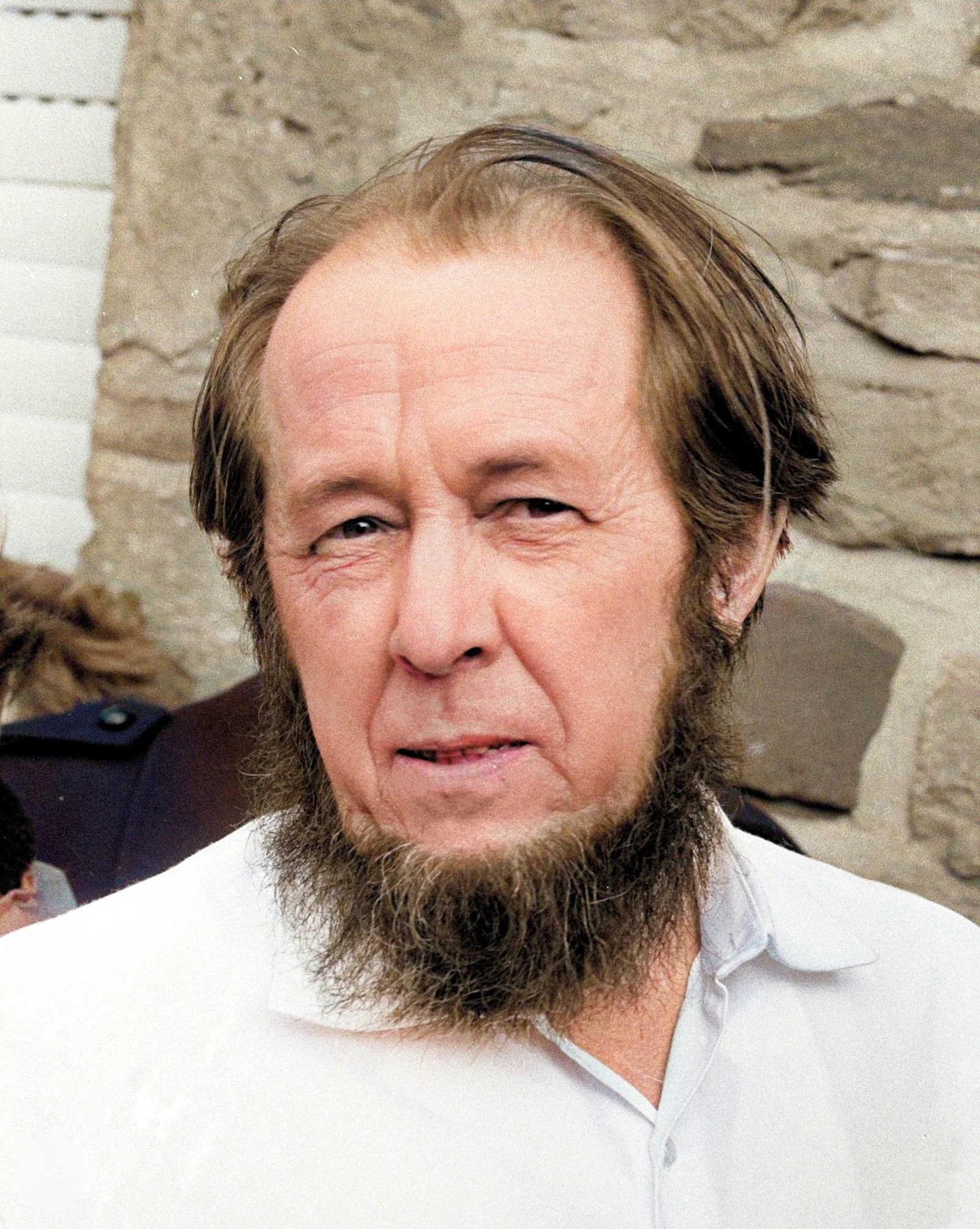
| 40 Quotes | |
| Born as | Aleksandr Isayevich Solzhenitsyn |
| Occup. | Author |
| From | Russia |
| Spouse | Natalia Alekseevna Reshetovskaya |
| Born | December 11, 1918 Kislovodsk, Stavropol Krai, Russian Empire |
| Died | August 3, 2008 Moscow, Russia |
| Cause | Natural Causes |
| Aged | 89 years |
| Cite | |
Citation Formats
APA Style (7th ed.)
Aleksandr solzhenitsyn biography, facts and quotes. (2026, February 2). FixQuotes. https://fixquotes.com/authors/aleksandr-solzhenitsyn/
Chicago Style
"Aleksandr Solzhenitsyn biography, facts and quotes." FixQuotes. February 2, 2026. https://fixquotes.com/authors/aleksandr-solzhenitsyn/.
MLA Style (9th ed.)
"Aleksandr Solzhenitsyn biography, facts and quotes." FixQuotes, 2 Feb. 2026, https://fixquotes.com/authors/aleksandr-solzhenitsyn/. Accessed 26 Mar. 2026.
Early Life and Background
Aleksandr Isayevich Solzhenitsyn was born on 1918-12-11 in Kislovodsk, in Russia's North Caucasus, into the aftershocks of revolution and civil war. His father, Isaakiy Semyonovich Solzhenitsyn, died in a hunting accident before Aleksandr was born, leaving his mother, Taisiya Zakharovna Shcherbak, to raise him amid scarcity, state propaganda, and the hardening mechanisms of the new Soviet order. From childhood he absorbed two competing educations: the official faith of Marxist-Leninism and the quieter, older Russia of family memory, Orthodox echoes, and the lived experience of want.He came of age under Stalin, when private speech trained itself to sound public, and ambition required political camouflage. The young Solzhenitsyn was neither born dissident nor exempt from the era's temptations; he initially accepted many Soviet premises, including the romance of historical destiny. Yet the social air he breathed - informers, fear, and the normalization of coercion - also trained his attention on the hidden wiring of power: how institutions shape souls, and how the smallest concessions in language can become moral surrender.
Education and Formative Influences
Solzhenitsyn studied mathematics and physics at Rostov State University, graduating in 1941, while also pursuing literature through correspondence courses at the Moscow Institute of Philosophy, Literature, and History. The dual training mattered: the mathematician's taste for structure, proof, and enumeration later organized his vast documentary narratives, while his literary apprenticeship drew him to the Russian classics and to moral realism rather than aesthetic play. Mobilized in World War II, he served as an artillery officer, earned decorations, and wrote letters that criticized Stalin - the private candor that, in 1945, triggered his arrest and began the ordeal that would become his central subject.Career, Major Works, and Turning Points
Sentenced to eight years in the Gulag followed by internal exile, Solzhenitsyn moved through prisons, labor camps, and a research "sharashka" before exile in Kazakhstan; he also survived cancer, later transmuting illness into the existential drama of Cancer Ward. After Khrushchev's thaw, he burst into public view with One Day in the Life of Ivan Denisovich (1962), a compressed masterpiece that made camp life undeniable without melodrama. As censorship tightened again, he circulated samizdat works - The First Circle, Cancer Ward - and built the monumental The Gulag Archipelago, a polyphonic indictment assembled from his experience and hundreds of testimonies. Awarded the Nobel Prize in Literature (1970) but hounded by the state, he was arrested and expelled in 1974, living in Switzerland and then Vermont as both chronicler and exile. Returning to Russia in 1994 after the Soviet collapse, he spent his final years writing, broadcasting, and arguing with equal ferocity against post-Soviet kleptocracy, spiritual emptiness, and the West's complacent triumphalism, dying on 2008-08-03 in Moscow.Philosophy, Style, and Themes
Solzhenitsyn's inner life was forged in captivity, where the state tried to reduce persons to functions and hunger. From that pressure emerged his central conviction: that political evil is sustained not only by institutions but by the bargains individuals make with falsity. His prose, even when expansive, keeps returning to the moral chemistry between coercion and self-deception. “Violence can only be concealed by a lie, and the lie can only be maintained by violence”. The sentence is not a slogan in his work so much as a diagnostic tool - explaining why terror needs falsified language, and why resisting tyranny begins with refusing to participate in its vocabulary.Stylistically he fused documentary precision with the Russian tradition of the moral novel: sharply observed detail, compressed dialogue, and a willingness to interrupt narrative for judgment. He distrusted ornament when it softened truth into mood. “Everything you add to the truth subtracts from the truth”. That severity shaped his method in The Gulag Archipelago: not just recounting suffering, but anatomizing how an administrative system trains citizens to repeat untruths until they feel natural. His psychology was marked by a survivor's impatience with euphemism and a believer's sense of obligation; the writer, to him, had public duties because the state could criminalize honest description. “In our country the lie has become not just a moral category but a pillar of the State”. The theme is less about Soviet uniqueness than about any regime - and any era - that turns comfort, ideology, or career into permission to deny what is seen.
Legacy and Influence
Solzhenitsyn endures as the writer who made the Gulag legible to the world and, just as crucially, made it morally interpretable: a system built from policy, cowardice, ambition, and the daily surrender of speech. His books helped shift global understandings of Soviet communism, strengthened dissident movements, and influenced later literature of incarceration and testimony, from Eastern Europe to Latin America. In Russia he remains a contested conscience - admired as a patriot and prophet, criticized as austere, nationalist, or uncompromising - yet his essential bequest is larger than politics: a model of literature as witness, insisting that personal integrity is not private at all when the public order is founded on organized lies.Our collection contains 40 quotes written by Aleksandr, under the main topics: Ethics & Morality - Truth - Wisdom - Art - Justice.
Other people related to Aleksandr: Bernard Pivot (Journalist), Tom Courtenay (Actor)
Aleksandr Solzhenitsyn Famous Works
- 1973 The Gulag Archipelago (Non-fiction)
- 1968 In the First Circle (Novel)
- 1968 Cancer Ward (Novel)
- 1962 One Day in the Life of Ivan Denisovich (Novel)
- 1962 A Day in the Life of Ivan Denisovich (Screenplay)
Source / external links