
Alexander Dubček Biography Quotes 2 Report mistakes
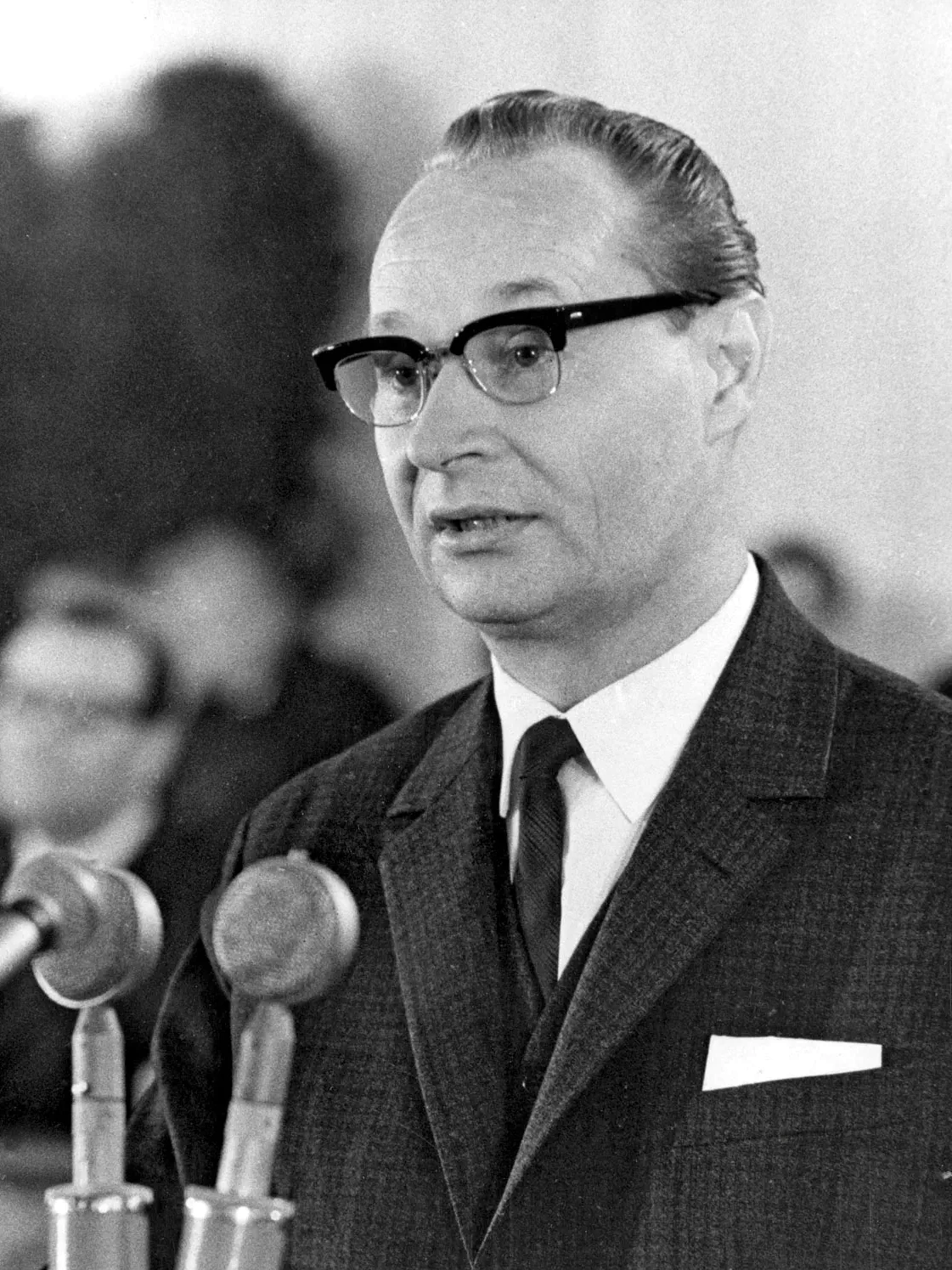
Attr: Britannica
| 2 Quotes | |
| Occup. | Politician |
| From | Czech Republic |
| Spouse | Anna Dubčeková |
| Born | November 27, 1921 Uhrovec, Trenčín Region, Czechoslovakia |
| Died | November 7, 1992 Prague, Czech Republic |
| Cause | Injuries sustained in a car accident |
| Aged | 70 years |
| Cite | |
Citation Formats
APA Style (7th ed.)
Alexander dubček biography, facts and quotes. (2026, March 14). FixQuotes. https://fixquotes.com/authors/alexander-dubcek1/
Chicago Style
"Alexander Dubček biography, facts and quotes." FixQuotes. March 14, 2026. https://fixquotes.com/authors/alexander-dubcek1/.
MLA Style (9th ed.)
"Alexander Dubček biography, facts and quotes." FixQuotes, 14 Mar. 2026, https://fixquotes.com/authors/alexander-dubcek1/. Accessed 14 Mar. 2026.
Early Life and Background
Alexander Dubcek was born on November 27, 1921, in Uhrovec, Slovakia, then part of the new Czechoslovak Republic, into a family for whom politics, labor, and moral purpose were inseparable. His father, Stefan Dubcek, was a carpenter and committed socialist; his mother, Pavla, shared the family's idealism. The household belonged to that current of interwar Central European radicalism that believed social justice could be built not only through parliament but through disciplined communal effort. This was not abstract doctrine. It shaped where the family lived, whom they trusted, and what they thought history demanded of ordinary people.In 1925 the Dubceks left for Soviet Kyrgyzstan, joining the Interhelpo cooperative near Frunze, an experiment in socialist industrial colonization. Alexander spent much of his childhood in a multinational, harsh, improvisational world marked by poverty, idealism, and the practical failures of utopia. In 1938 the family returned to Czechoslovakia as Europe darkened. During the Second World War Dubcek joined the illegal Communist resistance against the Nazi-backed Slovak state and took part in the Slovak National Uprising of 1944, where he was wounded. His older brother Julius died in the struggle. Those experiences gave Dubcek a durable political psychology: anti-fascist, collectivist, patriotic, and convinced that socialism, if it was to be worthy of sacrifice, had to be humane rather than terroristic.
Education and Formative Influences
Dubcek was not a theoretician in the mold of a party ideologue, and that fact mattered. He trained as a mechanic and worked in industry, rising through youth and party structures by reliability, warmth, and organizational skill rather than by doctrinal brilliance. After 1948, as the Communists consolidated power in Czechoslovakia, he became a full-time party functionary. Study in Moscow at the Higher Party School from 1955 to 1958 exposed him to the language of orthodox Marxism-Leninism, yet the contrast between official formulas and lived reality sharpened his reformist instincts rather than extinguishing them. In Slovakia during the 1950s and 1960s he saw both the achievements and brutalities of Stalinist rule, including censorship, centralism, and political trials. The de-Stalinizing climate after Khrushchev, along with Slovak demands for greater equality within the republic, helped shape him into a consensus reformer - loyal to socialism, suspicious of police methods, and increasingly persuaded that legitimacy required openness.Career, Major Works, and Turning Points
Dubcek's ascent was steady: he became First Secretary of the Slovak Communist Party in 1963 and, after mounting dissatisfaction with Antonin Novotny's rigid rule, First Secretary of the Communist Party of Czechoslovakia in January 1968. What followed made his name global. The Prague Spring, associated above all with Dubcek, sought "socialism with a human face" - abolition of the worst censorship, rehabilitation of victims of repression, economic reform, federalization of the state, and a limited public sphere in which criticism was not treason. The April 1968 Action Program crystallized this agenda. Dubcek tried to balance popular awakening with party control and to reassure Moscow that reform was not counterrevolution. He failed. On the night of August 20-21, 1968, Warsaw Pact forces led by the Soviet Union invaded Czechoslovakia. Dubcek was arrested, taken to Moscow, and compelled into humiliating compromise. Though briefly retained, he was displaced by Gustav Husak in 1969, sent as ambassador to Turkey, then expelled from the party and pushed into obscurity as a forestry official. He re-emerged during the Velvet Revolution of 1989 as a moral symbol of betrayed reform and served as chairman of the Federal Assembly until his death from injuries after a 1992 car crash.Philosophy, Style, and Themes
Dubcek's political philosophy was built less on system than on temperament. He believed socialism could survive only by renouncing fear as a method of rule and by reconnecting state power to ordinary life. He grasped politics as something intimate rather than merely institutional: “Politics is everything. Politics includes housing problems, the issue of whether or not we can travel - politics is everything you touch in the place you live. Politics is always here in one form or another”. That sentence reveals his deepest instinct. He was neither dissident liberal nor hardened apparatchik, but a reform communist who thought legitimacy came from daily human experience - speech, movement, dignity, fairness. His gift was trustworthiness; crowds and colleagues often experienced him as decent in a system that rewarded hardness. His weakness was the same quality turned geopolitical: he believed sincerity could calm an empire.That tragic naivete entered his own retrospective self-judgment. “My problem was not having a crystal ball to foresee the Russian invasion. At no point between January and August 20, in fact, did I believe that it would happen”. The remark is not merely defensive. It discloses a man formed by anti-fascist struggle and party loyalty who could imagine Soviet pressure, blackmail, even discipline, but not the full violence of fraternal occupation against a fellow socialist state attempting internal renewal. Dubcek's style was patient, conciliatory, and ethically disarming; he tried to reform by persuasion and symbolic thaw rather than by rupture. The central theme of his life is therefore paradox: he became the face of freedom while trying to save, not destroy, Communist legitimacy. His moderation made him historically potent and operationally vulnerable.
Legacy and Influence
Dubcek endures as one of the twentieth century's emblematic reformers, a figure whose failure was historically generative. The crushing of the Prague Spring destroyed hopes for easy democratization inside the Soviet bloc, yet it also exposed the moral bankruptcy of "actually existing socialism" and inspired later dissent from Charter 77 to Mikhail Gorbachev's more cautious reforms. In Slovakia and the Czech lands, Dubcek remains a symbol of decency in power - flawed, hopeful, and unusually free of vindictiveness. He did not leave a body of philosophical writing comparable to major dissidents, but his life became a text read across Europe: socialism without liberty decays into coercion, while liberty without political courage can be smothered by force. His historical greatness lies in having embodied, however briefly, the possibility that a closed system might humanize itself from within.Our collection contains 2 quotes written by Alexander.
Source / external links