
Alexander Herzen Biography Quotes 17 Report mistakes
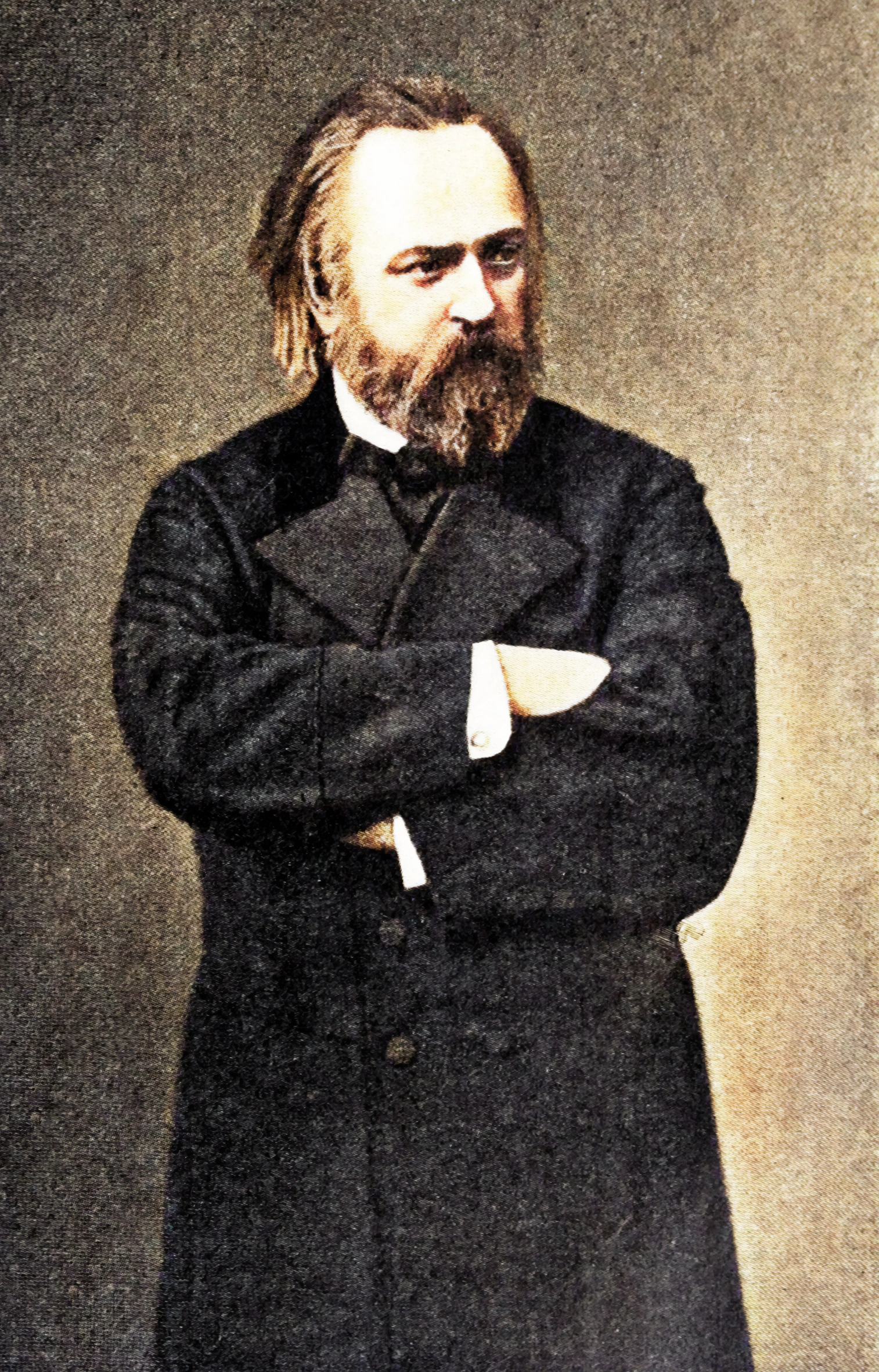
| 17 Quotes | |
| Born as | Aleksandr Ivanovich Herzen |
| Occup. | Journalist |
| From | Russia |
| Born | April 6, 1812 Moscow, Russia |
| Died | January 21, 1870 Paris, France |
| Aged | 57 years |
| Cite | |
Citation Formats
APA Style (7th ed.)
Alexander herzen biography, facts and quotes. (2026, February 11). FixQuotes. https://fixquotes.com/authors/alexander-herzen/
Chicago Style
"Alexander Herzen biography, facts and quotes." FixQuotes. February 11, 2026. https://fixquotes.com/authors/alexander-herzen/.
MLA Style (9th ed.)
"Alexander Herzen biography, facts and quotes." FixQuotes, 11 Feb. 2026, https://fixquotes.com/authors/alexander-herzen/. Accessed 6 Mar. 2026.
Early Life and Background
Aleksandr Ivanovich Herzen was born on 1812-04-06 in Moscow, in a Russia convulsed by the Napoleonic invasion and governed by an autocracy that demanded public deference and private fear. The illegitimacy that shaped his earliest identity was both literal and social: he was the unacknowledged son of the wealthy noble Ivan Yakovlev and the young German woman Henriette (Luise) Haag. Yakovlev gave the boy the surname "Herzen" - from the German Herz, "heart" - a polite fiction that marked him as loved yet outside lawful inheritance, and it seeded the lifelong sensation of standing at an angle to official life.Moscow in Herzen's youth was a city of salons and censorship, French novels and police informers, enlightenment talk and serf labor. As a teenager he absorbed the mythic memory of the Decembrists, the officers who attempted a constitutional uprising in 1825 and were hanged or exiled, and he internalized their defeat as a personal summons. The combination of privilege, stigma, and moral shock at Russia's servile order formed his early psychology: he craved freedom not as an abstraction but as a defense of dignity against the humiliations that society normalized.
Education and Formative Influences
Herzen entered Moscow University in 1829, studying natural sciences and moving through the charged circles of students reading the French Revolution, Saint-Simon, and the first waves of German philosophy. With his close friend Nikolay Ogaryov, he made a youthful vow on Sparrow Hills to devote himself to Russia's liberation, a scene he later treated as both sincere and naive. The state quickly tested him: in 1834 he was arrested in a student affair and banished to provincial service (Perm, then Vyatka and Vladimir), where bureaucratic pettiness and police oversight educated him as sharply as books did. Those years strengthened his distrust of administrative power and trained his eye for the everyday mechanics of oppression that would animate his journalism.Career, Major Works, and Turning Points
Returning from exile under Nicholas I, Herzen became a leading voice of the Westernizers, then broke with complacent reformism as the 1840s darkened. In 1847, amid marital turmoil and the deaths that would devastate him, he left Russia for Western Europe; the revolutions of 1848 thrilled and disillusioned him, pushing him toward a distinctive anti-authoritarian socialism skeptical of historical "necessity". After Nicholas's death he built an unprecedented platform for Russian opposition from abroad: the Free Russian Press in London (1853) and, with Ogaryov, the newspaper Kolokol (The Bell, 1857), smuggled into the empire and read by officials and radicals alike. His major writings - From the Other Shore (1849-50), essays on Russia and Europe, and the vast memoir My Past and Thoughts (published 1850s-60s) - fused autobiography, political analysis, and philosophical protest, turning private grief into a public method. By the 1860s he stood between camps: he supported the emancipation of the serfs but condemned half-measures; he sympathized with youthful nihilists yet feared conspiratorial violence, especially after the Polish uprising of 1863 widened the rift between Russian liberals and national aspirations.Philosophy, Style, and Themes
Herzen's thought is best read as a moral temperament forged into political writing: allergic to cant, impatient with systems, tender toward individual lives, and ruthless toward institutions that asked people to become instruments. His style - conversational, ironic, suddenly lyrical, and anchored in anecdote - treated history as lived experience rather than a courtroom proving a theory. The memoirist and the polemicist in him were one: he wrote to preserve the irreducible complexity of persons against any ideology that promised to solve them.Three tensions recur: freedom versus obedience, concrete life versus abstraction, and the tragic timing of generations. His critique of respectable reform pierced the psychology of compromise: “Liberalism, austere in political trifles, has learned ever more artfully to unite a constant protest against the government with a constant submission to it”. The sentence is not only political; it is self-diagnostic, a warning about how fear and comfort collaborate to produce a public conscience that performs dissent while avoiding risk. Equally central is his suspicion of intellectual escapism, sharpened by his own passage through German metaphysics and revolutionary rhetoric: “We have wasted our spirit in the regions of the abstract and general just as the monks let it wither in the world of prayer and contemplation”. Behind the polemic lies a wounded empiricist who believed ideas must answer to human cost. And his sense of historical tragedy - the loneliness of living through collapses without new stabilizing forms - is captured in his stark compassion: “No one is to blame. It is neither their fault nor ours. It is the misfortune of being born when a whole world is dying”. That fatalism did not excuse passivity; it disciplined his hope, keeping him from sacrificing the present to a future paradise.
Legacy and Influence
Herzen died on 1870-01-21 in Paris, a Russian in exile whose most powerful institution was a printing press and whose most lasting weapon was a voice that refused to simplify. He became a founding figure of the Russian intelligentsia as a self-critical moral estate: independent of the state, suspicious of party orthodoxies, and committed to speaking in public as an individual conscience. Later populists, liberals, socialists, and dissidents all claimed parts of him, while thinkers from Isaiah Berlin onward valued him as an early theorist of pluralism and the limits of historical determinism. His enduring influence lies in the way he made journalism into a form of ethical autobiography - a record of how a thinking person resists both tyranny and the temptations of certainty.Our collection contains 17 quotes written by Alexander, under the main topics: Ethics & Morality - Wisdom - Art - Dark Humor - Sarcastic.
Alexander Herzen Famous Works
- 1856 The Doctor Krupov (Play)
- 1855 From the Other Shore (Essay Collection)
- 1852 My Past and Thoughts (Autobiography)
Source / external links