
Alfred Nobel Biography Quotes 5 Report mistakes
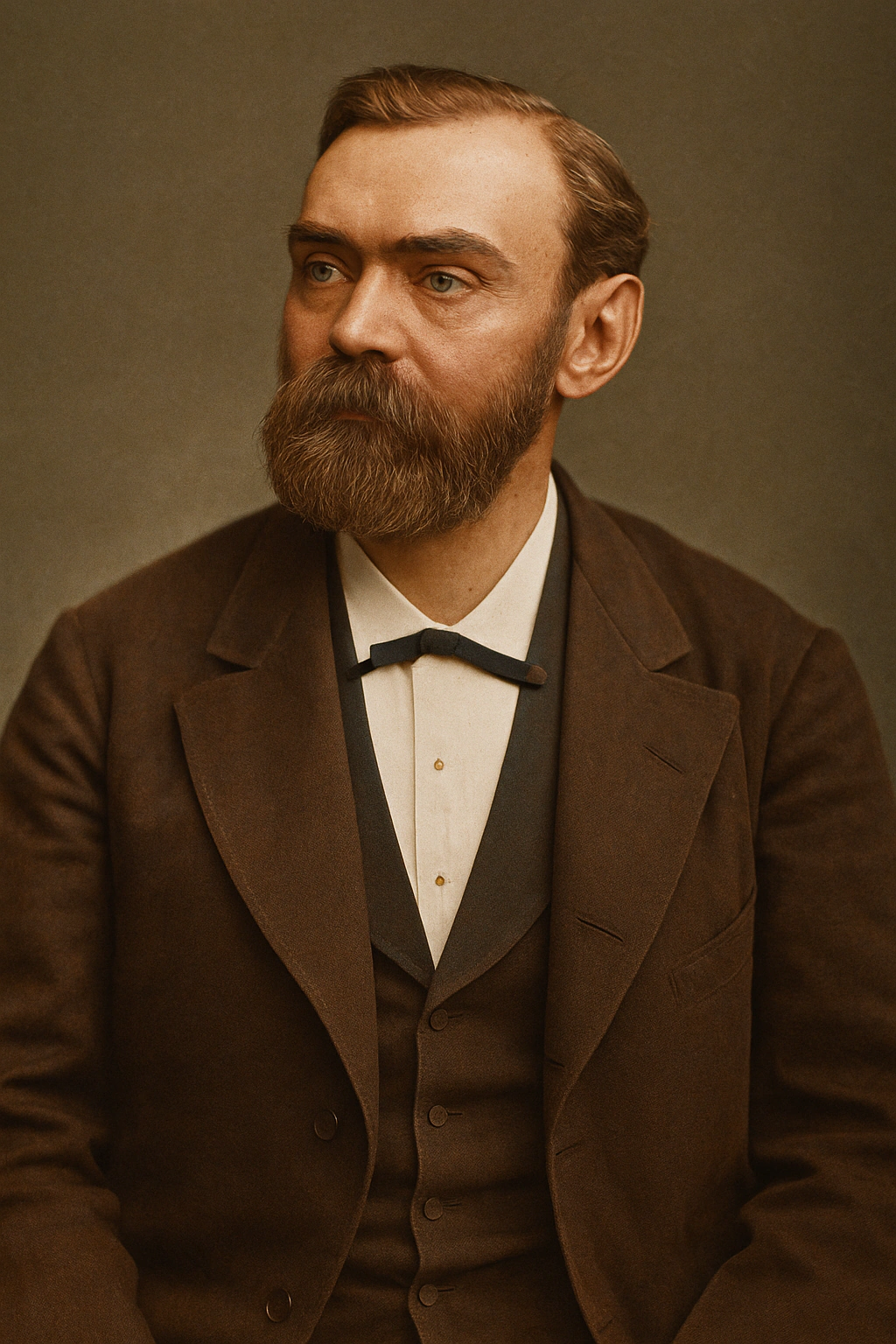
| 5 Quotes | |
| Born as | Alfred Bernhard Nobel |
| Occup. | Scientist |
| From | Sweden |
| Born | October 21, 1833 Stockholm, Sweden |
| Died | December 10, 1896 San Remo, Italy |
| Cause | Stroke |
| Aged | 63 years |
| Cite | |
Citation Formats
APA Style (7th ed.)
Alfred nobel biography, facts and quotes. (2026, February 11). FixQuotes. https://fixquotes.com/authors/alfred-nobel/
Chicago Style
"Alfred Nobel biography, facts and quotes." FixQuotes. February 11, 2026. https://fixquotes.com/authors/alfred-nobel/.
MLA Style (9th ed.)
"Alfred Nobel biography, facts and quotes." FixQuotes, 11 Feb. 2026, https://fixquotes.com/authors/alfred-nobel/. Accessed 26 Mar. 2026.
Early Life and Background
Alfred Bernhard Nobel was born on 1833-10-21 in Stockholm, Sweden, into a family shaped by both invention and instability. His father, Immanuel Nobel, was an engineer and entrepreneur whose ventures alternated between promise and collapse, while his mother, Andriette Ahlsell Nobel, kept the household afloat through practical business sense. That early contrast - visionary risk beside domestic realism - became a lifelong pattern in Alfred's own psyche: expansive imagination disciplined by a fear of failure and a need for control.Economic hardship pushed the family outward. In the 1840s they relocated to St Petersburg, where Immanuel's work supplying the Russian military, including mine-related technologies, finally prospered. Alfred grew up amid the clang of workshops and the anxieties of wartime industry, seeing how applied science could win contracts, alter geopolitics, and ruin or enrich families overnight. The later death and injury associated with explosives were not abstract to him; they belonged to the same world that provided his food, books, and expectations.
Education and Formative Influences
Nobel received a private, cosmopolitan education rather than a conventional university training. In St Petersburg he studied chemistry, physics, literature, and languages, becoming fluent in Swedish, Russian, French, English, and German, and he wrote poetry throughout his life. Sent on travels as a young man, he encountered leading chemical work in Paris and elsewhere, absorbing the era's faith that laboratory knowledge could be converted into industrial power. His formative influences combined precise scientific method with a restless, literary interior life - a mind comfortable with equations and with moral doubt.Career, Major Works, and Turning Points
Nobel's career pivoted on nitroglycerin, a powerful but terrifyingly unstable explosive first prepared by Ascanio Sobrero. After returning to Sweden in the 1860s, Nobel built a research-and-production network aimed at making that volatility controllable. Catastrophe struck in 1864 when an explosion at the Nobel factory in Stockholm killed several people, including his brother Emil; the disaster deepened his obsession with safer handling and reliable detonation. In 1867 he patented dynamite, stabilizing nitroglycerin in an absorbent medium, followed by innovations such as blasting gelatin (1875) and ballistite (1887). These advances transformed mining, tunneling, and infrastructure across industrializing Europe and America, while also feeding a global arms economy Nobel neither fully embraced nor escaped. He built factories and laboratories across multiple countries, filed hundreds of patents, and lived much of his adult life as a solitary transnational industrialist, moving between places like Paris and San Remo, seeking both privacy and proximity to skilled collaborators.Philosophy, Style, and Themes
Nobel's inner life was marked by a tension between romantic idealism and severe rational critique. He could be mordantly skeptical about public virtue and fashionable rhetoric, insisting, “Second to agriculture, humbug is the biggest industry of our age”. The line reads like a defense mechanism: a way to keep sentiment, nationalism, and self-serving moralizing from colonizing his judgment. Yet it also reveals loneliness - the stance of a man who expected disappointment and preferred the sting of clarity to the comfort of belonging.In the laboratory and in business, his style was iterative, fast-failing, and unsentimental about error. “If I have a thousand ideas and only one turns out to be good, I am satisfied”. That psychology - patience with waste, endurance through setbacks, refusal to mythologize the self - helps explain how he could persist after lethal accidents and public suspicion. At the same time, Nobel's late-life preoccupation with peace and recognition shows a mind seeking an ethical counterweight to the uses of his inventions. “I intend to leave after my death a large fund for the promotion of the peace idea, but I am skeptical as to its results”. Skepticism here is not indifference; it is the posture of a realist who understood that technology amplifies human motives rather than purifies them, and who nonetheless chose to bet his fortune on a moral aspiration.
Legacy and Influence
Nobel died on 1896-12-10 in San Remo, Italy, leaving a will that startled his family and much of Europe: most of his estate was to fund prizes for physics, chemistry, physiology or medicine, literature, and peace. The Nobel Prizes became one of the modern world's most powerful instruments for shaping scientific and cultural prestige, institutionalizing an international standard of merit at a moment when nationalism was tightening its grip on public life. His legacy remains deliberately paradoxical - an explosives magnate who redirected wealth toward human advancement - but the paradox is also the point: Nobel turned the era's faith in invention into a durable civic mechanism, rewarding work that expands knowledge, imagination, and, at least in intention, the prospects for peace.Our collection contains 5 quotes written by Alfred, under the main topics: Witty One-Liners - Hope - Equality - Peace - Entrepreneur.
Other people related to Alfred: Bertha von Suttner (Novelist)
Frequently Asked Questions
- Alfred Nobel education: Privately tutored; studied chemistry in St. Petersburg and Paris (with T. J. Pelouze).
- Alfred Nobel wife: Never married.
- Awards won by Alfred Nobel: Few major honors; he founded the Nobel Prizes but never received one.
- Alfred Nobel cause of death: Stroke (cerebral hemorrhage) in 1896.
- Why did Alfred Nobel create the Nobel Prize: To reward work benefiting humanity and improve his legacy after a harsh obituary; to promote science, literature, and peace.
- Alfred Nobel invented: Dynamite, gelignite, ballistite, blasting caps; held 355 patents.
- What is Alfred Nobel net worth? At death he left about 31 million SEK (1896), 94% endowed to fund the Nobel Prizes.
- Alfred Nobel dynamite story: After deadly nitroglycerin accidents (including his brother’s death), he stabilized it with kieselguhr, creating dynamite; patented in 1867.
- How old was Alfred Nobel? He became 63 years old
Alfred Nobel Famous Works
- 1895 Last Will and Testament (Non-fiction)
- 1887 Ballistite (Non-fiction)
Source / external links