
Alisher Navoi Biography Quotes 3 Report mistakes
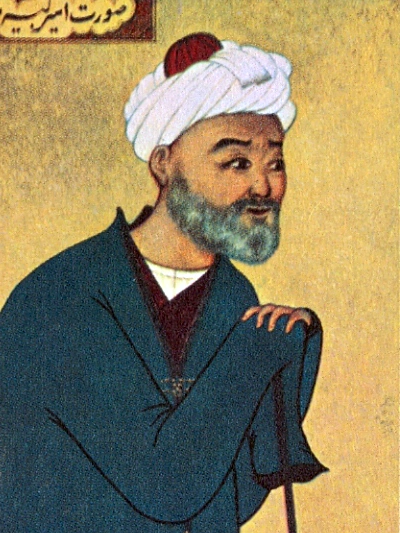
| 3 Quotes | |
| Born as | Nizam al-Din Ali-Shir |
| Known as | Mir Ali Sher Nava'i, Nizami |
| Native name | علیشیر نوایی |
| Occup. | Poet |
| From | Uzbekistan |
| Born | February 9, 1441 Herat, Timurid Empire (present-day Herat, Afghanistan) |
| Died | January 3, 1501 Herat, Timurid Empire (present-day Afghanistan) |
| Aged | 59 years |
| Cite | |
Citation Formats
APA Style (7th ed.)
Alisher navoi biography, facts and quotes. (2026, March 8). FixQuotes. https://fixquotes.com/authors/alisher-navoi/
Chicago Style
"Alisher Navoi biography, facts and quotes." FixQuotes. March 8, 2026. https://fixquotes.com/authors/alisher-navoi/.
MLA Style (9th ed.)
"Alisher Navoi biography, facts and quotes." FixQuotes, 8 Mar. 2026, https://fixquotes.com/authors/alisher-navoi/. Accessed 8 Mar. 2026.
Early Life and Background
Alisher Navoi, born Nizam al-Din Ali-Shir around 1441 in Herat, emerged from one of the great urban centers of the Timurid world, a city where Persian high culture, Turkic speech, Islamic scholarship, and court politics met in volatile combination. Though now claimed with pride in Uzbekistan, he belonged to a broader Khurasani civilizational sphere that linked present-day Afghanistan, Iran, and Central Asia. His family stood close to the Timurid administrative elite, giving him early access to the courtly education expected of a cultivated servant of empire. From childhood he moved within a milieu shaped by the afterglow of Timur's conquests and by the struggle of his successors to turn military dominion into lasting culture.That environment mattered profoundly to his inner formation. Herat in the fifteenth century was not merely a capital; it was a workshop of language and prestige, where Persian remained the dominant literary medium while Chagatai Turkic was spoken widely but often ranked below it in refinement. Navoi grew up conscious of hierarchy - political, linguistic, and spiritual. The instability of Timurid succession, the movement of families during factional conflict, and the fragility of favor at court all impressed on him that worldly standing could vanish quickly. From this tension came a lifelong doubleness: he was both a man of rank and a critic of vanity, both an insider to power and a witness to its moral costs.
Education and Formative Influences
Navoi received the education of a high-born Timurid intellectual: training in Arabic, Persian, theology, adab, poetics, calligraphy, and the ethical literature that joined statecraft to self-discipline. In youth he formed a crucial bond with Husayn Bayqara, later ruler of Herat, a friendship that would shape both his career and his political reach. He also came under the influence of the Naqshbandi Sufi master Jami, the leading Persian poet and thinker of the age, whose presence offered Navoi both literary companionship and spiritual seriousness. Persian masters - especially Nizami, Saadi, Attar, and Jami himself - furnished models of epic design, lyric compression, and mystical allegory, but just as important was his realization that Turkic could bear the same intellectual and emotional weight. That conviction became his civilizational mission.Career, Major Works, and Turning Points
When Husayn Bayqara secured Herat in 1469, Navoi entered the highest levels of administration and patronage, serving in offices that included the seal and other senior responsibilities, though his relation to court was never simple. He founded madrasas, khanaqahs, caravanserais, hospitals, and charitable endowments, presenting public service as an extension of literary ethics. At the same time he produced an extraordinary body of work in both Chagatai Turkic and Persian. His Turkish Khamsa, completed in the 1480s and modeled on the five-part epic sequence associated with Nizami, included Hayrat al-abrar, Farhad va Shirin, Layli va Majnun, Sab'ai sayyar, and Sadd-i Iskandari. His four divans gathered lyric poetry across the stages of life; Lisan al-tayr reworked Attar's mystical bird allegory; Majalis al-nafais offered a pioneering biographical anthology of poets; Muhakamat al-lughatayn argued forcefully for the expressive richness of Turkic against Persian condescension. The key turning point in his life was not a single appointment but the fusion of three roles - poet, moral counselor, and cultural architect - through which he helped make Herat one of the supreme courts of the late Islamic renaissance.Philosophy, Style, and Themes
Navoi's writing is animated by a rare combination of ambition and restraint. He wanted literature to delight, instruct, and elevate, but he distrusted verbal excess detached from ethical purpose. “If keeping the tongue is hard on the heart, scattering words recklessly brings calamity upon the head”. That sentence reveals a psychology disciplined by court danger and Sufi inwardness alike: language is power, but also temptation. His poetry returns repeatedly to the struggle between desire and self-command, worldly longing and spiritual aspiration, eloquence and silence. Even his praise poetry often carries an undertow of moral measurement, as though the poet were testing whether beauty can survive proximity to power. The result is a style at once ornate and controlled, rich in metaphor but governed by an ethical intelligence suspicious of mere display.He was equally drawn to the pathos of human limitation. “Insofar as the world was created without the possibility for man to achieve his desires, God should create the world anew, according to peoples' wishes”. The hyperbole is not rebellion so much as metaphysical honesty: Navoi understood desire as structurally excessive, forever pressing beyond what the world can satisfy. This is why his lovers, seekers, kings, and mendicants often become mirrors of one another. Their distinct stories stage a common drama - the soul discovering that deprivation can purify perception. Even his language of praise can tip into awed inadequacy: “His home is so beautiful that my tongue's pencil is insufficient to edit the few thoughts that I do manage to speak correctly”. In such moments Navoi exposes the limits of expression itself, turning rhetorical failure into evidence that truth, beauty, and sanctity exceed the poet's craft.
Legacy and Influence
Navoi's legacy is foundational for Turkic literary history. More than any single predecessor, he established Chagatai as a major written language of high poetry and reflective prose, making possible later traditions across Central Asia and influencing writers from the Timurids to the Uzbeks, Mughals, and beyond. He became not only a classic poet but a cultural argument: that a Turkic language could equal Persian in subtlety, music, and philosophical range. In modern Uzbekistan he has been elevated into a national symbol, yet that framing captures only part of his significance. He belongs equally to the shared Persianate and Islamic ecumene of Herat, where multilingual brilliance was normal and identity was layered rather than narrow. His endurance lies in that breadth. He gave a language prestige, gave a court conscience, and gave posterity a model of the poet as institution-builder, moral witness, and master of inner complexity.Our collection contains 3 quotes written by Alisher.
Source / external links