
Amartya Sen Biography Quotes 11 Report mistakes
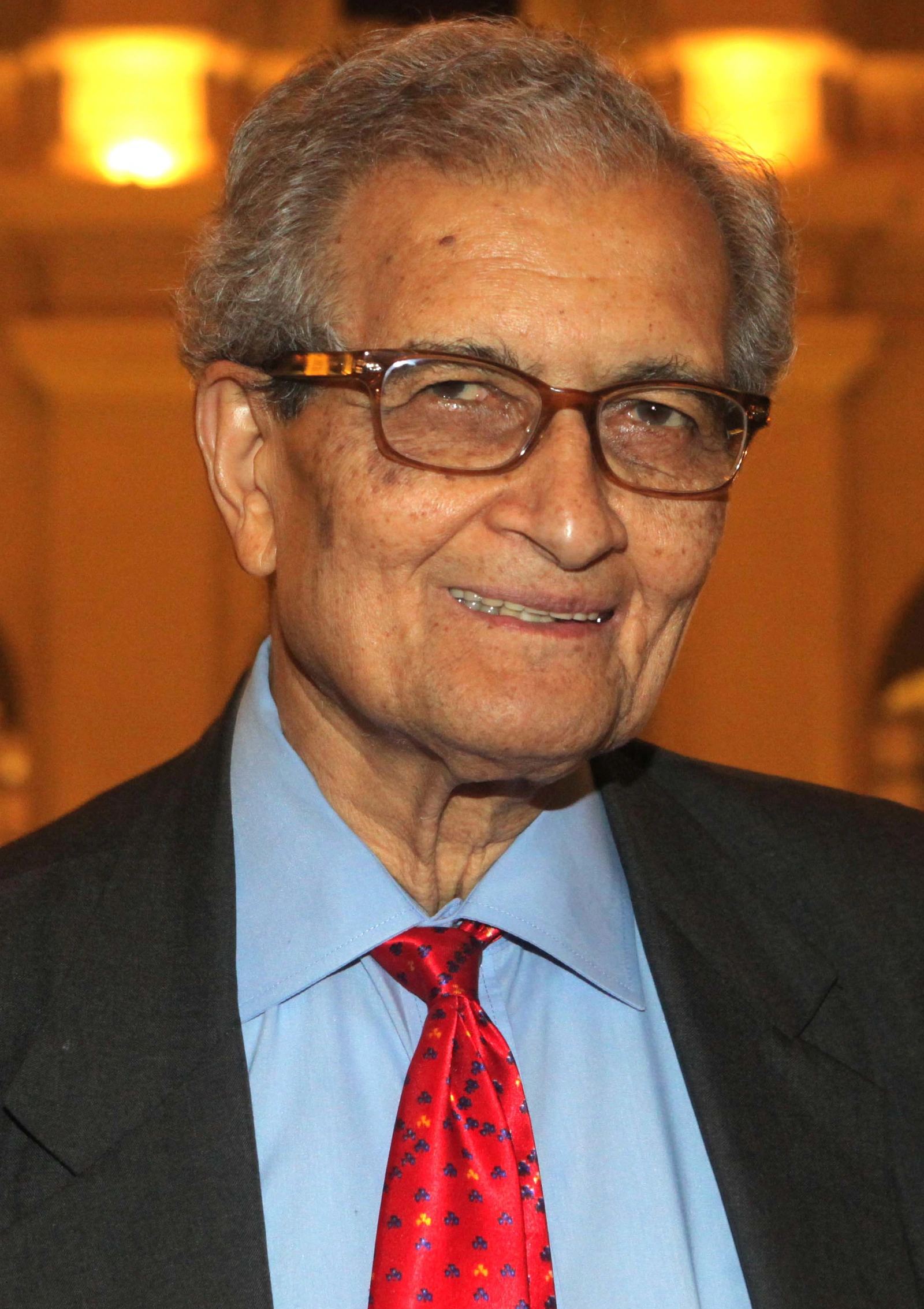
Attr: Fronteiras do Pensamento
| 11 Quotes | |
| Born as | Amartya Kumar Sen |
| Occup. | Philosopher |
| From | India |
| Spouses | Nabaneeta Dev (1958-1976) Eva Colorni (1978-1985) Emma Rothschild (1991) |
| Born | November 3, 1933 Santiniketan, Bengal Presidency, British India |
| Age | 92 years |
| Cite | |
Citation Formats
APA Style (7th ed.)
Amartya sen biography, facts and quotes. (2026, February 11). FixQuotes. https://fixquotes.com/authors/amartya-sen/
Chicago Style
"Amartya Sen biography, facts and quotes." FixQuotes. February 11, 2026. https://fixquotes.com/authors/amartya-sen/.
MLA Style (9th ed.)
"Amartya Sen biography, facts and quotes." FixQuotes, 11 Feb. 2026, https://fixquotes.com/authors/amartya-sen/. Accessed 26 Mar. 2026.
Early Life and Background
Amartya Kumar Sen was born on November 3, 1933, in Santiniketan, Bengal Presidency (then British India), into the intellectual world shaped by Rabindranath Tagore's Visva-Bharati. His father, Ashutosh Sen, taught chemistry, and his mother, Amita Sen, came from an educated family rooted in the Bengal Renaissance. The campus setting was not an ornament but a habitat, a place where argument, literature, and public affairs were daily weather.His childhood unfolded against the tremors of late colonial rule: the Bengal famine of 1943, the intensifying struggle for independence, and the fraying of pluralist civic life. A searing, early encounter came when Kader Mia, a Muslim day laborer, staggered into the Sen family compound in Santiniketan after being stabbed in communal violence; he later died. For Sen, it crystallized how poverty and fear conspire to narrow human choice, turning identity into a weapon and preventing people from walking even where work calls them.
Education and Formative Influences
Sen attended Santiniketan's Patha Bhavana school and later studied at Presidency College, Calcutta, before reading economics at Trinity College, Cambridge, completing a PhD on choice and welfare. His education carried a distinctive cosmopolitanism: “The curriculum of the school did not neglect India's cultural, analytical and scientific heritage, but was very involved also with the rest of the world”. In Calcutta he absorbed the city's Marxist, nationalist, and liberal debates alongside rigorous training in statistics and economic theory; at Cambridge he encountered postwar welfare economics and moral philosophy at close range, shaping his conviction that technical models must answer to human values.Career, Major Works, and Turning Points
Sen taught at Jadavpur University, the Delhi School of Economics, the London School of Economics, Oxford, and later Harvard, building an unusual career that moved between economics and philosophy without treating them as separate moral jurisdictions. His early landmark, Collective Choice and Social Welfare (1970), reshaped social choice theory by clarifying how individual preferences relate - and fail to relate - to collective decisions, and by sharpening the ethical limits of utilitarian aggregation. In Poverty and Famines (1981) he overturned the idea that famines are simply food shortages, arguing that they arise from failures of "entitlements" - the legal, economic, and political means by which people command food. The capability approach, developed through papers and then synthesized in works such as Inequality Reexamined (1992) and Development as Freedom (1999), reframed development as the expansion of substantive freedoms. In 1998 he received the Nobel Memorial Prize in Economic Sciences for contributions to welfare economics, social choice, and the study of poverty and famine.Philosophy, Style, and Themes
Sen's inner life reads as an ethic of attention: to what people can actually do, be, and endure, and to how public reasoning can enlarge those possibilities. His writing style is deceptively plain - careful distinctions, patiently constructed examples, and a refusal to let elegance excuse blindness. That lifelong academic immersion also became a method: “I was born in a University campus and seem to have lived all my life in one campus or another”. The campus, for him, was less retreat than laboratory, where argument is a civic practice and intellectual responsibility is tested by real deprivation.At the core is a deliberate crossing of boundaries: “While I am interested both in economics and in philosophy, the union of my interests in the two fields far exceeds their intersection”. He resisted the temptation to reduce ethics to preference satisfaction or to treat freedom as a slogan detached from material conditions. His approach joined measurement with moral scrutiny - hunger counts, but so does voice; income matters, but so do health, education, and security from humiliation. He also wrote against identity fatalism, tracing how communalism can eclipse shared citizenship: “People's identities as Indians, as Asians, or as members of the human race, seemed to give way - quite suddenly - to sectarian identification with Hindu, Muslim, or Sikh communities”. From that diagnosis came a sustained defense of plural affiliations and public debate, later sharpened in The Argumentative Indian (2005) and Identity and Violence (2006).
Legacy and Influence
Sen's influence is both conceptual and institutional: the capability approach helped inspire the UN Human Development Index and widened policy evaluation beyond GDP to include health, education, and agency; his entitlement analysis redirected famine research toward governance, markets, and rights; and his social choice work remains foundational in normative economics and political philosophy. He modeled a public intellectual who can read statistics and history together, arguing for democracy not only as procedure but as protection against catastrophe and as a forum for reasoned dissent. Across development studies, ethics, and public policy, Sen's enduring legacy is the insistence that prosperity is not merely having more, but being free - and being seen as fully human in the decisions that shape one's life.Our collection contains 11 quotes written by Amartya, under the main topics: Wisdom - Learning - Book - Equality - Peace.
Frequently Asked Questions
- Amartya Sen children: Four.
- Amartya Sen daughter: Nandana Sen and Antara Dev Sen.
- Amartya Sen education: Presidency College, Calcutta; Trinity College, Cambridge (BA, PhD); Visva-Bharati, Santiniketan (schooling).
- Amartya Sen books: Development as Freedom; The Idea of Justice; Poverty and Famines; Inequality Reexamined; The Argumentative Indian.
- Amartya Sen Nobel Prize: Won the 1998 Nobel Memorial Prize in Economic Sciences for work on welfare economics and social choice.
- How old is Amartya Sen? He is 92 years old
Amartya Sen Famous Works
- 2013 An Uncertain Glory: India and Its Contradictions (Book)
- 2012 Home in the World: A Memoir (Memoir)
- 2009 The Idea of Justice (Book)
- 2006 Identity and Violence: The Illusion of Destiny (Book)
- 2005 The Argumentative Indian: Writings on Indian History, Culture and Identity (Book)
- 2002 Rationality and Freedom (Book)
- 1999 Development as Freedom (Book)
- 1992 Inequality Reexamined (Book)
- 1987 On Ethics and Economics (Book)
- 1985 Commodities and Capabilities (Book)
- 1984 Resources, Values, and Development (Book)
- 1982 Choice, Welfare and Measurement (Book)
- 1982 The Importance of What We Care About: Philosophical Essays (Book)
- 1981 Poverty and Famines: An Essay on Entitlement and Deprivation (Book)
- 1973 On Economic Inequality (Book)
- 1970 Collective Choice and Social Welfare (Book)
Source / external links