
Amelia Earhart Biography Quotes 19 Report mistakes
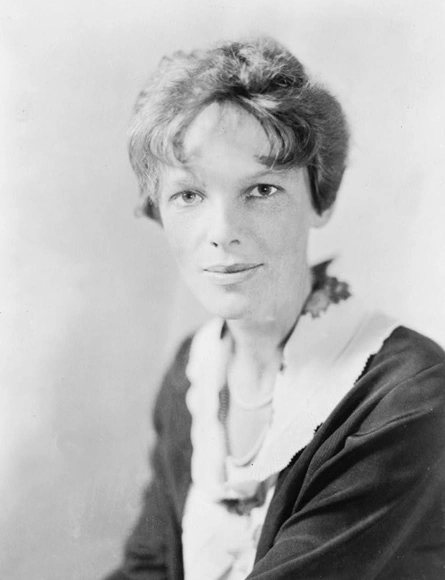
| 19 Quotes | |
| Occup. | Aviator |
| From | USA |
| Born | July 24, 1898 |
| Died | July 2, 1937 |
| Aged | 38 years |
| Cite | |
Citation Formats
APA Style (7th ed.)
Amelia earhart biography, facts and quotes. (2026, February 11). FixQuotes. https://fixquotes.com/authors/amelia-earhart/
Chicago Style
"Amelia Earhart biography, facts and quotes." FixQuotes. February 11, 2026. https://fixquotes.com/authors/amelia-earhart/.
MLA Style (9th ed.)
"Amelia Earhart biography, facts and quotes." FixQuotes, 11 Feb. 2026, https://fixquotes.com/authors/amelia-earhart/. Accessed 22 Mar. 2026.
Early Life and Background
Amelia Mary Earhart was born on July 24, 1897, in Atchison, Kansas, to Edwin Stanton Earhart, a railroad lawyer, and Amelia "Amy" Otis Earhart, from a more affluent family. Her early years moved between the security of her maternal grandparents' home and the instability of her father's alcoholism and intermittent employment, a pattern that would make self-reliance feel less like a virtue than a necessity.With her sister Muriel, she cultivated a rough-and-ready independence that resisted the era's tidy gender scripts. The United States she grew up in was industrializing rapidly, and Progressive Era ideals about efficiency and modernity sat beside strict expectations for women. Earhart absorbed both currents: the lure of machines and motion, and a quiet anger at boundaries that seemed arbitrary rather than natural.
Education and Formative Influences
Earhart attended schools in Kansas and Iowa, then briefly enrolled at Ogontz School near Philadelphia. World War I proved more formative than any classroom: while visiting Toronto in 1917, she trained as a nurse's aide with the Red Cross and worked at Spadina Military Hospital, tending wounded airmen whose injuries made aviation feel consequential rather than merely thrilling. After the war she studied intermittently - including courses at Columbia University and later at the University of Southern California without taking a degree - while taking jobs (including social work at Denison House in Boston) that sharpened her sense of how class and gender narrowed lives.Career, Major Works, and Turning Points
Earhart's first airplane ride in 1920 in Long Beach, California, was catalytic; she began flying lessons with Neta Snook and bought a secondhand Kinner Airster she nicknamed "The Canary", using it to set an early women's altitude record in 1922. National fame arrived in 1928 when she became the first woman to cross the Atlantic by air, though as a passenger on the Friendship; she used the attention strategically, writing 20 Hrs., 40 Min. (1928) and building a public identity that could finance real flying. In 1932 she made the solo transatlantic crossing from Newfoundland to Ireland, earning the Distinguished Flying Cross; more records followed, along with a high-profile marriage to publisher George P. Putnam in 1931 that doubled as a professional partnership. She co-founded the Ninety-Nines to support women pilots, served as a visiting faculty member at Purdue University to counsel women on careers and aviation, and wrote The Fun of It (1932) and Last Flight (published 1937). Her last project - an around-the-world flight near the equator with navigator Fred Noonan in a Lockheed Electra 10E - ended after the July 2, 1937 takeoff from Lae, New Guinea; radio calls placed them near Howland Island before contact was lost, and despite an unprecedented U.S. Navy search, they were never found.Philosophy, Style, and Themes
Earhart's inner life, as much as her logbooks, explains her trajectory: she did not romanticize danger so much as domesticate it into a discipline. “The most difficult thing is the decision to act, the rest is merely tenacity”. That sentence reads like a private method for converting anxiety into procedure - decide, then work - and it fits a woman who learned early that stability could not be assumed and therefore had to be constructed.Her style was modern, self-directed, and morally argumentative. She made adventure serve a social claim, refusing to let her achievements be treated as novelty acts. “Women, like men, should try to do the impossible. And when they fail, their failure should be a challenge to others”. She framed flying not as escape from duty but as proof that ability expands when permission is withdrawn. Yet she also protected a fiercely personal motive beneath the public symbolism: “I want to do it because I want to do it”. That insistence reveals a psychology that resisted being reduced to either heroine or helper - she wanted competence, and she wanted it on her own terms.
Legacy and Influence
Earhart became a defining figure of interwar modernity: a pilot who treated the airplane as both machine and argument, and a celebrity who tried to turn fame into infrastructure for others. The mystery of her disappearance intensified her myth, but her deeper influence lies in what she normalized - women as technical professionals, risk managers, and public narrators of their own ambitions. Through the Ninety-Nines, her books, and the enduring cultural image of a woman in a leather helmet looking past the horizon, Earhart remains less a cautionary tale than a template for audacity joined to method, and for the conviction that new frontiers are also social ones.Our collection contains 19 quotes written by Amelia, under the main topics: Witty One-Liners - Motivational - Wisdom - Mortality - Leadership.
Source / external links